










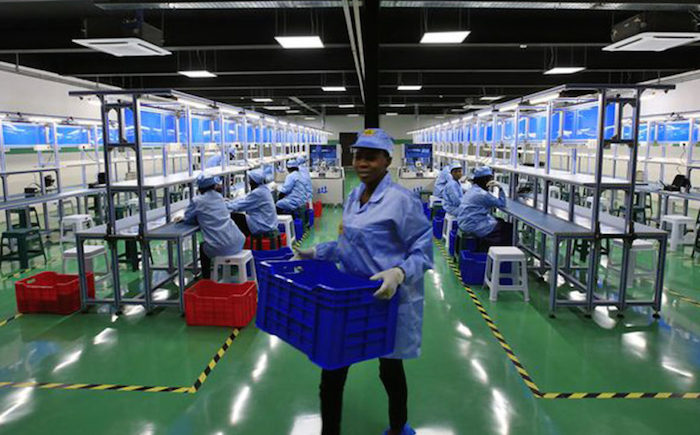



The Manufacturers Association of Nigeria (MAN) has urged the Federal Government to prioritize manufacturing and industrialization.
MAN believes this focus is crucial to accurately reflect Nigeria’s true economic situation and capitalize on the gains from the country’s improved rebased Gross Domestic Product (GDP).
MAN Director-General, Segun Ajayi-Kadri, made this call on Tuesday, July 29, in Lagos.

His statement comes in response to Nigeria’s GDP growth of 3.13% in the first quarter of 2025.
According to Ajayi-Kadri, this modest improvement from 2.27% in the same period of 2024 demonstrates the Nigerian economy’s capacity for recovery.
He observed, however, that the rebased GDP, a revised nominal GDP estimate, was a direct outcome of improved data capture, particularly in agriculture, services, and informal sector activities.
Ajayi-Kadri cautioned against interpreting the nominal expansion of the rebased GDP as evidence of significant economic progress. He stated that in spite of the upward revision, real GDP growth remained weak, averaging just 1.95% between 2020 and 2024.
This, he said, showed the underlying fragility of Nigeria’s productive base and the capacity of the economy to deliver sustainable and inclusive development.
“Industry’s share of GDP fell from 27.65% in the 2010 base year to 21.08% under the 2019 rebased structure, marking a structural shift away from production toward low-productivity service activities.
“The rebasing confirms that Nigeria’s economy may be statistically larger, but it is not more productive, nor more industrialised.
“While the rebasing exercise reveals a more diversified economy, it also exposes the underperformance of industry, particularly manufacturing, a sector which should be the backbone of Nigeria’s economic transformation,” he said.
Ajayi-Kadri urged the government to treat the rebased GDP not as a celebration of growth, but as a strong call for structural industrial reforms.
He stressed that Nigeria must re-industrialise to achieve inclusive growth, build export capacity, and reduce dependence on primary commodities and informal activities.
He called on the government to prioritise manufacturing in policy, financing, and infrastructure development.
He said this is important because without a strong industrial base, GDP expansion may just become a hollow statistic.
“The upward revision of Nigeria’s GDP to $243 billion could offer a lift in investors’ confidence and improve headline macroeconomic ratios such as the debt-to-GDP ratio.
“However, confidence in the economy is anchored not just on size, but on structural resilience, depth of industrial capacity and productivity growth.
“In this regard, we need to refocus on the development of the real and high-impact driven sector,” he said.
Ajayi-Kadri called for sustained industry-centric policies, already exemplified by the Industrial Revolution Working Group, infrastructure investments, and improved access to long-term finance to revitalise the industrial sector.
This, he said, was the way for the growth in GDP to alleviate poverty, create jobs, and contribute to macroeconomic stability.
The MAN DG strongly advocated a manufacturing-led growth strategy.
“This must include sector-specific interventions such as energy reliability for manufacturers, incentivised local content policies, streamlined regulatory frameworks, and strategic trade facilitation to boost competitiveness,” he said.
He added that the government should prioritise targeted industrial policy interventions to revive ailing sub-sectors such as textiles and vehicle assembly.
Persecondnews recalls that the National Bureau of Statistics (NBS) in its latest report, released on Monday, July 21, said Nigeria’s GDP grew by 3.13% year-on-year in real terms in the first quarter of 2025.
According to the bureau, this represents an improvement over the 2.27% growth recorded in the corresponding period of 2024, and was driven mainly by the services and industry sectors.
The report reads: “Gross Domestic Product (GDP) grew by 3.13% (year-on-year) in real terms in the first quarter of 2025. This growth rate is higher than the 2.27% recorded in the first quarter of 2024.”
Author










Leave a comment