















By Segun Adebayo
Today, phrases like “Get Ready With Me,” “Body Goals,” or “Look at This Body” almost guarantee one thing – a video focused heavily on curves. Whether it’s an deliberate camera angle or a slow turn for the lens, the physical display often overshadows whatever product is actually being pitched.
Scroll through any social media feed and it quickly feels like an endless parade of skin, where the actual offer is a mere afterthought.
A creator advertises a wig, yet the comment section talks exclusively about her figure. Another promotes a luxury dress, but the camera stays locked on her waistline. From high-end restaurants and nightlife spots to sprawling real estate listings, the property regularly ends up competing with the person standing in front of it.
This shift isn’t confined to screens either. Step into a modern gym, and the sheer volume of exposed skin can easily rival the exercise equipment.
At a popular gym in the Surulere area of Lagos, the scene offers a glimpse into how much the culture of body display has become part of everyday life.
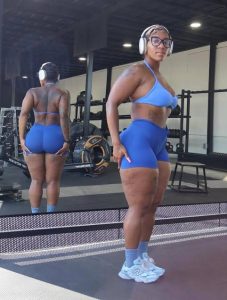
Exercise apparel has crossed the line from utility to performance art. Comfort and flexibility now take a backseat to visibility, with crop tops, body-sculpting shorts, and low-cut activewear dominating modern gym floors.
The gym is, of course, a place where people come to exercise and feel comfortable in what they wear. But it is also increasingly a social and visual space, where bodies are photographed, videos are made and fitness routines can quickly become social-media content.
From there, the pattern follows people beyond the gym. At parties, concerts and nightlife events, outfits designed to attract attention are increasingly part of the spectacle, while social gatherings and lounges provide yet another stage for the public display of carefully styled bodies.
At social gatherings, lounges and other public events, plunging necklines, short dresses and outfits that leave little to the imagination are no longer particularly unusual.
Even in churches and religious gatherings, where expectations around dressing have traditionally been more conservative, one increasingly encounters outfits that would have attracted considerably more attention a generation ago.
The debate, therefore, is no longer simply about what appears on Instagram or TikTok. It is also about how much the culture of displaying the body has moved from the screen into everyday public life.

It is almost like a pandemic of nakedness, except that nobody appears to have a cure and, judging by the numbers attached to many of these posts, very few people in the business of making money from social media are interested in finding one.
Then there are the “Get ready with me” videos, which have become a genre of their own.
A creator takes viewers through her makeup, hair, clothes and accessories, but what may begin as an innocent invitation into her dressing routine can quickly become a carefully choreographed production of angles, poses and movements designed to hold the audience for as long as possible.
The interesting part is that everybody appears to understand the arrangement.
The creator knows what she is doing, the audience knows what it is watching, the brand knows why the creator was chosen, and the platform quietly records the engagement.
That is what makes this story more complicated than the familiar complaint that “social media is becoming too revealing”.
The body has always been used to attract attention. Long before Instagram, TikTok and the influencer economy, the 1990s had its own version of the attention game.
Magazines, billboards, posters, television commercials and music videos held sway, with glossy fashion spreads, beauty campaigns and entertainment publications often using glamour, sex appeal and carefully styled bodies to sell everything from clothes and cosmetics to music and lifestyles.
Back then, however, the reach was largely controlled by publishers, advertisers, television stations and entertainment companies.
A model could appear on the cover of a magazine, a celebrity could feature in a billboard campaign, or a music video could turn an artist’s image into a talking point, but the average person did not have the same direct access to an audience.
What social media has done is take that old advertising language and put it in the hands of millions of ordinary people.
The difference is that the audience now talks back in real time, and every reaction can be counted.
A photograph can tell its creator exactly how many people stopped to look, how many commented, how many shared it and, increasingly, how many followed the trail from the picture to a product.
For the creator, that information can be powerful.

A young woman who discovers that her more revealing photographs consistently perform better than her ordinary pictures does not need a marketing degree to understand the lesson.
Social critic Temitope Blacksnow told Per Second News (PSN) that many of the women participating in the trend are fully aware of the attention economy they are operating in.
According to him, they have conducted their own form of market research, learning what gets people talking, what draws men into their comment sections, what makes women ask about their clothes, what makes blogs repost their pictures and, ultimately, what makes brands notice them.
“She has conducted her own market research. She knows what gets people talking. She knows what brings men into her comment section, what makes women ask about her clothes, what makes blogs repost her pictures and what makes brands notice her,” Blacksnow said.
In a crowded creator economy where thousands of people are fighting for attention, the discovery that the body can generate attention is not merely personal information.
It can become a business strategy.
This is where the defenders of the trend enter the argument, insisting that what critics describe as excessive exposure is, for some women, simply another form of personal branding and economic freedom.
Speaking with PSN about what she described as needless criticisms on the female gender, Femi Abass, a tech expert and media entrepreneur defended the trend, saying those who engage in such act have a compelling argument.
“Why should a woman be ashamed of using an asset she owns? If she is comfortable with her body, if she is not being forced, if she is earning money and building a career from her online presence, why should strangers determine how much of her body is acceptable for public consumption?”
According to him, to many of these women, the criticism sounds less like concern and more like an attempt to dictate what they should do with themselves.
They point out that men display their bodies too, celebrities have always used sex appeal to sell music and entertainment, and nobody questions a male celebrity when his physique becomes part of his brand.
There is also a straightforward commercial argument.
A popular wardrobe consultant in Abuja and car detailer, Gideon King, said businesses are not blind to what produces attention.
“If a fashion vendor has discovered that a photograph of a model wearing a dress generates ten times the engagement of the same dress displayed on a mannequin, the business owner is likely to notice.”
He added that If a fitness creator’s photographs bring thousands of people to her page, she can turn that visibility into subscriptions, personal-training clients, supplements, clothing and brand partnerships.
He said further that If a nightclub’s promotional video featuring an attractive influencer produces more bookings than a static flyer, the owner is going to ask why he should abandon something that appears to work.
“The morality of the image may be debated in the comment section, but the business owner is looking at a different figure: revenue.”
That commercial logic helps explain why the trend has moved beyond entertainment and fashion.
There was a time when Nigerians might have expected provocative imagery from music videos, nightlife promotions or celebrity pages.
Today, similar imagery can appear in the promotion of fashion, fitness, restaurants, real estate, beauty products and even ordinary small businesses trying to attract customers online.
The Nigeria Influencer Marketing Report by DottsMediaHouse describes an increasingly structured industry in which brands, creators and agencies are treating influencer marketing as a serious commercial channel.
The report estimates that influencer marketing spending in Nigeria reached tens of billions of naira annually, reflecting how much money businesses are now willing to put behind people who can command an audience online.
The creator is no longer simply someone with followers.
For many brands, the creator is a distribution channel, advertising platform and salesperson rolled into one.
In an environment where small businesses are fighting for visibility and consumers are bombarded with advertisements every day, anything capable of stopping the scroll can become valuable.
A marketing strategist looking at the phenomenon would probably remove the emotion from the discussion and reduce it to one word: attention.
Social media is an extraordinarily crowded environment.
A user can move from a political argument to a football video, from a celebrity photograph to a comedy skit, from a fashion advertisement to a breaking-news story within seconds.
Every creator is effectively fighting a tiny battle against the human thumb.
The first question is not whether somebody likes the content. It is whether the person will stop scrolling long enough to see it.
That is where the body can become commercially useful.

It is visually immediate, easily understood and capable of producing a strong reaction without requiring a long explanation.
A business selling a dress may need several sentences to explain the quality of the material, the cut, the price and where it can be purchased.
A photograph of an attractive woman wearing the dress communicates something in an instant.
The marketing conversation then becomes less about whether the image is tasteful and more about whether it has interrupted the scroll.
The algorithm adds another layer to the story.
Platforms such as TikTok and Instagram are built around recommendation systems that learn from user behaviour.
Watch time, likes, comments, shares and other interactions can help determine what content receives continued distribution.
The algorithm does not need to understand why somebody watched a video. It simply receives the signal that the person watched.
If thousands of people stop, react and share, the content has demonstrated that it can hold attention.
This is one reason creators constantly experiment with hooks, camera angles, captions, controversy and visual presentation.
They are not merely entertaining an audience; many are effectively conducting continuous experiments in what makes people stay.
The result is a curious feedback loop.

A creator posts a provocative photograph and receives unusually high engagement. The creator notices. Her followers notice.
Other creators notice. A brand manager notices.
The next photograph becomes slightly more provocative because there is now evidence that the first one worked.
Another creator copies the format. A business owner begins requesting similar material.
Soon, the unusual becomes normal, and what once might have been considered too revealing for an ordinary business advertisement becomes simply another accepted method of getting people to look.
In his submission, famous Lagos-based media influencer, Dami Adenuga said, it will shock many people to know that some “business owners will privately admit that they do not particularly care about the debate surrounding the imagery as long as it produces customers.
“Their language is usually practical: How many people saw it? How many sent a message? How many called? How many came to the shop? How many placed an order?
“In a difficult economy where small businesses are fighting for every customer, the temptation to use anything that can generate attention is understandable”, he added.
For a woman running an online fashion business, her social-media page may be her shop, her model may be herself and her phone may be the only advertising equipment she can afford.
That reality makes the temptation to use whatever appears to attract attention even stronger.
But there is an important distinction that marketers themselves increasingly recognise: engagement is not the same thing as conversion.
A post can receive 500,000 views and generate very little money.
A photograph can attract thousands of comments from people who have absolutely no intention of buying the product.
A controversial video may make a creator famous without making the business behind it profitable.
An advertising agency owner in Lagos who refused to put his name in the public said the real test of advertising is not simply whether people looked, but whether looking eventually produced an action that mattered to the business.
“The bum may stop the scroll, but it cannot, by itself, guarantee that somebody will buy the dress.”
Beyond the business argument is the uncomfortable question of what constant exposure to carefully constructed bodies does to the people consuming the content.
The image on social media is rarely simply a body standing in ordinary circumstances.
There is lighting, posing, makeup, clothing, camera positioning, editing and sometimes digital manipulation.
“Research into appearance-focused social-media content has repeatedly examined associations with body dissatisfaction, appearance comparison and negative mood, particularly among young people.”
He, however, noted that not every revealing photograph is psychologically harmful or that every person who sees one develops an unhealthy relationship with their appearance.
It does, however, explain why psychologists and body-image researchers are interested in a digital culture in which idealised bodies are presented repeatedly and often rewarded with public attention.
For young women especially, the message can become complicated.
On one hand, social media tells them that they should be confident, comfortable in their bodies and unapologetic about their appearance.
On the other, the same platforms can present very narrow ideas about what an attractive body should look like.
The woman with the tiny waist, pronounced curves, flawless skin and carefully positioned photograph can accumulate enormous attention, creating the impression that this particular appearance is not merely attractive but commercially valuable.
When likes, followers and brand deals begin to accompany that appearance, beauty stops being only an aesthetic question and starts looking like an economic asset.
Some social media users defend the trend and refuse to accept the suggestion that they are victims of the system.
According to some of them, social media and entertainment speak the same language, but it must be well understood perfectly.
Marketers know that attention has value and that social media is competitive.
They know brands want creators who can generate conversation.
They know that a photograph showing more skin may attract more engagement than a photograph showing less.
Some deliberately lean into that reality.
For them, there is no contradiction between empowerment and commercial calculation.
They can be confident in their bodies, enjoy displaying them and make money from the attention at the same time.
Perhaps that is why the argument about “decency” alone has failed to stop the trend.
It addresses the behaviour without addressing the incentive.
Another social media influencer and A and R expert, Kolawole Omoboriowo says as long as attention remains monetisable, somebody will find a way to capture it.
“If the audience responds to comedy, creators will produce comedy. If controversy produces clicks, controversy will multiply.
“If celebrity gossip keeps people watching, celebrity gossip will dominate timelines.
“And if images of attractive bodies repeatedly produce strong engagement, there will always be creators and businesses willing to put more of them on the screen”, he added.
Further checks by PSN revealed that the market follows demand, even when the demand is expressed through something as simple as a person refusing to scroll past.
The audience, interestingly, often participates in the very culture it complains about.
A person sees a provocative video and spends five minutes in the comment section condemning the woman.
Another person shares the photograph while complaining that young women have lost their values.
A blog reposts it under a headline criticising the original creator.
Thousands of people then arrive to argue.
Everybody is angry, but everybody is also generating engagement.
The creator’s reach increases, the post lives longer and the platform receives exactly what it was designed to receive: people staying on the screen.
In an exclusive interview with Charly Boy, he observed that he body is not the only thing that sells, but it remains one of the most immediate things capable of making people look.
“The Nigerian social media has no doubt become interesting place where a generation of creators has discovered that the body can be a billboard, the billboard can become a following, the following can become influence and influence can become money.”
For some women, this represents freedom over their image and an opportunity to make a living from their own platforms.
For some businesses, it is simply another advertising technique in an increasingly competitive marketplace.
For critics, however, the sheer frequency of the images raises questions about the kind of visual culture social media is gradually normalising.
The bum is selling clothes. The breasts are selling nightlife. The body is selling fitness, beauty, lifestyle and sometimes even houses.
The marketer may call it engagement. The business owner may call it sales. The critic may call it the decline of social-media decency.
Beneath all those arguments, however, one fact cannot be ignored. Yet beneath the debate lies an unmistakable truth—in today’s attention economy, human body has become the ultimate billboard on the Nigerian internet.
Author











Leave a comment