












By Samuel Akpan
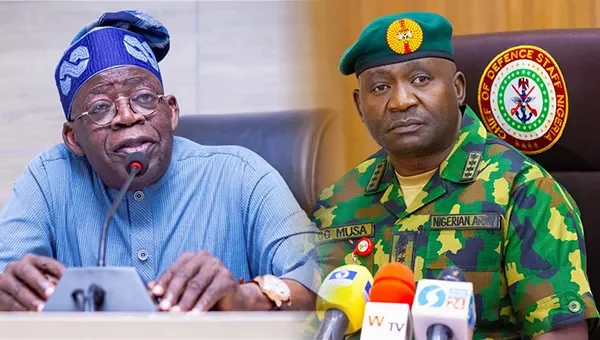
Defence Minister Christopher Musa has assessed the Tinubu administration’s security performance at 65 to 70 percent over its three-year tenure.
In an interview on ARISE News on Friday, the Minister lauded the significant decline in large-scale terrorism across Nigeria, while conceding that persistent school kidnappings continue to challenge national stability and reveal systemic societal flaws.
Reflecting on the score, Musa remarked, “No nation is totally free from crime and criminality.”
He maintained that contemporary security threats have evolved into localized crimes, characterizing them as a “social vice” rooted in the “failure of family values.”
The minister described kidnapping primarily as a societal ill rooted in family collapse rather than solely a security lapse.
“We have fathers kidnapping children, children kidnapping each other, brothers kidnapping sisters.
“It tells you that something is wrong with the family, and we need to look inward to see how we can develop those aspects,” Musa said.
His remarks follow a shocking wave of school attacks between May 13 and 15 that saw at least 82 pupils seized in Borno and Oyo states.
In Borno, armed groups snatched 42 pupils from schools in Askira Uba and Chibok areas on May 13 and 14. In Oyo, 40 pupils were taken on May 15 from Baptist Nursery and Primary School in Yawota, Community Grammar School, and L.A. Primary School in Esiele, Oriire Local Government Area.
Persecondnews recalls that during the Oyo assault, mathematics teacher Michael Oyedokun was beheaded, a motorcyclist died, and a security operative lost his life after triggering IEDs set by the attackers.
Defence headquarters linked the Oyo incident to JAS terrorists displaced by intense military campaigns elsewhere.
Borno authorities responded by temporarily shutting and relocating Government Day Secondary School, Mussa, in Askira/Uba.
Amnesty International reported at least 1,100 abductions nationwide from January to April 2026, branding it a persistent failure to safeguard vulnerable groups. These latest cases form part of an alarming trend.
In April, gunmen seized 23 pupils and a school proprietor’s wife from an orphanage and school facility in Zariagi, Lokoja, Kogi State; troops from the 12 Brigade rescued nine remaining victims on May 6 under Operation Tiger Paw II.
In November 2025, 145 people were kidnapped across Kebbi, Niger, and Zamfara states in four days, including a raid on a government secondary school in Maga, Kebbi, where bandits killed the vice principal and abducted 25 schoolgirls from their hostel.
Musa attributed much of the kidnapping epidemic to greed and aversion to honest work.
“People need to understand that to make money, you must work very hard. Don’t look for shortcuts. Most of those taking part in kidnappings and related crimes are looking for shortcuts.”
He cited a recent covert success as proof of improving capabilities – the elimination of a deputy ISIS commander after prolonged surveillance.
“The recent killing of that deputy ISIS commander was a painstaking operation that began since last year. We followed through, ensured we were certain of our target, and when we struck, we got them. That is what we are doing,” Musa said.
He also praised rising public support, saying:“The level of support we’re getting is far better than it used to be, and we’re making more inroads. Nigerians are working with us, and I want to appreciate them.”
The minister highlighted stronger global collaboration, noting contributions from the United States, Britain, France, Brazil, and Turkey.
“We are working with our partners, the Americans, the British, the French, all of them want Nigeria to succeed. They are bringing platforms we don’t have, and we are working together,” he said.
He cautioned against letting terrorism gain ground, referencing Turkey’s long battle.
“Do not allow asymmetric warfare to commence. Do not allow acts of terrorism to take root, it is extremely difficult to reverse. Look at Turkey. It took them 40 years, and it is only now that they are getting over it.
“We are learning from them, partnering with them, developing our special forces, and getting experience. We are also working with the French and the Brazilians. Everyone is putting hands on deck to ensure we achieve success,” Musa added.
Persecondnews reports that the PKK insurgency, which erupted fully in 1984, lasted over 40 years until a historic turning point in 2025.
The conflict claimed over 40,000 lives and cost hundreds of billions of dollars, spilling into Iraq and Syria.
Turkey’s approach evolved significantly. Early phases relied on hard-line measures: states of emergency, village evacuations to deny rural sanctuaries, and cross-border incursions like Operation Steel (1995) and Operation Hammer (1997), which inflicted heavy losses on PKK camps.
After Öcalan’s 1999 capture, violence subsided temporarily but reignited.
The 2012–2015 peace process collapsed, leading to urban clashes in 2015–2016.
From 2015 onward, Turkey shifted to a more proactive strategy: intensive domestic operations, technological superiority, and repeated cross-border campaigns (e.g., the multi-phase Operation Claw series in northern Iraq from 2019 onward) to destroy bases, logistics, and leadership in safe havens.
Challenges from Turkey’s path also warrant caution: high human and economic costs, risks of civilian alienation if rights are overlooked, and the reality that military gains must be consolidated with governance to prevent resurgence. One-dimensional strategies allow groups to pivot, as seen when PKK shifted tactics.
Overall, Turkey demonstrates that prolonged asymmetric threats can be rolled back through endurance, offensive posture, capability investment, and eventual political resolution — precisely what Nigeria is seeking via enhanced partnerships and internal reforms.
As Musa appreciates growing international support and Nigerian collaboration, emulating Turkey’s special forces development and whole-of-effort mindset could accelerate progress against isolated but persistent incidents like school abductions.
Author








Leave a comment