











At least 42 schoolchildren have been abducted by terrorists in Borno State, coming on the heels of a military raid that killed senior Islamic State commander Abu-Bilal al-Manuki in the Lake Chad Basin.
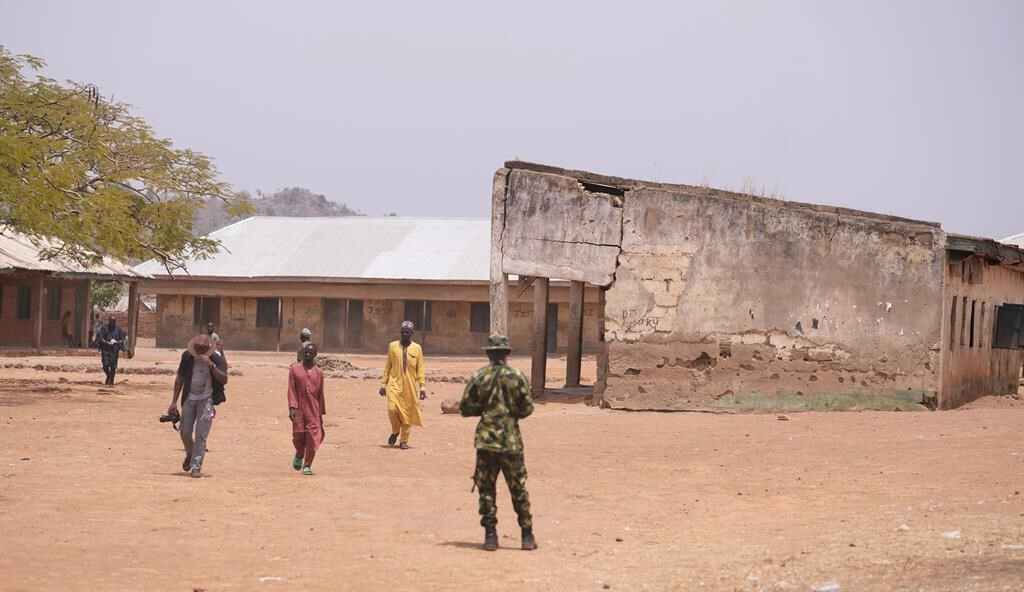
The attack targeted the Government Day Primary and Secondary School (GDSS) in Mussa, Askira-Uba Local Government Area, as confirmed by Borno South Senator Ali Ndume.
He attributed the raid to a combined force of Boko Haram and ISWAP fighters.
The gunmen struck early Friday morning while classes were in session, forcing students from their classrooms and kidnapping others from neighboring houses.
School records shared by the senator reveal that the terrorists took 28 primary pupils, four secondary students (two males, two females), and 10 children from residential properties, totaling 42 victims.
Persecondnews recalls that similar strikes were carried out against terrorists in Sokoto by the US in conjunction with Nigerian forces on December 25, 2025.
Ndume described the incident as barbaric, traumatic and heartbreaking, noting that it had thrown families and residents into despair.
The former Chairman of the Senate Committee on Army, appealed to troops of the Joint Task Force North-East, Operation Hadin Kai, and other security agencies to intensify rescue efforts and secure the safe return of the victims.
He also lamented the resurgence of attacks across Southern Borno communities, particularly recent assaults on Bambatsu and Ngadarma communities in Chibok area, where several residents, including elderly persons, were reportedly killed.
The mass abduction has revived deep-seated trauma for residents in Borno and the Lake Chad basin, echoing a dark decade of Boko Haram school raids—including the 2014 Chibok schoolgirls’ kidnapping.
Experts attribute the ongoing vulnerability of remote schools to inadequate security, poor infrastructure, and insurgent mobility across the border corridors linking Nigeria, Niger, Chad, and Cameroon.
However, amidst the grief, the military claimed a major counter-terrorism breakthrough in the North-East.
A specialized operation targeting Islamic State commander Abu-Bilal al-Minuki was launched at 12:01 a.m. on Saturday around Metele, Borno State.
The four-hour, multi-pronged air and ground assault successfully dismantled the insurgent enclave by 4:00 a.m.
The high-stakes operation was driven by months of strategic intelligence and surveillance shared between Nigerian forces and the United States Africa Command (AFRICOM).
The military said intelligence had confirmed that al-Minuki and members of his international terrorist network had established a concealed and fortified base within the Lake Chad fringes.
Special Forces were reportedly deployed simultaneously to block escape routes, secure the operational zone and support air assets involved in the strikes.
Military authorities said the operation involved multiple air platforms operating in a synchronised air-land configuration that left the terrorists with no escape path.
The operation, according to the military, was executed with no casualties or loss of equipment on the part of Nigerian and allied forces.
Al-Manuki, also known as Abu Bakr ibn Muhammad ibn Ali al-Mainuki, had been designated a global terrorist by the United States Department of State in June 2023 under Executive Order 13224 for allegedly coordinating ISIS operations and funding channels across the Sahel and Lake Chad region.
Military officials described his elimination as the single most consequential counter-terrorism outcome recorded since the establishment of Operation Hadin Kai.
The United States President, Donald Trump, reportedly commended the operation and praised the growing partnership between American and Nigerian forces in the fight against terrorism, even as he signalled the possibility of more strikes against ISIS targets in Nigeria.
In a post on Truth Social, Trump said US and Nigerian troops carried out a successful mission that eliminated al-Minuki,
Hours after announcing the strike, Trump shared a video featuring Plateau-based cleric, Rev. Ezekiel Dachomo, who has repeatedly appealed to Washington over insecurity and attacks in Nigeria’s Middle Belt.
In the accompanying post, the US President wrote that “more is coming,” suggesting that further operations against ISIS-linked groups in Nigeria may follow.
President Bola Tinubu also welcomed the development, describing the operation as a major milestone in efforts to dismantle transnational terror networks threatening Nigeria and the wider Sahel region.
The President reaffirmed Nigeria’s commitment to intelligence-sharing and stronger international security cooperation aimed at combating terrorism and violent extremism.
Meanwhile, former President Goodluck Jonathan has expressed concern that Nigerians had become dangerously accustomed to violence, killings and destruction.
Jonathan, who spoke at the first session of the 13th Synod of the Anglican Diocese of Abuja held at St. James Anglican Church, Asokoro, called for national reflection, moral rebirth and responsible leadership.
According to him, incidents that once shocked the conscience of the nation now pass with little public outrage.
“When we look around today, particularly at the challenges confronting our country, it is easy to become discouraged. Violence, insecurity, moral decline, and the loss of human values have become deeply troubling realities,” he said.
“What is even more painful is how society sometimes appears to normalise these tragedies as though they are ordinary occurrences.
” In times past, such incidents would shake the conscience of the nation. Today, people are killed, communities are destroyed, and life seems to continue as though nothing has happened.”
Author








Leave a comment