











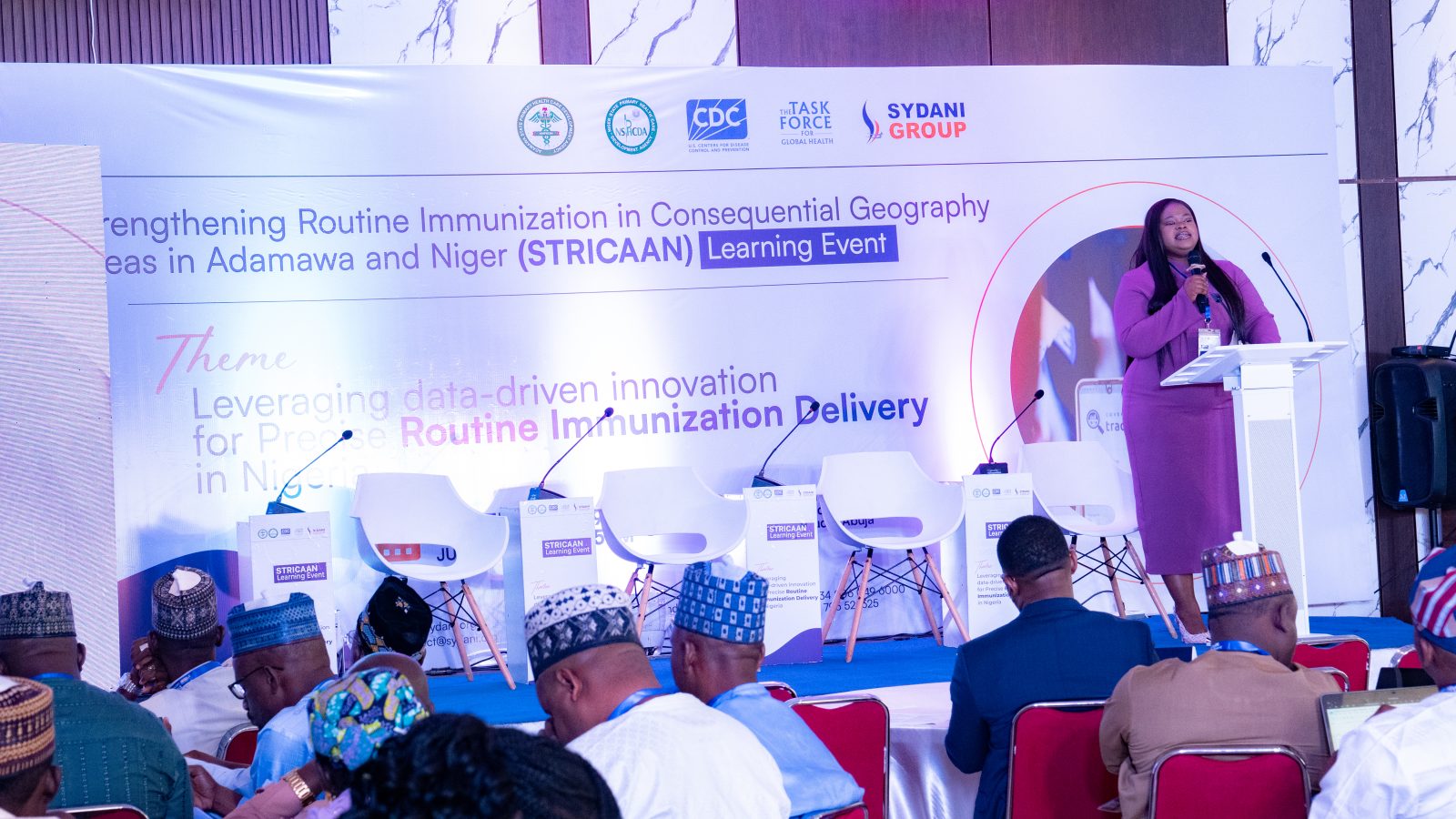




Routine immunisation planning in Adamawa and Niger States have received a boost through the deployment of digital tools designed to improve data quality, strengthen partner coordination and ensure more children receive life-saving vaccines.
Under the Strengthening Routine Immunisation through Continuous Accountability and Action in Nigeria (STRICAAN) project, more than 624,000 households have been enumerated.
The project added that over 90,000 zero-dose children have been identified across 20 local government areas, providing health authorities with more precise data for planning and targeted interventions.
Persecondnews correspondent reports that the achievements were highlighted during a presentation at the STRICAAN Learning Event in Abuja on Monday, where the project team outlined how technology is being deployed to address long-standing challenges affecting routine immunisation delivery.
Presenting the project, STRICAAN Team Lead Daniel Azuka said the intervention was developed after consultations with state governments and other stakeholders, which identified critical gaps in routine immunisation.
“We aligned with key stakeholders and asked, ‘What are the challenges the states are facing?’ We were able to identify six key challenges and develop strategies to address them.”
He said the challenges included fragmented partner coordination, conventional planning blind spots, high numbers of zero-dose children, low demand for immunisation services, missed vaccinations and limited detection of vaccine-preventable diseases.
He added that the intervention has improved coordination among development partners through a Partner Resource Mapping Tool designed to reduce duplication and improve collaboration.
“We noticed partners were working in the same areas without collaborating, so we designed a tool that helps harmonise systems. It shows where partners are working and how they can collaborate instead of duplicating efforts.”
The project also deployed a Coverage Tracker that captures household-level data, identifies zero-dose and under-immunised children, and supports targeted vaccination and follow-up.
“The Coverage Tracker gives you the child details. It shows you where the child is and the immunisation status of the child, so it makes everything targeted,” he said.
He added that the technology has also improved micro-planning by enabling health workers to accurately estimate vaccine requirements, staffing and logistics for each community.
“Once you map the area, you can have targeted interventions. You know exactly how many children are there, how many health workers you need, how many vaccine doses and syringes you need.”
Also speaking at the event, STRICAAN Programme Lead and Associate Partner Akolade Jimoh said the project emerged from a shift in thinking away from estimates and assumptions towards precision-based data systems that could identify and reach every child.
He said the idea was born out of the need to build a platform that would locate children and households and ensure they receive all required health interventions.
“We decided to build a project that would allow us to find children where they are, find households, and use that data to target them and ensure they receive every intervention they need,” he said.
He said the intervention, developed in partnership with the U.S. CDC Office of Global Health, has expanded to reach thousands of households and children, improving protection against vaccine-preventable diseases.
The Programme Lead said one of the most significant achievements has been identifying children who would otherwise have been missed by routine systems.
He added that another key achievement is government ownership of the system, which supports sustainability and long-term impact.
“The government has backed it, they’ve taken it up, and they are now running with it. That is a very big win for us because it shows sustainability beyond the project itself,” he said.
According to the team, the intervention led to a 92 per cent improvement in health partner mapping, as organisations were able to operate within a shared coordination framework.
The STRICAAN project called for wider adoption of data-driven tools and stronger government ownership to improve routine immunisation delivery and ensure no child is left behind.
Author












Leave a comment