
















By Omoyeni Ojeifo
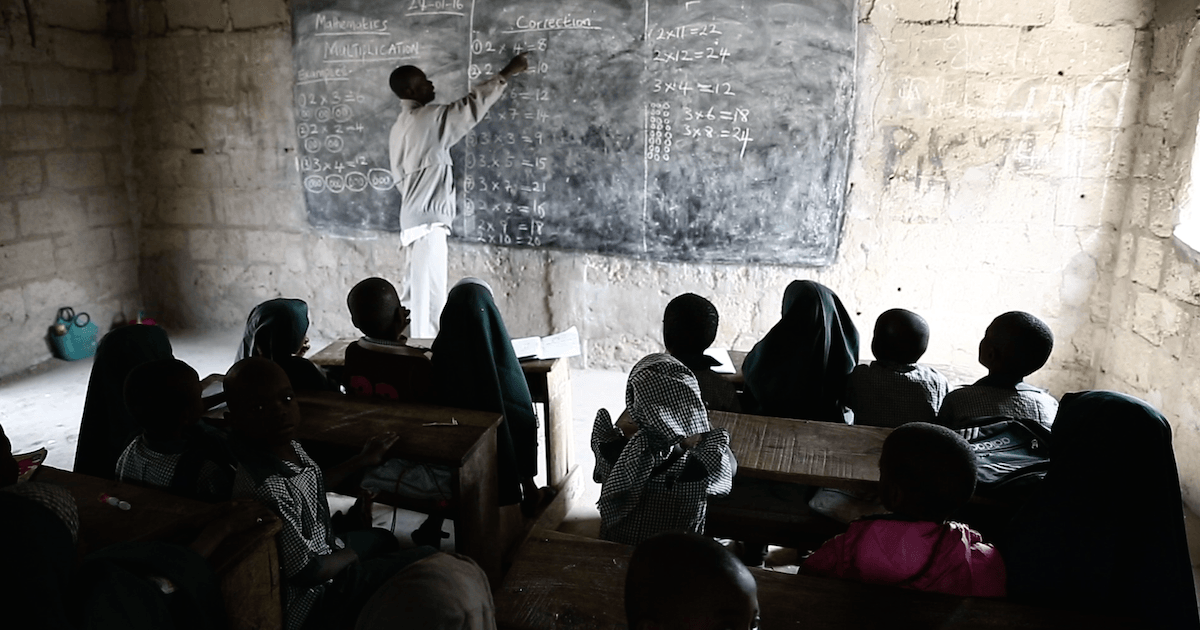
A long standing international estimate placing Nigeria’s out-of-school children population at 18.3 million is coming under renewed scrutiny following a fresh nationwide data mapping exercise by the Federal Ministry of Education.
The exercise, which involves geo-tagging and physically locating children outside the school system, is aimed at generating what officials describe as a more accurate and real time national education database.
Preliminary findings from pilot states have already produced figures that differ sharply from earlier global estimates.
In Kaduna State, one of the locations covered in the initial phase, officials say about 700,000 out-of-school children were identified, compared to the 1.8 million previously cited in UNICEF data.
Minister of Education, Dr. Tunji Alausa, during an interview on Channels TV, monitored by Persecondnews on Tuesday, said the exercise is revealing significant gaps in outdated data that have remained largely unchanged for years.
“What we are doing for the first time at this scale is a proper, state-by-state geo-mapping of out-of-school children.
“What we are seeing on the ground is significantly different from the static figures that have been repeated over time, and it is important that policy is driven by current, verifiable data rather than estimates that have not been updated,” he asserted.
He added that government interventions have already recorded measurable progress, including the return of more than one million children to classrooms within the last 30 months.
The data-mapping initiative is being expanded nationwide in collaboration with development partners, including the World Bank, to cover all 36 states and produce a unified national dataset.
The minister explained that the exercise is also intended to directly inform targeted education interventions.
“This exercise is not an academic one, it is operational. We are using it to locate children, understand why they are out of school, and design interventions that are specific to each community so that no child is left behind because of a lack of data or planning,”he noted.
Beyond the data exercise, the ministry said it was introducing new interventions to reduce the number of out-of-school children, including partnerships with private schools under a per-child funding arrangement to absorb affected pupils.
A national school feeding programme is also being developed to boost enrolment and retention, particularly in low income and underserved communities.
Several states, including Kaduna, Lagos, Borno and Katsina, have recently increased investments in school infrastructure and access programmes as part of wider reforms.
The federal education strategy is also tied to broader economic reforms aimed at repositioning Nigeria toward a knowledge driven economy, with increased investment in science, technology, engineering and mathematics across tertiary institutions.
Author








Leave a comment