









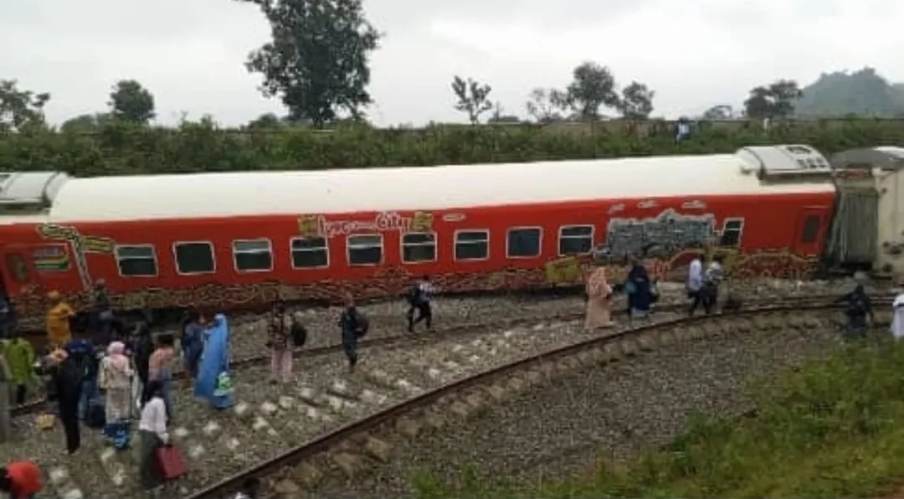




As Nigeria awaits the outcome of the investigation into the Abuja-Kaduna train derailment, the Nigerian Safety Investigation Bureau (NSIB) announced that its preliminary report will be released in 23 days.
The derailment occurred at Asham Station on August 26, causing passenger injuries, damaging railway infrastructure, and leading to the indefinite suspension of train services along the Abuja-Kaduna route.
At a media briefing in Abuja, NSIB Director-General, Capt. Alex Badeh Jnr. stated that the bureau needs funding to acquire modern equipment and train investigators to handle cases beyond the aviation sector.
He also said the NSIB plans to technically examine the locomotives, coaches, and other rolling stock to determine the cause of the accident and issue safety recommendations.
Badeh said: “The NSIB has appointed an Investigator-in-Charge (IIC) based on qualifications to organise, conduct, and control the investigation.
“The IIC has full access and control over the accident site, evidence, and relevant records, including the protection and custody of rolling stock, locomotives, contents, and other evidence to prevent disturbance or tampering.
“Evidence protection measures include securing the site, restricting access, and coordinating with railway security authorities, police, and other relevant entities.
“Recorded data from the train, including vigilance control systems, speedometers, on-board CCTV cameras, and over-speed trip mechanisms, will be preserved and analysed.”
He added that the NSIB may appoint technical experts to assist the IIC and may delegate parts of the investigation if needed, while ensuring coordination with any judicial panel or tribunal of inquiry.
The DG further explained that the ongoing investigation includes a detailed inspection of the site, switch, track geometry, and infrastructure.
It also involves reviewing Nigerian Railway Corporation (NRC) records and a technical examination of the locomotives, coaches, and other rolling stock.
He added that the NSIB will interview the crew, staff, responders, passengers, and witnesses, as well as obtain evidence and organizational information from the operator.
The goal is to determine the causes and contributing factors of the derailment and analyze any recorded data.
The investigation records will be protected from unauthorized disclosure or use in judicial proceedings.
Badeh stated that if the investigation has international aspects, the NSIB will notify the relevant states and may invite accredited representatives or advisers to participate, respecting their rights and obligations.
On the likely date the preliminary report would be ready, he said: “Within 23 days, we should be able to make public the preliminary report of the investigation.
“The report would contain some of the factual evidence that is related to the occurrence, at least those that will give us a way forward on the way the investigation is going to go. So within 23 days, we should provide you with the preliminary report.”
On funding, he said: “Some funding has been made available, but it is not enough. If you look at the NSIB Act again, we are still battling with the same case of funding. At the NSIB, we are trying to prevent this accident and funding is one big part of this.
“We require funding to train our investigators, not just in aviation, but now you see with rail, maritime, all the others.
“Yes, we have some training, but more extensive training is needed, especially with the expansion of rail services in Nigeria, and then more equipment to investigate these accidents. So yes, we do require more funding”.
Author





Leave a comment