















By Omoyeni Ojeifo
As part of measures to curb certificate racketeering and restore confidence in Nigeria’s education system, the Federal Government is turning to digital records to strengthen the verification of academic qualifications and protect genuine graduates from fraud.
According to the Minister of Education, Dr. Maruf Tunji Alausa, the digital transformation of Nigeria’s education system under President Bola Ahmed Tinubu’s Renewed Hope Agenda is strengthening the integrity of academic qualifications, tackling certificate racketeering and ensuring genuine students and graduates are not disadvantaged.
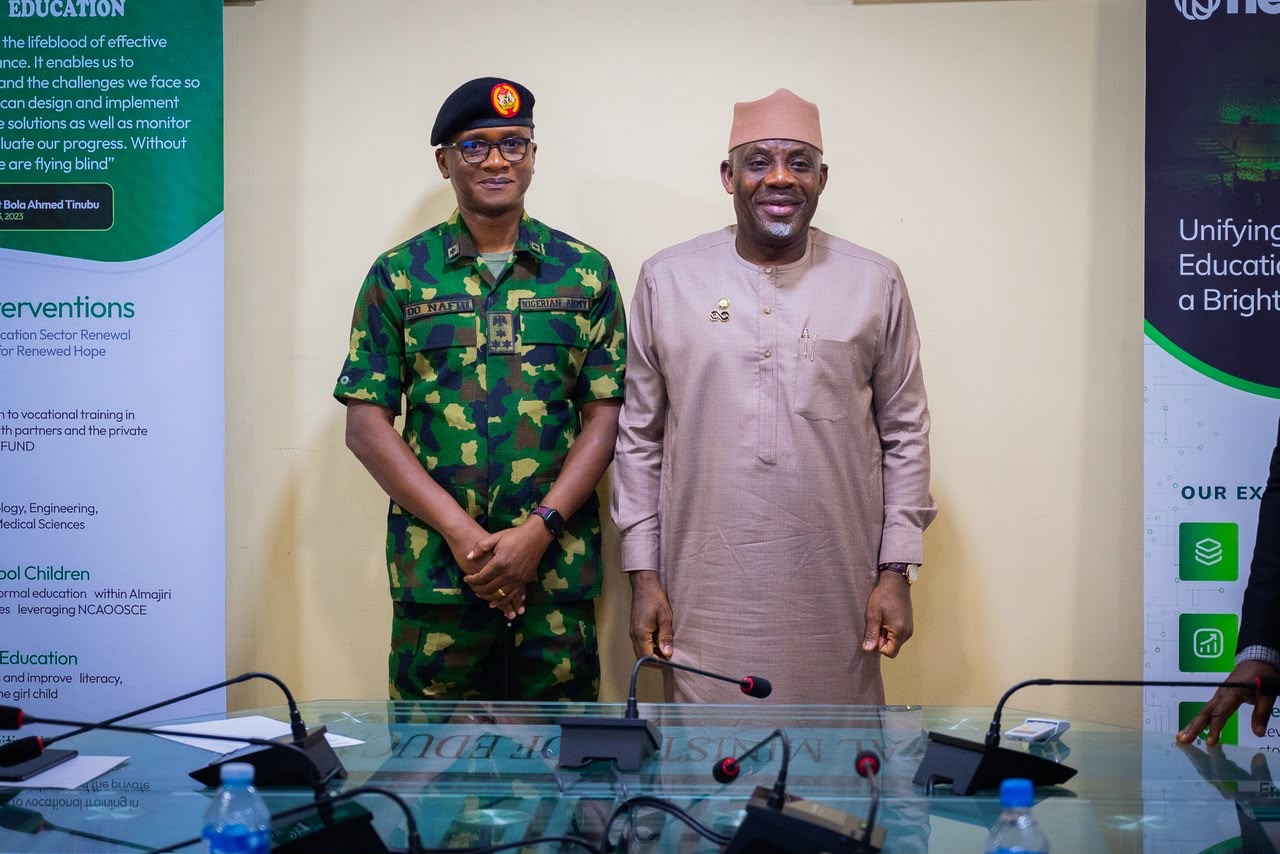
Alausa disclosed this during a meeting with the Director-General of the National Youth Service Corps (NYSC), Brig.-Gen. Olakunle Nafiu, who led a delegation of the corps to the Ministry on Tuesday.
“The reforms are designed to close gaps in the management and verification of educational records, making it easier to identify learners and authenticate qualifications across the education system,” Alausa explained.
The Minister commended the NYSC leadership for embracing technology and supporting efforts to strengthen the credibility of education records.
“Closer integration between the Ministry and NYSC would improve verification, reduce opportunities for fraud and make the exchange of credible learner and graduate data more seamless,” he added.
Alausa explained that the Nigerian Education Repository Data Bank (NERD) was collecting and verifying university certificates, tracking learners across the education system and supporting tertiary institutions through help-desk officers.
He said the Nigerian Education Data Infrastructure (NEDI) would link records across different stages of a learner’s educational journey.
The Minister further disclosed that the Ministry had digitised its Education Support Services end-to-end, including certificate verification and processes involving foreign applicants.
“Discussions are also underway with NYSC on an application programming interface that would enable faster and seamless verification and exchange of relevant data.”
According to Alausa, the reforms would also address administrative and data-related challenges that have prevented some qualified graduates from participating fully in national service and the labour market.
He identified discrepancies in names, issues affecting graduates of part-time National Diploma programmes and the admission of NCE holders into Higher National Diploma programmes among the issues requiring attention.
“The Ministry would engage the National Board for Technical Education, Joint Admissions and Matriculation Board, National Identity Management Commission and other stakeholders to develop lasting solutions,” Alausa stated.
“These would include a national Learner Identification Number and a consistent national framework for recording and sequencing names across government education and identity databases,” the Minister added.
He explained that the framework would ensure accurate and consistent identity records are established from the beginning of a learner’s educational journey.
The Minister also disclosed that the government had strengthened measures to curb examination malpractice, including the leakage of examination questions, and stressed the need to sustain the gains and extend such measures to tertiary institutions.
At the meeting, the NYSC Director-General, Brig. Gen. Olakunle Nafiu, backed the reforms and reaffirmed the Corps’ readiness to support the Ministry’s digitalisation efforts.
Nafiu explained that NYSC began digitising its operations in 2014, developing systems designed to provide reliable information on Corps Members and their deployment.
“The Corps has complied with the Federal Executive Council’s directive on collaboration with NERD and is ready to deepen the partnership with the Ministry,” he said.
The NYSC DG highlighted the impact of technology on the integrity of the Corps’ operations, noting that the introduction of QR codes had virtually eliminated document cloning within NYSC.
He assured the Minister that the Corps would continue to strengthen its verification systems to guard against emerging fraudulent practices.




Nafiu also highlighted ongoing efforts to resolve challenges affecting graduates of part-time National Diploma programmes, HND mobilisation and the admission of NCE holders into HND programmes.
He said discussions with the new JAMB Registrar had produced an understanding to create a window for graduates affected by discrepancies in names to regularise their records in collaboration with NIMC.
The NYSC DG called for a broader meeting involving JAMB, NIMC, NYSC and the Ministry to develop a lasting solution to the challenges.
He stressed that a consistent national framework for recording and sequencing names across government education and identity databases, supported by a unique Learner Identification Number, would prevent similar difficulties in the future.
Nafiu assured the Minister that NYSC would continue to work with the Ministry and other relevant agencies to strengthen verification and ensure that qualified graduates are not unfairly excluded from national service.
Reaffirming the administration’s commitment to the reforms, Alausa said the Ministry would sustain its collaboration with NYSC and other stakeholders and pursue the digital transformation agenda with renewed vigour.
“The ultimate objective is to build an education system in which every Nigerian child has access to quality education and every genuine graduate can progress on the strength of merit and hard work,” he maintained.
PerSecondNews earlier reported that the Federal Government unveiled the Learner Identification Number in May to give every learner a unique identity linked to the National Identification Number and enable tracking of their educational journey nationwide.
Author













Leave a comment