











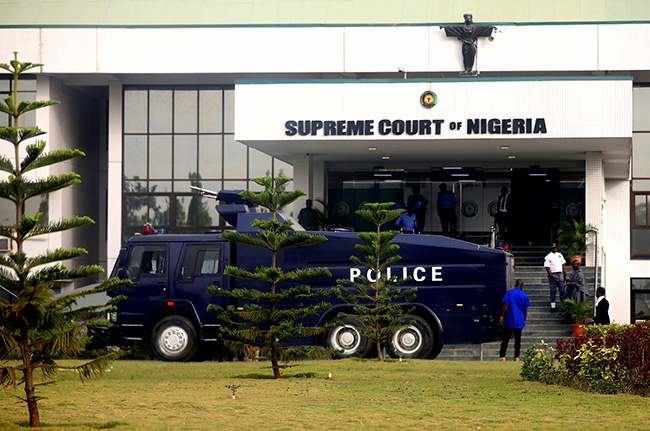




Eight months after the Federal Government declared a state of emergency in Rivers State—an order that was lifted three months ago—the Supreme Court has finally resolved the matter by dismissing the lawsuit filed by Adamawa and 10 governors challenging President Bola Tinubu’s emergency rule in the state.
Persecondnews reports the declaration in March 2025 resulted in Rivers State Governor Siminalayi Fubara and other elected state officials being suspended for six months.
The 11 states, which were controlled by the opposition Peoples Democratic Party (PDP) through their respective attorneys-general, queried President Tinubu’s statutory powers to suspend a serving governor from office after the proclamation of emergency rule.
They prayed the apex court to declare that based on provisions of sections 1(2), 5(2), and 305 of the 1999 Constitution, as amended, the president “has no powers whatsoever or vires to suspend a democratically elected governor and deputy governor of a state in the federation of Nigeria under the guise of or pursuant to the proclamation of a state of emergency in the state of the federation by the president, including the states of the federation represented by the plaintiffs.”
The plaintiffs equally urged the court to declare that President Tinubu had no power to suspend a democratically elected House of Assembly of a state pursuant to Sections 192 (4) (6) and 305 of the Constitution of the Federal Republic of Nigeria 1999 (as amended).
They also wanted a declaration that the suspension of Gov. Fubara, his deputy and members of the Rivers State Assembly was unconstitutional, unlawful, illegal and utterly in gross violation of provisions of the 1999 Constitution, as amended.
Cited as 1st and 2nd defendants in the suit marked SC/CV/329/2025, were the Attorney General of the Federation(AGF) and the National Assembly (NASS).
In its judgement on Monday, December 15, a seven-man panel of Justices of the Supreme Court, in a split decision of six to one, struck out the case for want of competence.
The apex court panel, in its majority verdict, held that the plaintiffs failed to establish any cause of action that led to the activation of its original jurisdiction.
Justice Mohammed Idris, who delivered the lead judgement, said the states were unable to show that there was any actionable dispute between them and the federation to require the apex court to exercise its original jurisdiction.
He stressed that the Supreme Court could only be called upon to adjudicate as a court of first instance where there is a dispute between the federation and any state of the federation.
According to the court, the subject matter of the litigation did not qualify as a dispute between the federal government and any of the plaintiffs on record.
Persecondnews recalls that the panel, which was led by Justice Inyang Okoro, had on October 21 reserved its judgement on the case, after all the parties adopted their briefs of argument.
However, before the case was slated for judgement, Delta State, which was initially listed as the 5th plaintiff, formally withdrew from the case.
The withdrawal followed the defection of Gov. Sheriff Oborevwori of Delta State from the PDP to the ruling All Progressives Congress (APC).
Aside from Delta, other states behind the suit were Adamawa, Enugu, Osun, Oyo, Bauchi, Akwa Ibom, Plateau, Taraba, Zamfara, and Bayelsa.
Governors of some of the states that filed the suit had, since dumped the PDP.
Arguing the case, Mr Eyitayo Jegede (SAN), who represented the plaintiffs, said his clients did not approach the Supreme Court to challenge the power of the president to proclaim a state of emergency, but “the extent to which the proclamation can be made to affect the offices of the governor, deputy governor, and the State House of Assembly.”
On his part, the AGF insisted that President Tinubu’s action was in the overall interest of Rivers State.
According to him, the state was engulfed in a political crisis that involved the governor, deputy governor and the lawmakers.
“No responsible government would sit back and allow the state to burn without taking any action,” Mr. Lateef Fagbemi (SAN), submitted, adding that Fubara’s suspension, along with his deputy and lawmakers, “was an extraordinary measure to check an extraordinary situation.”
He said: “My Lords, the president had to act and act fast to safeguard the state.
“The starting point is the judgement of the Supreme Court, wherein your lordships held that as things were at that time, there was no government and governance in Rivers State. Therefore, the president had no choice but to act in the best interest of the state.
“What he did was to suspend the protagonists, not remove them. Rivers was in an extraordinary situation, and that required taking extraordinary measures to restore peace and protect democracy,” the AGF contended.
His position was adopted by NASS, which also urged the court to dismiss the suit.
The NASS contended that the plaintiffs failed to fulfil the condition precedent that would empower the Supreme Court to hear the suit it described as frivolous and speculative.
It was part of the contention of the 2nd defendant that the plaintiffs failed to issue the statutorily required three-month pre-action notice to its clerk, as mandated under Section 21 of the Legislative Houses (Powers and Privileges) Act, 2017.
While urging the apex court to dismiss the suit as “unfounded, frivolous and a vexatious waste of resources, time and energy of the 2nd defendant”, the NASS prayed for a cost of N1 billion to be awarded, jointly and severally, against the plaintiffs.
Other members of the seven-man panel that heard the case were Justices Chioma Nwosu-Iheme, Haruna Tsammani, Obarinde Ogbuinya, Stephen Adah, Habeeb Abiru and Mohammed Idris.
Persecondnews recalls that President Tinubu had, on March 18, declared a state of emergency in Rivers State after he slammed Gov. Fubara, his deputy and lawmakers in the state with a six-month suspension.
Tinubu appointed Vice Admiral Ibok-Ete Ibas to pilot affairs of the state within the period as sole administrator.
The president’s decisions received legislative backing from both the Senate and the House of Representatives.
Dissatisfied with the development, the PDP states had approached the apex cour.
Author











Leave a comment