







By Omoyeni Ojeifo
The Pan Niger Delta Forum (PANDEF) has rejected a proposal in the National Research and Innovation Development Fund Bill, 2026 to divert 20 per cent of the Nigerian Content Development Fund to a new research institution.
The forum warned that the proposed deduction could weaken the Nigerian Content Development and Monitoring Board (NCDMB), arguing that the fund should instead be increased to support indigenous technology development and local capacity in the oil and gas industry.
PANDEF, socio-political and regional advocacy group representing the states and ethnic nationalities of Nigeria’s South-South geopolitical zone comprises Akwa Ibom, Bayelsa, Cross River, Delta, Edo, and Rivers states.
PerSecondNews recalls that PANDEF was co-founded and long led by the late Ijaw national leader and former Federal Commissioner for Information, Chief Edwin Clark (who served as its National Leader until his passing in February 2025).
Following his death, leadership transitioned to the group’s Board of Trustees and National Executive Committee, chaired by figures such as former Akwa Ibom State Governor Obong Victor Attah (Co-Chairman/BOT) and Ambassador Godknows Igali (National Chairman).
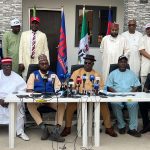
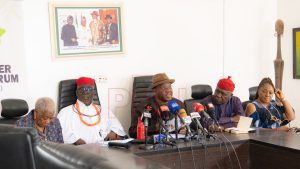
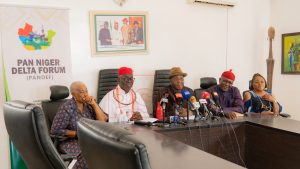
PPANDEF National Chairman, Amb. Godknows Igali, made the position known in Abuja on Friday during a media briefing on the state of the nation and the Niger Delta region.
The controversy stems from the National Research and Innovation Development Fund Bill, 2026, sponsored by Senate Leader Opeyemi Bamidele.
The bill, which proposes a 20 per cent annual contribution from the Nigerian Content Development Fund, seeks to finance research, indigenous technology and innovation.
He maintained that PANDEF supported establishing a national research institution but opposed financing it with resources dedicated to developing Nigerian capacity in the oil and gas industry.
Igali recalled that Nigeria’s 70 years of oil exploration had been characterised by heavy dependence on imported equipment, machinery and technical expertise, resulting in substantial capital flight.
He described the NCDMB’s establishment in 2010 as an important intervention.
“Our people have been able to give a good account of what they are doing, and of course there’s always room for improvement. But so far they are trying to develop local technology, and they are investing also in local capacity,” he said.
He listed the board’s interventions to include training in oil and gas, agriculture, manufacturing and transportation, as well as investments in modular refineries, machining factories, gas plants and petrochemical facilities.
Igali warned that the proposed deduction could weaken the board’s work and create a precedent for diverting resources from other statutory institutions, including Tertiary Education Trust Fund (TETFund), National Examinations Council (NECO) and Nigerian Upstream Petroleum Regulatory Commission (NUPRC).
“We think that it is disturbing, and all Nigerians, not just those of us from the area, every Nigerian should rise up and say, ‘No This is not sound fiscal arrangement’,” he stated.
He urged the government to identify independent funding sources for new institutions rather than take resources from existing agencies, asking the National Assembly to reconsider the funding provision and return the bill for a review.
“If anything, they should give you more money. If anything, because I know Nigerians, we don’t need any outsider to come and develop technology in oil and gas for us,” he added.
Beyond the funding controversy, Igali reaffirmed the importance of the oil and gas industry, saying Nigeria had the potential to produce up to 3 million barrels of crude oil daily.
He advocated more modular refineries to complement the Dangote Refinery and other major facilities.
He also called for increased investment in liquefied natural gas (LNG), liquefied petroleum gas (LPG) and compressed natural gas (CNG), identifying Nigeria’s 215 trillion standard cubic feet of gas reserves as Africa’s largest and the world’s seventh-largest.
“We are not against the law. The government must have thought through, but we think that National Assembly should, at this stage, send the law back to the government to think through on how to fund and not to take the money of an existing body that is doing well, that is serving the country well,” he said.
Igali also used the briefing to call for the arrest and prosecution of those responsible for the recent political violence in Delta State, urging the Inspector-General of Police and the Director-General of the Department of State Services to identify the perpetrators.
He appealed to traditional rulers, youth leaders, women leaders and community leaders to discourage political violence as activities intensify ahead of the 2027 general elections.
“The children of those politicians are not there with you. So you shouldn’t go and take a bullet for somebody,” he warned.
Author



Leave a comment