















By Omoyeni Ojeifo
The Federal Government has launched Nigeria’s first National Education Technology (EdTech) Strategy to transform teaching, expand learning opportunities and strengthen education management through digital innovation and artificial intelligence.
PerSecondNews correspondent at the launch, reports that the strategy provides a coordinated framework for integrating technology into teaching, learning and education management, with a focus on building a connected, inclusive and AI-enabled education system.
Developed by the Federal Ministry of Education and the Federal Ministry of Communications, Innovation and Digital Economy, in partnership with the Mastercard Foundation and World Bank Group, it seeks to build a connected, inclusive and AI-enabled education system.
It also seeks to improve access to quality education across basic, secondary, tertiary and non-formal education through digital infrastructure, learning platforms, curriculum-based content and stronger coordination among education institutions.
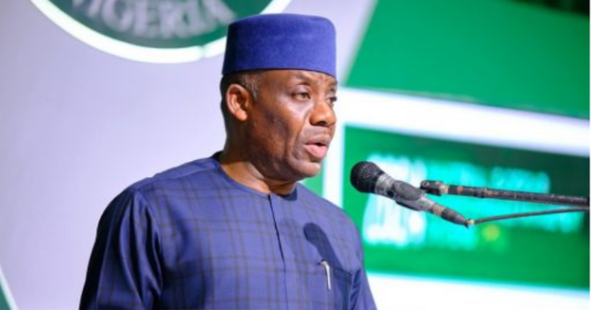
Speaking at the launch in Abuja, on Tuesday, the Minister of Education, Dr Tunji Alausa, described the framework as a national effort to improve the education sector.
“It is not just about unveiling; it is a national framework, a joint common framework to improve teaching, expand learning opportunities and strengthen education management across all tiers of our education system,” he said.
Alausa highlighted the potential of digital learning platforms to address teacher shortages, particularly in rural communities where schools struggle to recruit qualified teachers for essential subjects.
“If you are a school in a remote part of Jigawa without an English teacher for Primary Three or a Mathematics teacher for JSS One, you can log in and get real-time teaching delivered by an excellent, vetted teacher,” he said.
On education data management, the minister revealed that Nigeria’s integrated platform now captures 51 million students across basic and secondary education.
“Today, we have 51 million students across our basic and secondary school education. Nigeria has moved from having low, fragmented data to having the biggest robust education data in sub-Saharan Africa in less than two years,” he stated.
He identified data interoperability, technology and procurement standards, teacher transformation, governance and system coordination as key components of the national strategy.
At the Ministerial Fireside Chat, the Minister of Communications, Innovation and Digital Economy, Dr Bosun Tijani, said the government was expanding telecommunications infrastructure to ensure poor connectivity did not prevent schools from benefiting from digital education.
He disclosed that 3,700 telecommunications towers procured through government and private-sector collaboration would be deployed to school premises, extending network coverage to surrounding communities.
Tijani also highlighted the 90,000-kilometre fibre-optic network project, explaining that its design would ensure connectivity reaches primary, secondary and tertiary institutions nationwide.
“The implication is that as the minister brings the use of technology into education, quality, meaningful connectivity will not be the reason why his dreams will not be achievable,” he said.
He further disclosed that the government planned to ensure all communities, especially in the Niger Delta benefited from telecommunications connectivity by the end of 2027.
Earlier in her opening remarks, the Minister of State for Education, Prof. Suwaiba Ahmad, called for inclusive implementation across all levels
“Digitalisation should focus on ensuring that we do not leave any group of learners behind. People in rural and underserved communities should have equal access to digital resources,” she said.
In his goodwill message, the World Bank Country Director for Nigeria, Mathew Verghis, commended the leadership of the Federal Ministries of Education and Communications, Innovation and Digital Economy, describing their collaboration as critical to overcoming coordination challenges across government institutions.
“Digital technologies and artificial intelligence can help teachers respond to different learning needs, provide more timely feedback and extend access to learning resources. Their promise is not to replace the teacher, but to strengthen teaching and human relationships at the heart of education,” he said.
PerSecondNews correspondent reports that the launch also featured the unveiling of the AskFME chatbot and Nigeria Education Data Infrastructure (NEDI), designed to improve public access to education information, strengthen data integration and support more effective education planning and management nationwide.
Author











Leave a comment