





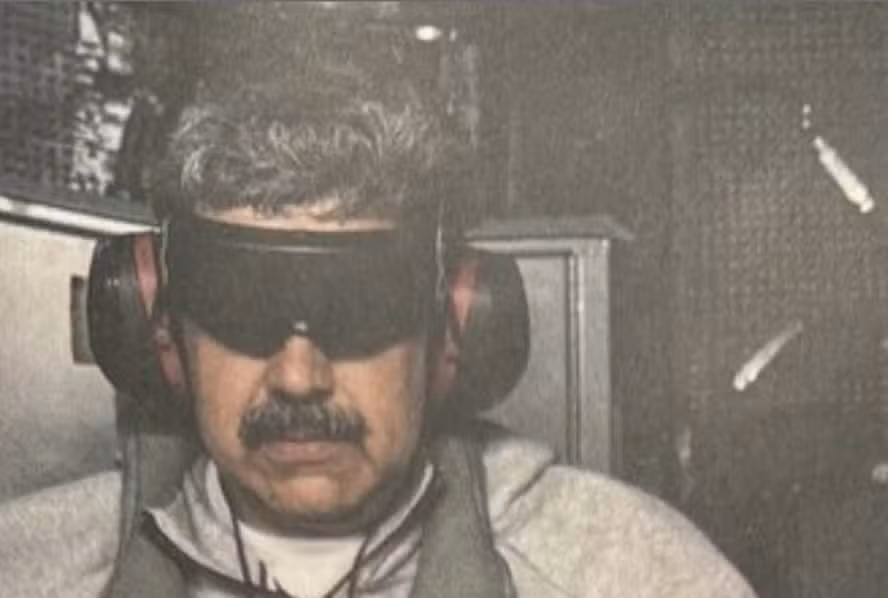



Following a daring military operation, President Donald Trump shared a photo on Truth Social on Saturday showing Venezuelan leader Nicolas Maduro in U.S. custody.
The image depicted a handcuffed and blindfolded Maduro, 63, aboard a U.S. warship, dressed in a gray tracksuit and wearing large headphones while holding a plastic water bottle.
At a subsequent press conference, Trump announced that the U.S. would oversee Venezuelan governance until a stable transition of power is established.
He further revealed plans to authorize American oil companies to begin tapping into the nation’s vast crude reserves.
Venezuela has been under US oil sanctions since 2019. It produces about a million barrels of crude per day.
Trump has claimed that Caracas is using oil money to finance “drug terrorism, human trafficking, murder and kidnapping.”
The US military operation to extract Venezuelan president in a nighttime raid in Caracas took “months of planning and rehearsal,” and more than 150 US aircraft were used, top US General Dan Caine told reporters.
“The word integration does not explain the sheer complexity of such a mission, an extraction so precise — it involved more than 150 aircraft launching across the Western Hemisphere,” Caine, the chairman of the US joint chiefs of staff, told a joint press conference with President Trump.
“Maduro and his wife, both indicted, gave up and were taken into custody by the Department of Justice, assisted by our incredible US military with professionalism and precision, with no loss of US life,” the top US general said.
“It was a brilliant operation, actually,” Trump told The New York Times shortly after US forces were cleared from Venezuelan airspace. He later added in an appearance on “Fox & Friends” that some US troops were injured in the strike but none were killed.
US-backed opposition leader Maria Corina Machado, who won the Nobel Peace Prize last year, posted on social media: “the hour of freedom has arrived.”
She called for the opposition’s candidate in the 2024 election, Edmundo Gonzalez Urrutia, to “immediately” assume the presidency.
Earlier, Trump said Maduro and his wife, Cilia Flores, would be taken to New York to face drug and weapons charges after military strikes and an operation which he described as looking like a “television show”.
Trump said that he and key members of his administration watched in real time from Mar-a-Lago, his Florida club, the Delta Force raid that captured Maduro.
The Venezuelan government decried what it termed a “extremely serious military aggression” by Washington and declared a state of emergency.
Countries such as Russia and Iran, which had longstanding ties with Maduro’s government, were quick to condemn the operation but their alarm was also shared by Washington’s allies including France and the EU.
The operation to remove Maduro certainly marks another big moment for Trump’s foreign policy in his second term, as he hasn’t shied away from flexing US military might even as he has vowed to keep America out of war, wrote news agency AFP.
Trump has now twice used US forces to carry out risky operations against American adversaries. In June, he directed US strikes on key Iranian nuclear sites.
Saturday’s action stirred fresh anxiety in capitals around the world that have sought to adjust to a new normal in Trump 2.0, where the idea of the US trying to find global consensus on issues of war and peace is now passe.
On Friday, Trump issued a new threat to Iran that if it “violently kills peaceful protesters” – in protests sparked by the collapse of Iran’s currency – the United States “will come to their rescue.”
With the Venezuela operation, Trump followed through on a promise, spelled out in his National Security Strategy published last month, to assert US dominance in the Western Hemisphere.
Author




Leave a comment