











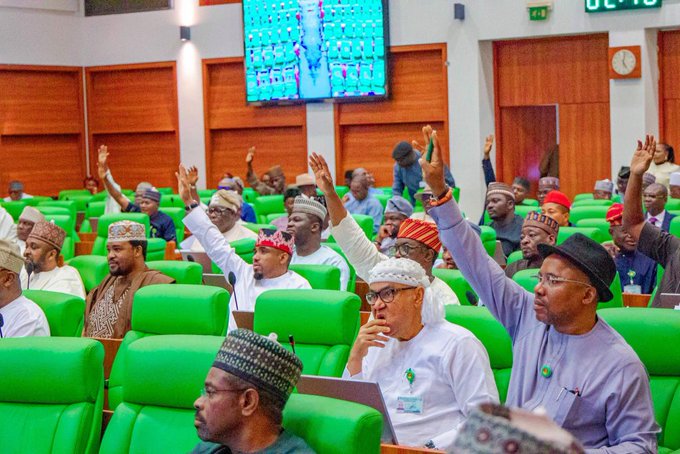



The House of Representatives has initiated legislative action on a bill to significantly amend the Central Bank of Nigeria (CBN) Act, aiming to boost transparency, governance, and oversight at the apex bank.
Co-sponsored by House Leader Julius Ihonvbere and Lagos Rep. Jesse Onakalausi, the bill passed its second reading without opposition on Thursday.
Titled, “A Bill for an Act to Amend the Central Bank of Nigeria Act, 1991, to allow for proper day-to-day operations, professional oversight, and enhance checks and balances, and for other matters connected thereto, 2025,” the legislation seeks to address major concerns regarding governance gaps and lack of oversight.
These issues came to the forefront following recent public controversies over monetary policy, foreign exchange handling, and the 2022 currency redesign.
Rep. Onakalausi, leading the debate, stressed that recent economic developments made such reforms an unavoidable necessity.
Explaining the rationale behind the bill, Onakalausi said, “The CBN plays a central role in stabilising the financial system, ensuring monetary credibility, safeguarding price stability, and promoting public confidence in the Nigerian economy.”
He cited governance lapses, FX distortions, poor policy communication and “weak oversight mechanisms” as some of the issues the bill seeks to address.
He stated: “Developments in recent years – ranging from governance concerns, foreign exchange distortions, monetary policy inconsistency, weak oversight mechanisms, to the challenges witnessed around currency redesign and policy communication – have exposed structural gaps in the principal Act.”
Onakalausi said a key objective of the bill is restoring sound corporate governance.
He argued that in most jurisdictions, the governor manages day-to-day operations while the Board provides oversight—an arrangement that ensures institutional balance.
While stressing that “both roles are meant to be separate to avoid conflict of interest.
“The current CBN Act merges the positions of Governor and Board Chairman, creating an avoidable concentration of power. This bill separates these roles to ensure professional oversight without interference in day-to-day operations.”
Persecondnews reports that the draft legislation also introduces reforms targeted at strengthening the Monetary Policy Committee, improving independence, and aligning Nigeria’s framework with global standards in the UK, South Africa, Brazil and the EU.
A major component of the bill is the tightening of Ways and Means financing.
“It prevents fiscal abuse as Section 38 (Ways and Means Advances) has historically been one of the most abused provisions under the CBN Act.
“This bill introduces a clear limit – 10% of the previous year’s actual revenue – to prevent inflationary financing of government deficits and ensure fiscal responsibility,” he said.
Additional provisions of the bill focus on safeguarding the naira and improving transparency in foreign exchange management.
It also introduces “A 90-day notice, impact assessments, mandatory National Assembly briefing before major monetary actions like redesign or demonetisation,” ensuring that sudden policy shocks are avoided.
While acknowledging the need for central bank autonomy, Onakalausi maintained that such independence must be accompanied by strong oversight mechanisms.
The bill proposes new reporting standards that will require the apex bank to submit its annual audited accounts within two months, provide quarterly reports on monetary policy decisions, and maintain a publicly accessible website containing all its publications.
Other key amendments include revising Section 6 to read: “A professional Chairman separate from the Governor, experienced in economics, banking, finance, or public financial institutions.”
Section 8 is also amended to state: “Governor and Deputy Governors to serve a single six-year term.”
To promote continuity and reduce political interference, the draft legislation provides that “two Deputy Governors must be drawn from internal Directors for institutional continuity.”
The reconstituted Monetary Policy Committee will consist of the governor, four deputy governors, two board members, and four external experts who, according to the bill, “must be independent and cannot hold public office.”
If passed, the bill would mark one of the most far-reaching reforms of the CBN Act since its enactment, with implications for governance, monetary policy and the broader financial system.
Author









Leave a comment