











The National Assembly has called for the public naming and prosecution of terrorism financiers as a key measure to address Nigeria’s escalating insecurity crisis.
Persecondnews reports that the Senate specifically debated amendments to the 2022 Terrorism (Prevention and Prohibition) Act, seeking to impose capital punishment for kidnappers and anyone who finances, enables, or provides information to them.
Sponsored by Senate Leader Opeyemi Bamidele, the proposed amendment aims to classify kidnapping and hostage-taking as acts of terrorism.
This reclassification would grant security agencies broader powers to track, disrupt, and prosecute criminal networks nationwide.
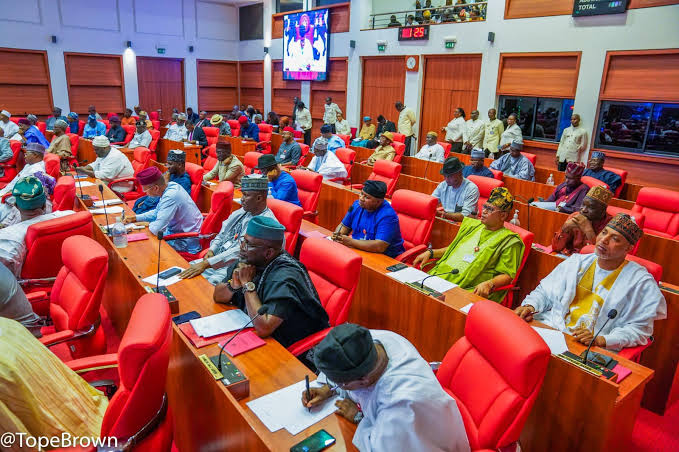
Following hours of debate, which included contributions from key senators like Adams Oshiomhole, Orji Uzor Kalu, and Minority Leader Abba Moro, the Senate unanimously approved the bill for further legislative work.
It was subsequently referred to the Committees on Judiciary, Human Rights and Legal Matters (lead), National Security and Intelligence, and Interior.
The committees are expected to report back within two weeks.
While leading the debate, Sen. Bamidele emphasized that the bill’s core purpose is to formally classify kidnapping, hostage-taking, and related offenses as acts of terrorism.
Crucially, it seeks to prescribe the death penalty for these crimes, eliminating the option of a fine or alternative sentence.
He stressed that kidnapping has evolved far beyond isolated acts, describing it now as “coordinated, commercialized, and militarized acts of violence perpetrated by organized criminal groups.”
“Kidnapping has instilled widespread fear in communities; undermined national economic activities and agricultural output; interrupted children’s education; bankrupted families forced to pay ransom; overstretched our security forces, and claimed countless innocent lives,” Bamidele lamented.
According to him, the patterns of brutality associated with kidnapping “now carry all the characteristics of terrorism,” making it necessary to treat the offence under the counter-terrorism framework.
Bamidele said the bill would empower security agencies with “broader operational authority, intelligence capabilities, and prosecutorial tools” to pursue terrorists and their enablers.
He stressed that the death penalty would apply not only to kidnappers but also to “their informants, logistics providers, harbourers, transporters, and anyone who knowingly assists, facilitates, or supports kidnapping operations,” adding that “attempt, conspiracy or incitement to kidnap attracts the same penalty.”
“Nigerians are kidnapped on highways, in schools, in homes, on farms and in markets,” he said. “This is not a mere crime. It is terrorism in its purest form.”
Supporting the amendment, Oshiomhole criticised deradicalisation programmes for terror suspects, arguing that many offenders returned to crime.
“We should not continue with deradicalisation programmes again,” he said. “No more de-radicalisation. If you are caught and convicted for acts of terrorism, then the penalty should be death.”
Kalu also supported the bill, insisting that informants and sponsors of kidnappers must “face the consequence.”
“Nigerians have suffered at the hands of kidnappers. Young girls have been raped. Women have become widows for no reason. This must not continue again,” he said.
Senate Minority Leader Moro described the bill as “a unanimous decision of the Senate,” noting that it was necessary to impose capital punishment “with the hope that kidnappers will face the penalty.”
Contributing, Sen. Victor Umeh, condemned the rising trend of abductions and the killing of victims even after ransom payments, adding that financial institutions aiding such crimes must also be scrutinised.
On the same Wednesday, the House of Representatives also passed a resolution demanding the public naming and prosecution of terrorism financiers.
This action followed the review of its draft security report during a plenary session, which was presided over in part by Speaker Tajudeen Abbas and Deputy Speaker Benjamin Kalu.
The debate and subsequent resolutions stemmed from Tuesday’s dedicated plenary session, where the House conducted a comprehensive national debate on rising insecurity, driven by the recent kidnappings of hundreds of school pupils and church worshipers across the country.
Kalu urged lawmakers to contribute meaningfully, noting that the final resolutions would be sent to President Bola Tinubu for potential implementation.
Among the key resolutions adopted were
Publicly naming, sanctioning, and prosecuting the financiers of terrorism, banditry, and kidnapping, ensuring that all terrorism-related prosecutions are open, expeditious, and transparent.
Others are the establishment of a Special Court for terrorism, banditry, and kidnapping cases and strengthening and enforcing penalties for arms trafficking and illegal possession of weapons.
The resolutions include: “All security expenditure should be placed on ‘First Line Charge’ to guarantee predictable and timely funding, and all approved security budgets must be fully and promptly disbursed.
“That, in recognition of the established link between cash-based economies and the financing of terrorism, banditry, ransom payments and other criminal/enterprises, the House recommends a phased strengthening of cashless transaction frameworks nationwide.
“Accordingly, the House urged the executive, the Central Bank of Nigeria and financial institutions to expand, upgrade and secure e-banking infrastructure, particularly in rural and underserved arena, ensure reliability, accessibility and public confidence.
“That enhanced digital payment systems, transaction monitoring mechanisms and financial crime analytics be integrated into national security operations, while ensuring that the transition remains inclusive, does not exclude vulnerable populations, and is implemented in a manner that balances security imperatives with economic realities.”
The plenary session also saw a significant debate over President Tinubu’s directive to immediately withdraw police guards from Very Important Persons (VIPs).
Lawmakers Abubakar Yelleman (Jigawa) and Ahmed Satomi (Borno) supported the directive.
Yelleman argued against the current practice where “one person will be going about with about 10 policemen,” advocating for the Nigeria Security and Civil Defence Corps (NSCDC) to take over protection duties, freeing police personnel to return to their core policing functions. Satomi, who chairs the House Committee on National Security and Intelligence, echoed this, stating that security is primarily driven by intelligence gathering, not guns, and emphasized strengthening the NSCDC.
However, Kalu ruled against a complete withdrawal for key national figures. He argued that officials like the Chief Justice of Nigeria, other Justices, and state governors are “national officers,” not merely VIPs, and require the protection of the Nigerian Police Force (NPF). Kalu questioned the value of providing a governor with immunity while simultaneously withdrawing their security.
Ultimately, the House resolved that only serving national officers should be entitled to police protection.
In addition to the security detail debate, the House passed a crucial resolution regarding military deployment.
Lawmakers proposed a formal review of the military’s ‘super-camp’ strategy, citing its operational limitations, such as reduced territorial presence and increased community vulnerability.
The resolution called upon the Armed Forces to consider returning to forward operating bases and sustained community-level deployment as a more effective doctrine for securing affected areas.
Others are: “That new army formations, police divisions and Civil Defence units be established or expanded in volatile regions, high-risk areas and strategic locations,
“Security coverage for schools, worship centres, markets and other soft targets should be strengthened through coordinated preventive measures and improved rapid-response capacity.
“This should include enhanced implementation of the Safe Schools Initiative, with attention to risk assessments, perimeter protection, Closed Circuit Televisions, early-warning systems and community-based reporting to protect pupils, teachers and other vulnerable groups.
“All public CCTV systems should be reactivated, upgraded, and, where necessary, complemented with new installations, and integrated into a national and sub-national surveillance grid.”
The House also proposed: “Actionable intelligence generated by the Department of State Services and other security agencies, including intelligence shared across agencies, should be proactively operationalised by all security formations, with strengthened inter-state collaboration, particularly along border corridors and other high-risk zones.”
It also advocated that “the process to establish State Police be expedited through Constitutional amendments, placing policing on the Concurrent Legislative List.”
The House underscored the urgent need to curb fake news, misinformation, harmful content and deceptive AI-generated material, “especially content that threatens national security.
In line with global best practice, the House calls for a balanced regulatory framework that protects free expression while requiring digital platforms to remove harmful content.
The House called for “an effective national tracking mechanism for all arms, weapons and security equipment held by security agencies.”
This should include a unified inventory system, digital tracking tools, periodic audit, and Strict accountability measures to prevent diversion, loss, or misuse and to strengthen operational integrity and public safety.”
To strengthen national security, the House called for “massive recruitment into the armed forces, the police and other security agencies shall commence without delay to meet current operational demands; and that clear recruitment timelines and implementation schedules be developed and submitted to the National Assembly for effective legislative oversight.
“The welfare of security personnel be enhanced through improved salaries, insurance, housing, medical care and compensation frameworks.
“Officers approaching retirement who possess specialised operational or technical skills be formally co-opted to support security agencies in a structured, clearly regulated manner that does not alter or interfere with existing command hierarchies or lines of authority.”
The lawmakers also called for the establishment of a National Fallen Heroes Support Fund to provide sustained assistance to the families of deceased servicemen and women, including automatic employment opportunities and scholarships for their immediate family members.
Another resolution is the establishment of a Truth, Justice and Reconciliation Commission “to address extremist, communal and religiously motivated violence.”
“Ransom payments and informal amnesty negotiations by government entities should be prohibited, and a clear legal framework should be enacted to outlaw such practices while regulating any authorised amnesty processes. Only lawful criminal-justice procedures shall prevail,” the lawmakers further proposed.
They further noted that “the ongoing bilateral engagement with the Government of the United States should be strengthened, particularly in intelligence, surveillance, counter-terrorism training, and financial network disruption.”
It also proposed that emergency relief, trauma care and stabilisation programmes be rapidly deployed to affected communities, adding that “weapons mop-up operations continue across all affected regions.”
The resolutions would be transmitted to the Senate for concurrence.
Author







Leave a comment