










By Joycelyn Ellakeche Adah, Abuja
Four years after Nigeria’s landmark Petroleum Industry Act (PIA) came into force, senior government officials, regulators, and industry leaders acknowledge notable progress but warn that its full benefits are threatened by slow implementation, weak coordination, and lingering structural gaps.
This consensus emerged at the maiden conference of the Energy Correspondents Association of Nigeria (ECAN), held in Abuja on Thursday.
Speakers from the Ministry of Petroleum Resources, the Nigerian Upstream Petroleum Regulatory Commission (NUPRC), marketing associations, and media stakeholders agreed that while transparency has improved and investor interest is gradually returning, the real test of the reform lies ahead.
Representing the Minister of State for Petroleum Resources (Oil), Hon. Ekperikpe Ekpo, Mrs. Ruth Mela Nughe affirmed that the PIA has successfully “redefined governance, fiscal rules, and operations” across Nigeria’s oil and gas sector.
She noted that transparency had improved and investor confidence strengthened, but warned that gaps still persisted particularly in host community development, the energy transition, and the full rollout of PIA provisions.
She urged journalists and stakeholders “to generate actionable insights” that will help government refine the law and drive broader economic growth.
Delivering the keynote address, NUPRC Chief Executive, Engr. Gbenga Komolafe, represented by Head of Regulatory and Statutory Compliance at the Nigerian Upstream Petroleum Regulatory Commission, Mr Kingston Chikwendu
said the Act had shifted Nigeria from “static regulation to performance-based, investor-centric governance.”
He highlighted the Commission’s 19 new regulations, aggressive licensing rounds, revival of dormant fields, and new evacuation routes aimed at cutting crude theft.
Nigeria, he said, is pushing toward 2.5 million barrels per day by 2026, supported by the Project One Million Barrels initiative and digitally driven regulatory processes.



Komolafe also pointed to Nigeria’s growing gas ambition, including LNG expansion, flare out programmes, downstream gas infrastructure, and a decarbonisation blueprint designed to position Nigeria for global energy transition financing.
But he warned that challenges remain: infrastructure deficits, regulatory overlaps, and global climate pressures.
He urged deeper industry collaboration, stronger host community frameworks, and regional alignment through the African Petroleum Regulatory Forum (AFRIPERF).
In his goodwill message, the representative of Major Energies Marketers association of Nigeria (MEMAM) Mr Muhammad Al Kassim, AGM Retail, highlighted progress since 2021 including clearer regulatory roles and more predictable licensing procedures but cautioned that “policy alone will not deliver results for citizens.”
He noted that several Host Community Development Trusts remain stalled, institutional capacity gaps persist, and procedural delays still raise costs for operators and consumers.
He called for tighter coordination among regulators, stronger competition rules, and measurable performance indicators across the energy value chain.
The marketers’ association proposed a six point agenda, including capacity building, digitalised licensing, transparent competition rules, and clearer community-benefit metrics.
Earlier in his welcome address, ECAN Chairman, John Ofikhenua, urged participants to “speak frankly and think boldly,” stressing that while the PIA ended two decades of uncertainty, the law must evolve with global energy realities.
Ofikhenua reminded delegates of the difficult path that led to the Act from the stalled Petroleum Industry Bill era to years of policy paralysis and fuel scarcity noting that the PIA had finally brought structure and accountability.
He warned that the reforms “are not a finished product” and that Nigeria must confront persistent barriers, including technology gaps, weak institutions, and limited energy access.
Across all presentations, a common thread emerged: the next phase of the PIA requires faster implementation, stronger inter agency coordination, clear performance targets, and sustained engagement with host communities.
Speakers also emphasised the central role of journalists in shaping public understanding of reforms, holding institutions accountable, and promoting transparency in a sector responsible for most of Nigeria’s foreign exchange earnings.
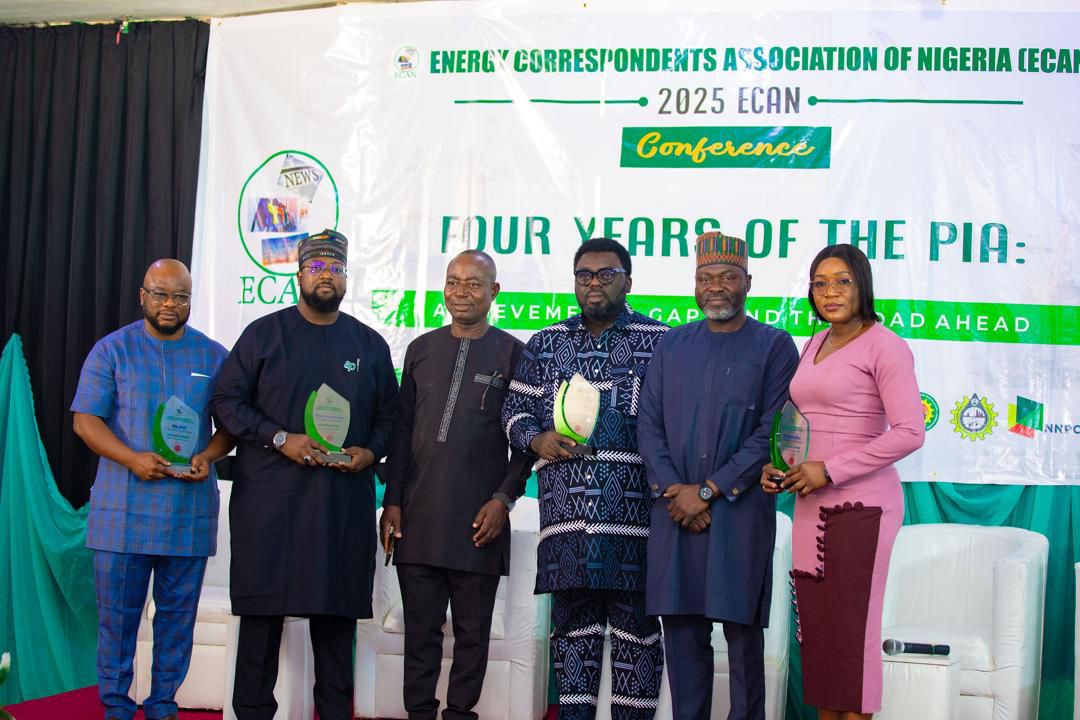
As part of the inaugural conference, ECAN presented Recognition of Support Awards to organisations that backed the event’s debut edition. Honourees included Persecondnews (PSN), the Nigerian Upstream Petroleum Regulatory Commission (NUPRC), the Nigerian National Petroleum Company Limited (NNPCL), the Major Energies Marketers Association of Nigeria (MEMAN), and other industry stakeholders acknowledged for their contributions to strengthening energy sector reporting.
Author






Leave a comment