






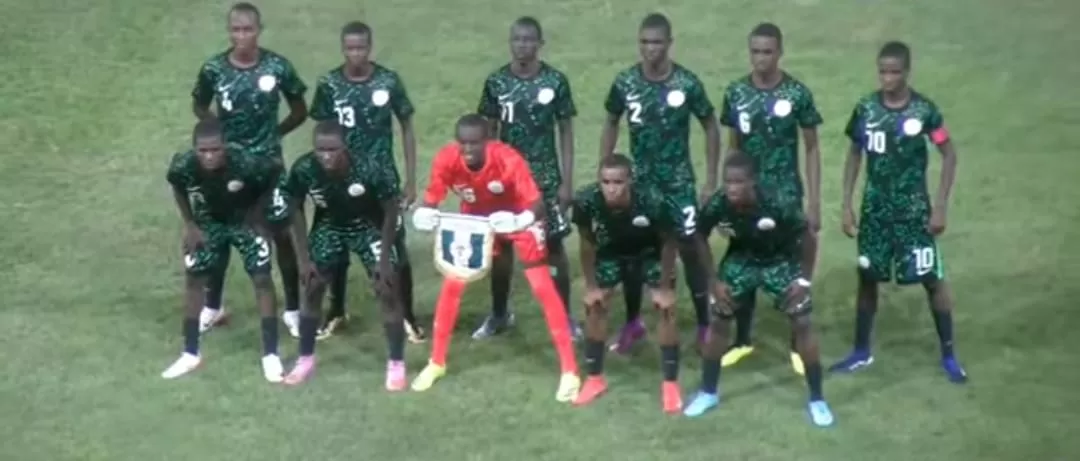



Following the Golden Eaglets’ 2-0 defeat against the Ghana Black Starlets in the WAFU-B U17 tournament semi-finals on Tuesday, the Nigeria Football Federation (NFF) is under increased pressure to review the state of the country’s cadet football system.
This outcome carries significant historical weight: it marks the first time since 1999 that Nigeria has failed to qualify for the FIFA U-17 World Cup back-to-back, clearly highlighting a worrying trend in youth football development.
The highly contested derby saw Ghana seize control early with first-half goals from Michael Awuli and Yao Gavi.
Although the Golden Eaglets attempted to rally in the second half, they ultimately failed to break the Ghanaian defence, confirming the 2-0 final score.
Nigeria has a rich history of producing talented young players who have gone on to excel on the world stage.
The Golden Eaglets have won the FIFA U-17 World Cup five times, with their most recent victory in 2015.
However, their performance in recent years has been underwhelming, with the team failing to qualify for the World Cup in 2023 and 2025.
The decline of Nigerian youth football is a cause for concern.
The U-23 team, which won a bronze medal at the 2016 Olympics, failed for the first time in the history of to qualify for back-to-back Olympics Tokyo 2020 and Paris 2024.
This decline is a sharp contrast to the country’s dominance in the past, when players like Nduka Ugbade, Wilson Oruma, and Kanu Nwankwo emerged from the cadet system to become stars in the Super Eagles.
While age cheating is often cited as a major problem in Nigerian football, the reality is that the country’s football ecosystem is plagued by a multitude of complex issues.
These include missing funds, rigging of player selection and call upd, underpaid players, and poor infrastructure.
Football administrators in Nigeria often prioritize personal gain over the development of the sport, with positions in the Football Federation, committees, or clubs being highly sought after due to the high financial gains.
The government plays a significant role in Nigerian football, providing substantial funding for national teams and infrastructure development.
However, despite this involvement, there is a lack of accountability and oversight, allowing corrupt practices to thrive.
Football leaders are often not held accountable for corruption charges, perpetuating a system that prioritizes personal interests over the development of the sport.
The issues facing Nigerian football are deeply ingrained and require a comprehensive solution.
To address these problems, there needs to be a concerted effort to promote transparency, accountability, and good governance in football administration.
This includes implementing effective oversight mechanisms, ensuring that funds are used for their intended purpose, and holding football leaders accountable for their actions.
Only then can Nigerian football begin to realize its full potential and achieve consistent success on the world stage.
Unlike European countries, Nigeria has failed to invest in long-term sporting development, instead relying on ad-hoc solutions. This approach has led to a decline in the country’s football fortunes.
Morocco’s successes in 2022 and 2023, not to mention the country’s successful bid to host the FIFA World Cup 2030 alongside Spain and Portugal, were no accident.
In fact, all of this stems from a carefully constructed plan, which is now bearing fruits for Moroccan football and, with long-term sporting investment.
After a group stage exit in the 1998 World Cup, Morocco failed to qualify for another World Cup until 2018.
However, under the leadership of Royal Moroccan Football Federation President Fouzi Lekjaa, the country implemented a comprehensive plan to revamp its football ecosystem.
The plan included talent identification, player development, and professionalization, which has borne fruit with Morocco’s successful bid to host the FIFA World Cup 2030.
Nigeria needs a similar approach to revive its football fortunes.
The NFF must prioritize long-term development, investing in talent identification, coaching, and infrastructure.
This requires a structured and sustainable approach, rather than relying on short-term fixes.
By learning from Morocco’s example, Nigeria can potentially restore its position as a football powerhouse.
The Moroccan model offers a roadmap for Nigeria’s football revival.
By adopting a similar approach, Nigeria can develop a robust football ecosystem that produces talented players and achieves success on the world stage.
It’s time for the NFF to take bold action and implement a comprehensive plan to revive Nigerian football.
Author



Leave a comment