









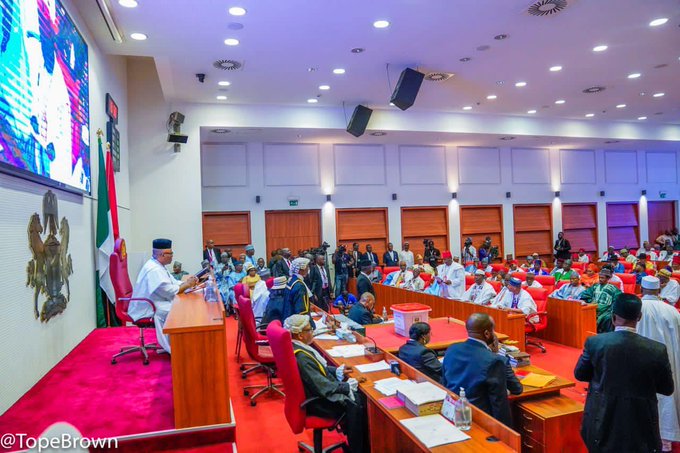



The Senate on Wednesday adopted the harmonised version of the tax reform bills presented to both houses of the National Assembly by President Bola Tinubu.
The resolution of the Senate followed the consideration of the recommendations of the conference committee of both chambers tasked with aligning the differences in the bills.
Presenting the harmonised report, Chairman of the Senate Committee on Finance, Sen. Sani Musa, laid out the final agreements reached.
The legislative efforts mark a significant step in overhauling Nigeria’s tax administration and revenue generation framework, as part of the Tinubu administration’s broader fiscal reform agenda.
Persecondnews reports that the four tax reforms bills which were transmitted to the National Assembly in November 2024 by Tinubu are: the Joint Revenue Board (Establishment) Bill, 2025 (SB. 583); Nigeria Revenue Service (Establishment) Bill, 2025 (SB. 584); Nigeria Tax Administration Bill, 2025 (SB. 585) and Nigeria Tax Bill, 2025 (SB. 586).
The development comes three days after the parliament hinted that it may consider passing the harmonised tax reform bills following a successful review of the “troubling clauses” in the proposed legislation.
The Chairman of the House of Representatives Committee on Finance, James Faleke, disclosed it via his official X account last Sunday.
Faleke is the leader of the House delegation for the bills harmonisation exercise.
He tweeted: “The Conference Committee set up by the House and the Senate on the Tax Reform Bills has successfully concluded its work. The joint committees thoroughly reviewed all sections and addressed the grey areas of the four Bills, examining each clause strategically and resolving contentious issues.
“After an intensive deliberation that stretched through Thursday night, all day Friday, and into the early hours of Saturday, I am pleased to report that the Bills are now ready for presentation to both the House and the Senate for final passage.
“I would like to especially appreciate the Senate Conference Committee, ably led by the Chairman of the Senate Committee on Finance, the Distinguished Senator Sani Musa, as well as all members of the Senate Conference Committee.”
Persecondnews reported that the four tax bills were sent two weeks ago to the joint harmonisation committee made up of members of the Senate and the House of Representatives to reconcile the amendments of both Chambers before it is transmitted to the President for his assent.
After announcing the passage of the bills following a majority voice vote, the Senate President, Godswill Akpabio, praised the lawmakers for their sacrifice in ensuring that the tax system in Nigeria meets an international standard.
He said, “These four executive bills seek to transform and modernise the tax system in Nigeria.”
President Bola Tinubu had in October 2024 transmitted the four tax reform bills to the National Assembly for consideration and passage, Persecondnews recalls.
The bills, drafted by the Presidential Committee on Tax Reforms and Fiscal Policy, aim to revolutionize Nigeria’s tax landscape by overhauling the existing tax laws, promoting exports, and streamlining tax administration.
However, the bills faced stiff opposition, mainly from the Northern parts of the country, particularly from Northern governors who had described the bills as “anti-North.”
The debates of the bills took a divisive turn, pitting the North against the South, with the contentious issue of VAT sharing formula at the forefront of the controversy.
The National Economic Council (NEC) chaired by Vice-President Kashim Shettima had urged President Tinubu to withdraw the tax reform bills for further consultations.
Tinubu, however, stood his grounds, asserting that all concerns regarding the bills should be addressed during deliberation in the National Assembly, instead of withdrawing the bills.
Author








Leave a comment