











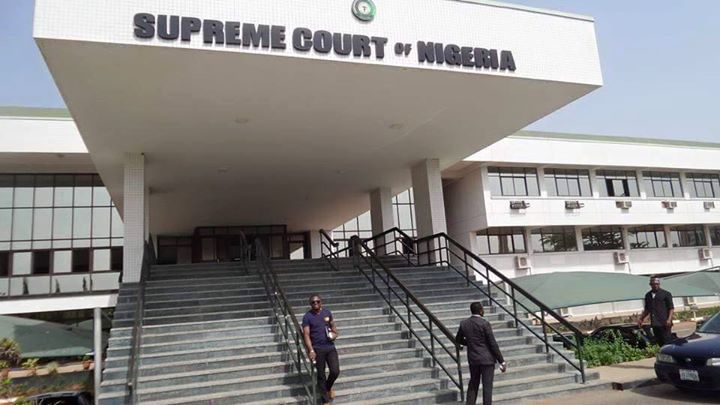




The bid by President Muhammadu Buhari and Attorney-General of the Federation, Malam Abubakar Malami (SAN) to annual the controversial Section 84(12) of the Electoral Act has failed as the Supreme Court on Friday dismissed the suit.
In dismissing the suit, the judgment delivered by Justice Aokmaye Agim, the Supreme Court justices said having earlier assented to section 84 (12) of the Electoral Act 2022, the President cannot again ask the court to abrogate it.
Persecondnews reports that a unanimous judgment of a seven- man panel of the apex court dismissed the suit.
The provision, included in the amended Electoral Act 2022 signed into law by President Muhammadu Buhari on February 25, 2022 bars political appointees from voting or being voted for at conventions of political parties.
The provision states: “No political appointee at any level shall be a voting delegate or be voted for at the convention or congress of any political party for the purpose of the nomination of candidates for any election.”
Buhari had written the National Assembly to delete the Section which claims that it was unconstitutional as it will stop political appointees from exercising their constitutional rights to contest for elections.
The Attorney General Malami had approached the Supreme Court after the National Assembly failed to accede to the President’s request to delete the provision.
Malami had sought an order of the Supreme Court striking out the Section of the Electoral Act which he argued was inconsistent with the 1998 Constitution.
He contended contended that the Section 84 (12) of the Electoral (Amendment) Act, 2022 is inconsistent with the provisions of sections 42, 65, 66, 106, 107, 131, 137, 147, 151, 177, 182, 192 and 196 of the Constitution of Federal Republic of Nigeria, 1999, (as amended), as well Article 2 of the African Charter on Human and People and Peoples Rights.
Also, he argued that the Nigeria’s 1999 constitution has provisions related to qualification and disqualification for the offices of the President and Vice- President, Governor and Deputy Governor, Senate and House of Representatives, House of Assembly, Ministers, Commissioners and Special Advisers.
The apex court argued that the suit cannot be entertained under section 1(1) (a) of its additional jurisdiction, describing it an abuse of court process.
“There is no provision in the constitution that vests the president the power to challenge the constitutionality or desirability of a legislation after he has assented or denied his assent. In this case, the president gave his assent,” Agim ruled.
The Apex Court also said the request by the President to the National Assembly to delete the provision amounted to constitutional violation.
“The president has no power to request or compel the national assembly to amend any part of the Act of the National Assembly in which he has participated in its making.”
Author











Leave a comment