










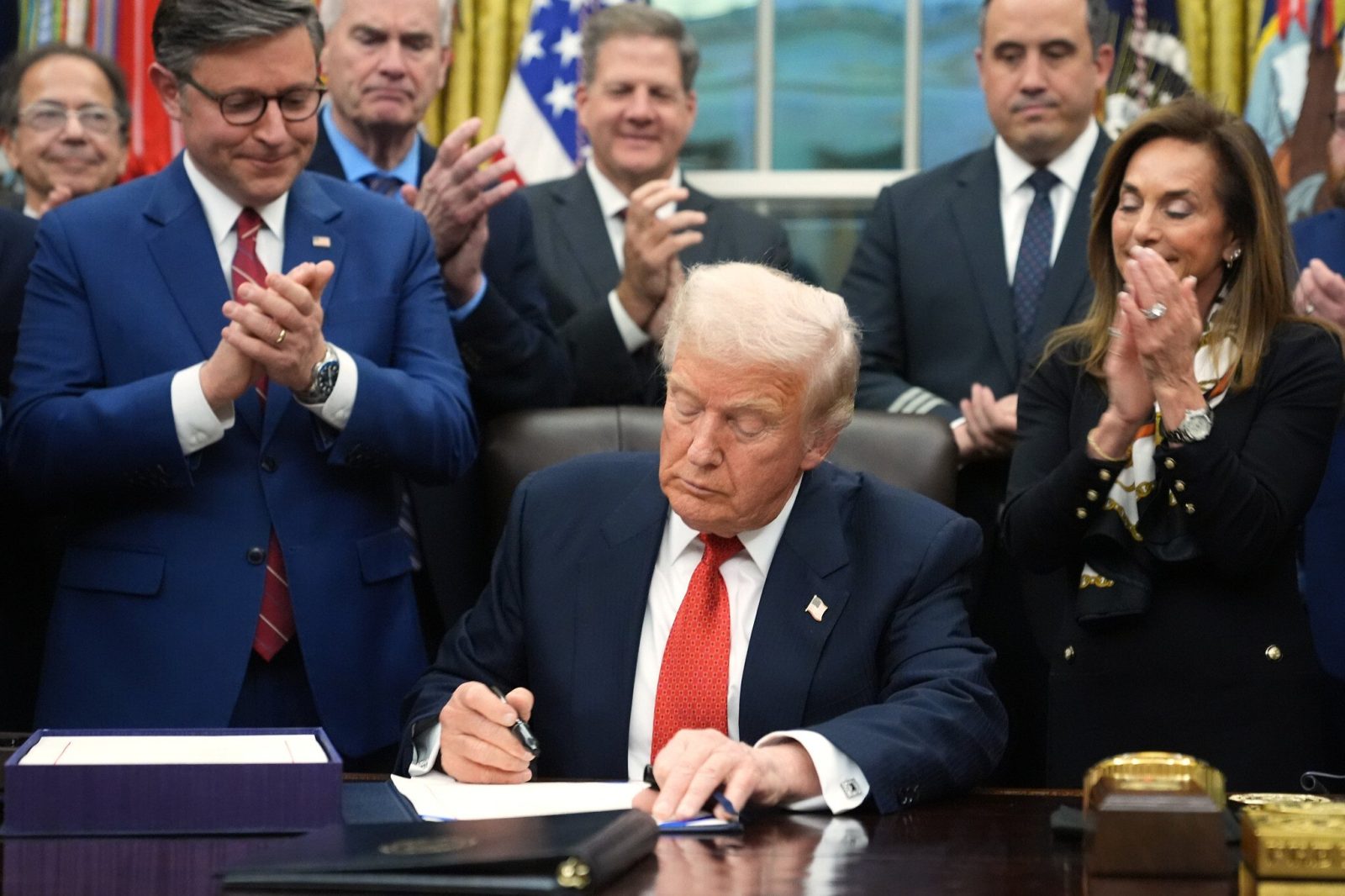




President Donald Trump late Wednesday inked a stop‑gap spending bill that ended the longest U.S. government shutdown in history, a 43‑day impasse that left federal workers unpaid, airports chaotic and food‑aid programs in limbo.
The measure cleared the House on a 222‑209 vote after the Senate had already approved it, and Trump signed it in an Oval Office ceremony just hours later.
“They didn’t want to do it the easy way. They had to do it the hard way, and they look very bad,” Trump said, blaming Democrats for the prolonged crisis.
He added that the bill’s passage was a “clear message that we will never give in to extortion” and celebrated the move as a victory for Republicans.
Trump continued his critique, noting the shutdown had caused “financial stress for federal workers who went without paychecks, stranded scores of travelers at airports and generated long lines at some food banks”.
He underscored that the new law guarantees back‑pay for the 1.4 million federal employees who missed wages and protects them from further layoffs until January 30.
The legislation funds the Agriculture Department for the full year, covers military construction and legislative agencies, and keeps the Supplemental Nutrition Assistance Program (SNAP) alive, ensuring food aid for roughly one‑in‑eight Americans.
It also includes $203.5 million for lawmakers’ security and $28 million for Supreme Court security.
Crucially, the package only pushes funding through January 30, setting up another potential showdown.
It does, however, force an early‑December Senate vote on the expiring Affordable Care Act subsidies—a key Democratic demand that was left unresolved in the current deal.
House Minority Leader Hakeem Jeffries told MSNBC that Democrats remain steadless on health‑care priorities: “Over the last several weeks, we have elevated successfully the issue of the Republican health care crisis, and we’re not backing away from it. This fight is not over. We’re just getting started.”
Senate Minority Leader Chuck Schumer is drawing heat from progressives for not keeping the caucus united, while several high‑profile Democrats California Governor Gavin Newsom, Illinois Governor JB Pritzker, and former Transportation Secretary Pete Buttigieg publicly slammed the agreement as “pathetic,” an “empty promise,” and a “bad deal,” respectively.
The shutdown, which began on October 1, forced 1.4 million federal workers onto unpaid leave or forced them to work without pay, halted key data releases, and snarled air travel nationwide.
The Congressional Budget Office estimated the six‑week closure shaved about 1.5 percentage points off GDP for the quarter, with roughly half of that loss expected to be recouped later.
Eight Senate moderates broke ranks with their party to forge the compromise, securing the December health‑care vote in exchange for the short‑term funding.
The deal also includes a provision allowing senators to sue federal agencies for up to $500,000 if their electronic records are searched without notice a clause that drew criticism from both sides.
As the government restarts, lawmakers will reconvene in early 2026 to tackle the looming funding deadline and the fate of the ACA tax credits, which could double premiums for millions if they lapse.
The outcome of that vote may shape the political landscape ahead of the 2026 midterms, with both parties already positioning for advantage.
Author










Leave a comment