















Traumatised refugee children are being enticed by tempting offers of escape from poverty, then sold into slavery – but survivors are fighting back
By Philip Obaji Jr.
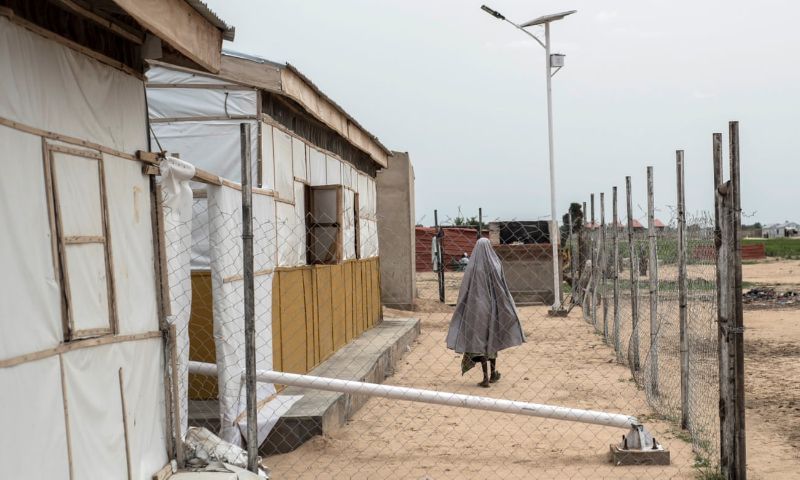
At the age of 15, Aisha and Halima were abducted from their compound in north-eastern Nigeria by Boko Haram insurgents. For a year they were held in captivity, and were raped. They managed to escape their captors, and find their way across the desert to a camp in Madinatu, in Borno state.
Though they had made it to relative safety, life in the camp was hard for the traumatised teenagers. They had had no contact with their family since their abductions, and there was little to eat. They had to fend off unwelcome advances by local community law enforcers, including members of the Civilian Joint Task Force, who, they say, offered food in exchange for sex.
“It was so frustrating having to beg for food, and coming into contact with people who only wanted to exploit us,” says Aisha. “We were ready to do anything to leave Madinatu.”
One morning as the girls went in search of firewood outside the camp, a group of women stopped them, asking them if they would be interested in work as hairdressers in Italy.
“They told us we would be well paid, and that we’d be given a place to stay,” says Halima. “We were so happy we were going to leave all our troubles in Madinatu and make money abroad.”
The women were traffickers. Aisha and Halima were taken to central Nigerien city of Agadez, to a “connection house”, where they were instructed to wait until the smugglers were ready to continue their journey through north Africa for the Mediterranean crossing. Their arrival had coincided with a government crackdown on smugglers, and they found themselves moved from one house to another to escape arrest. When finally they were driven from the city towards the southern Libyan town of Sebha, their trafficker spotted a police convoy patrolling the route through the desert. Worried he would be apprehended, he ordered the girls to get out of the car and drove away.
Abandoned in the desert, the girls feared for their lives. “We almost died of heat, and had to drink our pee to stay alive,” says Halima. They were rescued after about two hours by a passing car, who took them back to Agadez. There, a Nigerian woman took pity on them, giving them cash to pay their fare back to Nigeria.
Aisha and Halima’s story is all too common. Unofficial reports based on survivors’ testimony and local data suggest there have been at least 17 cases of trafficking out of Madinatu camp in the last two years. The majority of the victims were girls aged under 18.
The situation is reflected across the region. The 2019 US State Department Trafficking in Persons report revealed that “sexual exploitation, including sex trafficking, of IDPs in camps, settlements, and host communities around Maiduguri remained a pervasive problem”. It noted that security personnel are also involved in this criminal activity.
When they finally returned to the Madinatu camp, Aisha and Halima made it their mission to warn other girls against the dangers of trafficking. They became involved with the Caprecon Development and Peace Initiative, which educates girls in refugee camps on how traffickers make their approaches, and the huge risks involved. Aisha and Halima are now part of the organisation’s advocacy, and campaign against trafficking in Madinatu.
“These people are criminals, who have no jobs to offer anybody,” Aisha recently told a group of women at the Madinatu camp. “When you fall into their trap, they sell you into slavery.”
Another girl at Madinatu, Sarah, is also involved with the campaign, after surviving a similar fate to Aisha and Halima. When she was 15 years old, Boko Haram attacked the camp where she lived, killing her mother, and abducting and raping Sarah.
She escaped to Madinatu, but desperate over the lack of food at the camp, she turned to prostitution on the streets of Maiduguri. There she met a woman who offered the chance of work in a hairdressing salon in Italy – but like Aisha and Halima, she only made it as far as Agadez. After some months of waiting in a connection house, she was told she needed to go into sex work to pay her rent. She escaped.
“I came back feeling so devastated and worried about my future,” Sarah says. “It felt like I had lost everything, including my soul, to the trafficker.”
With support from Caprecon, the three girls have formed their own group to keep watch over the camp. Working with them are fellow trafficking survivor Nana Abdullahi, who was taken to Niger in 2015, and Hajja Alooma, who was approached by a trafficker in 2018.
“We thought that just talking to women and children about trafficking would not be enough to stop traffickers from targeting them,” says Halima.
Every morning, the girls note which children leave the camp, and where they are going, and then search for them if they have not returned three hours after their departure.
“We want to be sure that they are not going to meet someone who could turn out to be a trafficker,” says 16-year-old Hajja, who rejected an offer to work as a salesgirl in Niger from a man she met in Maiduguri because she felt he wasn’t genuine. “If we are not very watchful, more children will fall into the hands of human traffickers.”
When strangers come to the camp, the girls welcome them politely and ask them the reason for their visit.
“If we are not satisfied … we invite the vigilantes working near the camp to interrogate the person,” says Nana Abdullahi, whose male trafficker met her on the streets of Maiduguri, where she sold fruit to earn money. He had promised to help get her a job outside the city. “If there is reason to hand over suspected traffickers to the police, the vigilantes will do so.”
One afternoon, the girls spotted a young woman who had walked into the camp and was speaking to some children there. They confronted her, and when she couldn’t explain the reason for her visit, they summoned local community law enforcers.
“She couldn’t escape because many girls had surrounded her,” says Nana, who escaped from her trafficker at the age of 15. “We then handed her over to the vigilantes, who set her free after warning her never to set foot in the camp again.”
It is when girls leave the camp in search of water, firewood and food that they are particularly at risk, explains Jibrin Bukkar, Caprecon’s project coordinator. “Traffickers always keep a close eye on the movement of women and girls.”
Caprecon is not the only organisation working to protect Madinatu’s most vulnerable from being exploited. “We are encouraging women and girls to stand up against trafficking and report to us any incident of abuse and exploitation, by anyone, including security officials,” says Yusuf Mohammed, who oversees the Madinatu unit of the Borno Community Coalition, a group of local leaders and humanitarian workers assisting survivors of the Boko Haram insurgency in Borno state. “Our role is to protect women and children from being exploited by selfish individuals and groups.”
The girls in the group supported by Caprecon are under no illusions about the importance of their work. “We want to make sure traffickers stay away completely from IDP camps,” says Halima.
Philip Obaji Jr is a Nigerian author, human rights educator and initiator of the Up Against Trafficking Campaign in Maiduguri. He won the Future Awards Africa Prize in Education in 2014, and the Future Awards Africa Prize for Young Person of the Year in 2015. Obaji was listed among 100 most influential people in Nigeria in 2016 by popular Nigerian news website, YNaija. Follow him on twitter @PhilipObaji
Author












Leave a comment