













By Samuel Akpan
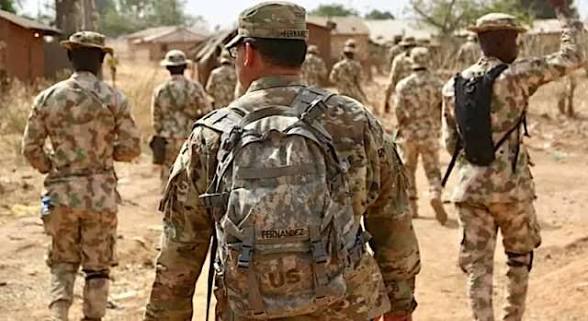
The Nigerian military has clarified recent reports regarding US troop movements in the Lake Chad Basin, explaining that the rumoured withdrawals only apply to temporary, short-term reinforcements, rather than the 200 US personnel currently engaged in joint counter-terrorism operations with local forces.
The clarification came from the Director of Defence Information, Maj.-Gen. Samaila Uba, noting that the troops reported withdrawn are different from the 200 deployed to Nigeria specifically for joint intelligence and training operations against ISIS and other terrorist elements.
According to the director, the Nigeria-US partnership remains unchanged.
Uba clarified that the US commander was primarily referring to the additional forces that came to execute the Lake Chad mission.
“The Commander was primarily talking about the additional forces that came to execute the mission in Lake Chad. Initial US personnel are still in Nigeria,” Uba said.
He emphasised that the partnership between Nigeria and the US is unchanged, with key information sharing ongoing.
“Nigeria and US continue to work closely together to disrupt and eliminate shared threats and that remains unchanged,” the defence spokesman added.
Uba noted that, as seen in May, there are times that require additional forces to execute specific missions.
“Those forces are intended for short periods of time only,” he said, adding that where the need arises for peculiar competencies, personnel and resources would be provided going forward.
He reassured that core security cooperation between Nigeria and the United States endures, focused on eliminating shared terrorist threats through sustained intelligence collaboration and targeted support when required.
Persecondnews reports that the clarification follows a report by a foreign news agency claiming that the United States had withdrawn the majority of its military personnel deployed for a joint counterterrorism mission in the Lake Chad Basin, while continuing intelligence sharing and other security cooperation with Nigerian authorities.
The agency quoted Commander of US Air Forces in Africa, General Dagvin R.M. Anderson, during a virtual press briefing on the outcome of the African Chiefs of Defence Conference 2026.
He said the specific mission that required the deployment of US troops had been completed, prompting the withdrawal of most personnel.
Anderson explained that the operation helped countries in the immediate region and globally by disrupting the ISIS network.
“And so, we have withdrawn much of our forces that were just there for that operation, but are continuing the partnership that Nigeria has asked for to help continue with the intelligence sharing and the understanding that’s necessary to be able to prosecute these difficult tasks,” he said.
He added that the United States would continue providing intelligence assistance at the request of the Nigerian government.
The US commander described Nigeria as a key regional partner with a capable military, strong economy and large educated population.
Anderson credited intelligence cooperation between the two countries for enabling an operation that eliminated the number two leader in the global ISIS network, Al Manuki, who was responsible for much of the group’s global operations, media and recruiting.
“But there are things that we have learned in the counter terrorist fight over several years that we were able to assist and integrate with them to help them with their intelligence… and be able to prosecute together the number two leader within the ISIS or Daesh organization,” he stated.
Persecondnews reports that the Lake Chad Basin remains one of Africa’s most complex and protracted security theatres, spanning northeastern Nigeria (especially Borno State), Cameroon’s Far North, southeastern Niger, and western Chad.
The basin’s porous borders, islands, swamps, and shrinking lake create ideal terrain for asymmetric warfare and smuggling.
Boko Haram (Jama’atu Ahlis Sunna Lidda’awati wal-Jihad or JAS) emerged in 2009, fractured after 2015, and spawned the Islamic State West Africa Province (ISWAP) affiliate.
Between 2025/2026 violence escalated sharply. Militant Islamist-related fatalities reached nearly 4,000 in the past year (up 7%), with civilian targeting rising 32% to 880—the highest since 2016.
Borno State alone accounted for 74% of regional deaths; Nigeria saw an 18% increase, while Chad’s toll more than doubled.
A major development was the November 2025 “Battle of Lake Chad,” where JAS fighters launched a naval-style assault on ISWAP-held islands, killing 170–200 rivals, seizing bases, weapons, and smuggling routes.
This infighting reflects competition over extortion revenues, arms, and fuel corridors through Niger, Chad, and Cameroon.
In a significant counter-terrorism win, joint US-Nigerian forces killed Abu-Bilal al-Minuki (also referred to as Al Manuki), the second-in-command of global ISIS/ISIL and a senior ISWAP figure, in May 2026.
The operation had degraded ISIS leadership in West Africa.
The United States deployed approximately 200 personnel earlier in 2026 for intelligence, surveillance, and targeted support in the Lake Chad Basin.
Following the successful operation against al-Minuki and mission objectives, most of these temporary additional forces were withdrawn.
US Air Forces in Africa Commander Gen. Dagvin R.M. Anderson clarified that core partnership and intelligence sharing with Nigeria continue uninterrupted, with initial US personnel remaining and future short-term support available for specific needs.
The mission was credited with disrupting ISIS networks regionally and globally.
Author






Leave a comment