









The World Trade Organization (WTO) is poised to launch a sweeping reform agenda aimed at restoring trust in the global trading system and modernising the organisation for a rapidly changing world.
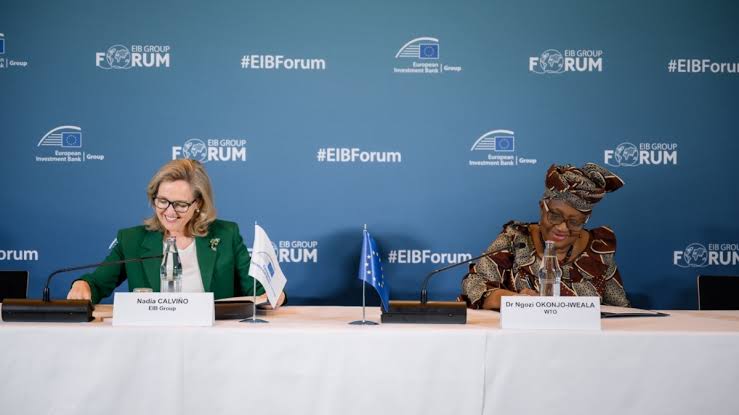
Speaking during a panel session at the European Investment Bank Annual Forum 2026, the WTO Director-General, Dr. Ngozi Okonjo‑Iweala acknowledged that the organisation currently faces a “trust deficit” among its members — a problem she said must be addressed for global trade rules to remain effective.
According to Okonjo-Iweala, rebuilding confidence in the multilateral trading system requires confronting the weaknesses within the organisation and reforming outdated rules.
“Trust is an intangible, but it is such an important ingredient to make things work,” she said.
“If you are in a multilateral setting where there is no trust, you can’t really have good results.”
Okwojo-Iweala explained that the global trade system was originally built after the Second World War by just 23 economies that shared similar structures and had strong trust among themselves.
Over time, the system expanded significantly, evolving into the modern WTO established in 1995 with 76 members.
Today, the organisation has 166 member countries, with 22 more seeking membership.
Okonjo-Iweala, however, said that while the membership expanded, the foundational agreements guiding the system were not sufficiently updated to reflect the growing diversity of economies participating in global trade.
“As membership grew and different types of economies were admitted, the fundamental agreements and principles were never revived and changed,” she said.
The result, she explained, is that some countries now feel excluded or disadvantaged by the existing framework.
Developing countries often believe they are not fully integrated into the global trading system, while even advanced economies — including the United States — sometimes take unilateral trade actions when they feel the current rules no longer serve their interests.
To address these challenges, the WTO is working on a comprehensive reform programme that will review decision-making procedures, competition rules, and transparency requirements.
One major issue under review is the organisation’s consensus-based decision-making process, which gives every member — regardless of economic size — an equal voice.
While this approach ensures fairness, Okonjo-Iweala said it can also slow down decisions because all members must agree before major policies move forward.
“We are very proud of the consensus because it gives a voice to even the smallest member,” she said. “But sometimes we practice it as unanimity, and that holds us back.”
The reforms will also examine issues such as subsidies and competitive fairness, where some countries believe existing rules allow practices that distort competition.
Despite the challenges, Okonjo-Iweala said the WTO’s framework remains remarkably resilient, noting that global trade still largely operates on the rules established decades ago.
She revealed that WTO members have spent the past nine months drafting proposals for reforms and are expected to meet within weeks to formally launch the initiative.
If successful, she said the changes would produce a faster, more agile organisation capable of responding to new opportunities in emerging sectors such as digital trade, services trade, and green trade.
“These are exciting opportunities that people don’t talk about enough,” she said.
Okonjo-Iweala also emphasized that global challenges, such as climate change and pandemics, require collective action, warning that no single country can address these problems alone.
The planned reforms, she added, aim to ensure the WTO remains relevant in an era of technological transformation and shifting global economic dynamics.
The European Investment Bank (EIB) Group Forum, which held its 4th edition this week in Luxembourg, brought together policymakers, innovators, academics, and business leaders to discuss Europe’s investment priorities and the steps needed to reinforce its competitiveness, from digital infrastructure and climate action to strategic autonomy, deeper capital markets, and win-win global partnerships.
Several new agreements and financing commitments were also solidified, including finance for Europe’s security and defense capabilities, energy efficiency, and tech innovation, as well as deepening cooperation with EU partner financial institutions, clean energy projects in Africa, and a new partnership with the World Trade Organization.
Author




Leave a comment