











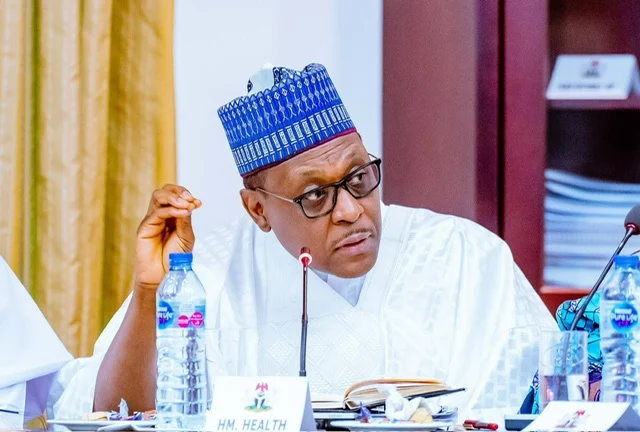



Nigeria has stepped up its drive to eliminate Tuberculosis (TB) and HIV as public health threats by 2030, with plans to significantly boost domestic funding and deploy new prevention technologies.
The Coordinating Minister of Health and Social Welfare, Prof. Muhammad Ali Pate, said the country was repositioning its health response to rely less on donor support and more on internally mobilised resources.
Pate said Nigeria was shifting towards a model anchored on innovation, efficiency, and national ownership, warning that declining global health funding requires urgent domestic action.
Speaking in Abuja at a ministerial briefing to mark World TB Day, the minister announced that the Federal Government plans to inject an additional $346 million into HIV, TB, and malaria programmes in 2026 as part of a broader co-financing strategy aligned with the Renewed Hope Agenda of President Bola Ahmed Tinubu.
“By 2030, Nigeria should be able to fund its own priority health programmes without constantly relying on external grants. We must take full ownership,” he added.
He said despite heavy reliance on donor partnerships, over 90 per cent of Nigeria’s health expenditure is already domestically financed through government spending and household contributions.
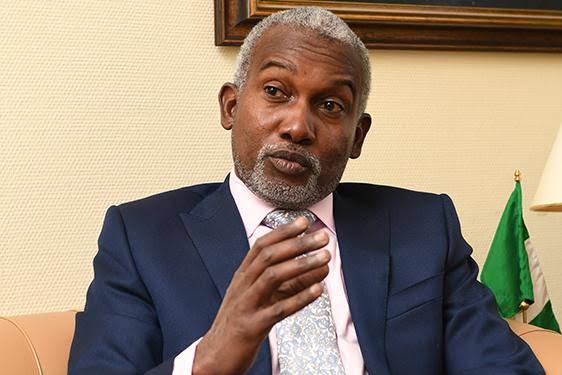
Minister of State for Health and Social Welfare, Dr. Iziaq Adekunle Salako, said the era of fragmented, donor-driven programmes is being replaced with a more coordinated system that aligns government efforts with partner support under a unified national framework.
“In the past, funding streams were fragmented. Now, we are building a coherent system where all actors work under national priorities,” he said.
He said Nigeria’s TB response has recorded significant gains, with case notifications rising from 138,591 in 2020 to 440,000 in 2025—the highest on record.
He attributed the increase to expanded diagnostic capacity, noting that GeneXpert machines grew from 32 in 2012 to 527, while TrueNAT units increased from 39 to 372 within the same period.
Despite a high treatment success rate of 94 per cent, Salako warned that many cases remain undetected.
“While we celebrate these gains, the reality is that thousands of cases are still missed. This calls for sustained innovation and stronger domestic financing,” he said.
On HIV, he said Nigeria is approaching global targets, with 93 per cent of people living with HIV aware of their status, 99 per cent on treatment, and 95 per cent achieving viral suppression.
Describing Lenacapavir as a “transformative advance,” Salako said the injection provides a discreet and convenient prevention option with high efficacy.
“It offers minimal burden while making prevention more accessible and scalable,” he said.
The government also unveiled the MAP-TB digital platform to enhance real-time coordination and accountability in TB response efforts.
The briefing, held with support from development partners including NASCP, NACA, the World Health Organization , United Nations and the Global Fund, highlighted the country’s shift toward a more self-reliant and technology-driven approach to disease control.
The launches underscore the Federal Government’s renewed commitment to strengthening Nigeria’s public health response through innovation, collaboration, and accountability.
With the introduction of Lenacapavir for HIV prevention and the Multisectoral Accountability Framework for TB, stakeholders expressed optimism that these initiatives will accelerate efforts toward ending tuberculosis and reducing new HIV infections in Nigeria.
Author









Leave a comment