











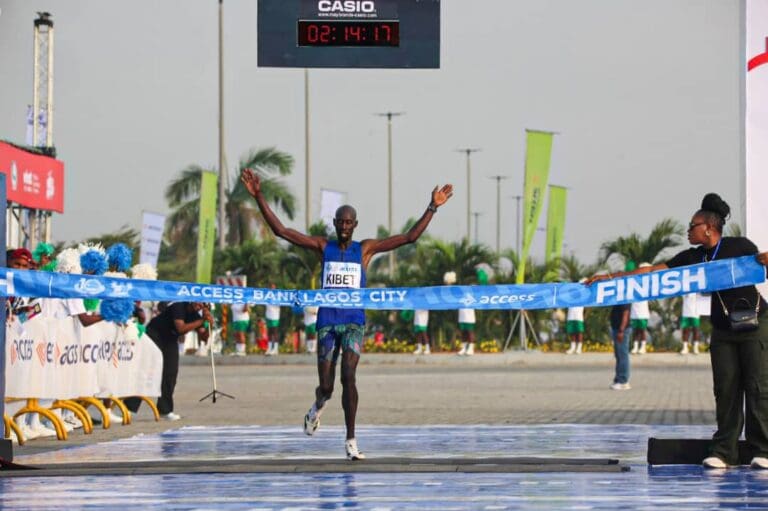



The 11th edition of the Access Bank Lagos City Marathon tells a familiar story – the Kenyan excellence.
By sweeping the podium once again, the East African powerhouse has turned the Lagos streets into a showcase for the Rift Valley’s legendary training culture.
Ezra Kering’s clinical victory in 2:11:55 earned him $50,000 and reinforced a decade-long pattern of dominance.
It is a performance that demands a strategic response from Nigeria, highlighting the urgent need for domestic training environments that mimic the grueling conditions of Kenya’s elite camps.
Launched in 2016, the marathon has evolved into a prestigious event holding World Athletics Gold Label certification, drawing participants and fans to the bustling streets of Lagos.
Its inaugural run on February 6, 2016, saw over 20,000 competitors from various countries converge, setting the stage for what has become a globally acclaimed race.
As the years progressed, the competition has ballooned in scope and allure, attracting more corporate sponsorship, a larger field of entrants, and throngs of onlookers passionate about track and field.
This growth reflects the marathon’s rising status as a key fixture in international athletics calendars.
Kenyan runners have claimed victory in nine out of the eleven editions held so far, highlighting their prowess in endurance events.
The complete roster of men’s champions includes: Abraham Kiptum from Kenya in 2016 with a time of 2 hours and 16 minutes; Kiptum retaining his crown in 2017 while establishing a fresh course benchmark; Abraham Kiprotich of Kenya in 2018 finishing in 2 hours and 13 minutes; Sintayehu Legese from Ethiopia in 2019 at 2 hours, 17 minutes, and 28 seconds; David Barmasai of Kenya in 2020 with 2 hours and 10 minutes.
Others include; Emmanuel Naibei from Kenya in 2021 clocking 2 hours, 15 minutes, and 4 seconds; Ulfata Deresa of Ethiopia in 2022 at 2 hours, 11 minutes, and 54 seconds; Edwin Kibet Koech from Kenya in 2023 with 2 hours and 14 minutes; Bernard Sang of Kenya in 2024 recording 2 hours, 16 minutes, and 49 seconds; Edwin Kibet from Kenya again in 2025 at 2 hours and 14 minutes; and Ezra Kering’s recent Kenyan win in 2026.
Nigeria’s athletics scene has undergone significant transformations, shifting from a leisurely activity during colonial rule among European settlers, to intense rivalries in the independence era where competitors vied for national pride, and now to lucrative professional pursuits that generate substantial revenue.
Achieving consistent top-tier results demands nurturing talent from youth through structured regimens until they reach peak form, a process that requires a well-defined national strategy emphasizing community-level initiatives.
A striking factor in Kenya’s marathon success is the Rift Valley province, which accounts for approximately 73 percent of the nation’s gold and silver medals in premier global long-distance contests.
Many elite Kenyan marathoners reside and prepare in the elevated terrains of the Rift Valley, where the thin air at high altitudes enhances their physiological adaptations, making sea-level races feel comparatively effortless, according to experts like Vincent Onywera.
Iten, Kenya, is the gold standard for marathon training. Perched at 8,000 feet, it is a high-altitude laboratory that consistently produces the world’s fastest runners.
Nigeria’s answer lies in Plateau State. The Jos Plateau offers the same thin air and cool climate that defined the Kenyan success story.
With international bodies like World Athletics already eyeing the region for development, the foundation for a Nigerian athletics revolution is already in place.
If Nigeria prioritizes specialized centers in these “Rift Valley-esque” highlands, the nation can move beyond hosting marathons to winning them.
Developing local talent in Jos is the fastest route to seeing a Nigerian at the top of the podium.
Persecondnews reports that high-altitude training involves athletes living or exercising at elevations typically above 2,000 meters (about 6,500 feet), where the air is thinner due to lower atmospheric pressure, resulting in reduced oxygen availability—a condition known as hypoxia.
This approach leverages the body’s adaptive responses to improve endurance performance, particularly for events at sea level.
The core idea is that by exposing the body to lower oxygen levels, it triggers physiological changes that enhance oxygen uptake and utilization, making athletes more efficient when competing in oxygen-rich environments.
The primary mechanism revolves around the body’s response to hypoxia. When oxygen levels drop, the kidneys release more erythropoietin (EPO), a hormone that stimulates the bone marrow to produce additional red blood cells.
These extra cells increase the blood’s capacity to carry oxygen, improving hemoglobin levels and overall oxygen delivery to muscles.
Athletes often experience an initial drop in performance at altitude due to the increased perceived exertion from hypoxia, which limits oxygen to muscles and can cause fatigue.
After about three or four weeks of breathing thin mountain air, the body undergoes a transformation.
For world-class athletes, this shift translates into a 1–2% gain in endurance, the exact sliver of time that separates a podium finish from the rest of the pack.
This “altitude edge” is a biological hack: it allows for intense aerobic conditioning at slower paces.
By reducing musculoskeletal stress while maximizing cardiovascular output, athletes can train harder for longer without the risk of burnout or impact-related injuries.
Author








Leave a comment