











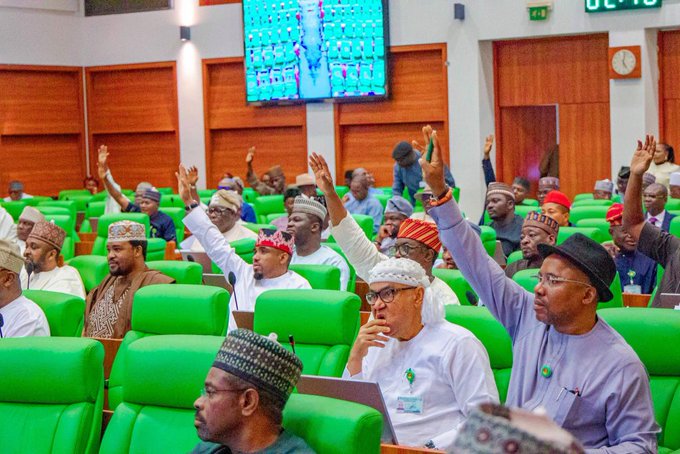



The Senate and the House of Representatives have disagreed over the contentious “real-time” clause in the Electoral Act (Amendment) Bill 2026 already passed by both chambers.
While the Red Chamber endorsed electronic transmission of election results, without including the contentious “real-time” provision, the Representatives had in December 2025 had insisted on electronically transmission of results from each polling unit to the IREV portal in real time.
The Green Chamber had stated: “The Commission shall electronically transmit the results from each polling unit to the IREV portal in real time, and each transmission shall be done simultaneously with the physical collation of results.”
The House also passed Section 60(5), which provides: “The Presiding Officer shall transmit the results, including the number of accredited voters, to the next level of collation.”
Persecondnews had reported that on February 4, approved electronic transmission of results following a public outage but without including “real-time” transmission in a rowdy session.
A conference committee of both chambers will now harmonise the bills before final approval and eventual presentation for presidential assent.
The amendment of Section 60(3), effected yesterday and passed along with other sections read by Senate President Godswill Akpabio, states: “The Presiding Officer shall electronically transmit the results from each polling unit to the INEC Result Viewing Portal, and such transmission shall be done after the prescribed Form EC8A has been signed and stamped by the Presiding Officer and countersigned by the candidates or polling agents where available at the polling unit.
“But if the electronic transmission of the result fails as a result of communication failure, and it becomes impossible to transmit the result electronically, the signed and stamped Form EC8A by the Presiding Officer, and countersigned by the candidates or polling agents where available, shall in such a case be the primary source of collation and declaration of results.”
The Electoral Act 2022, under which the 2023 elections were conducted and which is in the process of being repealed, states in part under Section 60(5): “The Presiding Officer shall transfer the result, including the total number of accredited voters and the result of the ballot, in a manner as prescribed by the Commission.”
Before senators began proceedings yesterday, protesters, for the second consecutive day, gathered in front of the National Assembly to call for the passage of real-time electronic transmission of election results.
Among the protesters was the former Governor of Rivers State and immediate past Minister of Transportation, Chibuike Amaechi.
The police prevented the protesters from gaining access to the National Assembly complex.
The modification followed the approval of a motion by the Senate Chief Whip, Mohammed Tahir Monguno (Borno North), titled: “Motion for Rescission on Clause 60(3) of the Electoral Act, 2022 (Repeal and Enactment) Bill, 2026.”
Moving the motion, Monguno recalled that the bill had been passed by the Senate on February 4 but said “fresh issues have emerged in respect of Clause 60(3), which require further legislative consideration to ensure the conduct of smooth, transparent and credible elections in Nigeria.”
Invoking Orders 1(b) and 52(6) of the Senate Standing Orders, 2023 (as amended), he urged the chamber to rescind its earlier decision on the clause and recommit it to the Committee of the Whole for reconsideration and passage.
Trouble began when Monguno rose to move the motion while the Senate President was reading out the rules on Votes and Proceedings.
His action triggered confusion, with many senators questioning whether the Senate could revisit a decision already taken within the same legislative session.
Some senators argued that Order 1(b) empowered the Senate to suspend normal procedure.
Following a voice vote, the chamber agreed to allow Monguno to proceed.
Monguno said ambiguity surrounding the earlier amendment, particularly the controversy over the use of the words “transfer” and “transmission” of election results, had generated public concern and required urgent legislative clarification.
He proposed a fresh amendment stipulating that presiding officers at polling units must electronically transmit results to the INEC Result Viewing Portal (IREV) after completing and signing Form EC8A.
He added that where electronic transmission fails due to communication challenges, the signed and stamped Form EC8A would serve as the primary source for collation and declaration of results.
After the motion was seconded by Senator Abba Moro, who described the development as “a victory for democracy,” the chamber descended into disorder when the Senate President declared that the voice vote had carried the amendment.
Several senators protested and invoked Order 72, which allows any senator to challenge the opinion of the presiding officer by calling for a division.
Citing Order 72, Senator Enyinnaya Abaribe demanded individual voting, triggering loud protests, shouts of points of order, and repeated calls to order by Akpabio.
At the height of the confusion, Abaribe withdrew his request for a division, a move that further unsettled the chamber.
Akpabio ruled that Abaribe’s withdrawal stood, thereby upholding the voice vote that carried the amendment.
Following the approval of the revised clause, the Senate adopted the Votes and Proceedings of the previous sitting, bringing the stormy session to a close.
Meanwhile, former Vice President Atiku Abubakar, who spoke in Minna, the capital of Niger State on Tuesday, said electronic transmission of results would restore sanity and avert chaos.
However, he expressed doubts about the ability of the proposed law to guarantee real-time transmission.
Atiku said: “This is below the expectations of Nigerians. During the last elections, Nigerians were expecting real-time electronic transmission of election results at various levels of the election, but what we got was a mixture of electronic and manual uploading, which caused more confusion and chaos.
“It will be best if we have a single-tier electronic transmission, which is real-time electronic transmission, which is the preference of all Nigerians.”
The African Democratic Congress (ADC) stalwart urged opposition political parties to reject the Senate’s decision to allow manual uploading of election results.
He said: “We need all opposition political parties to pursue this issue. We should not allow it to rest the way they wanted it to rest today at the Senate.”
On its part, the African Democratic Party (ADP) warned of likely public distrust of the electoral process if electronic transmission is not upheld.
The party’s National Chairman, Yabagi Sani, said in a statement that “while the Senate’s reversal of its earlier rejection of electronic transmission reflects public pressure and democratic expectation, the ADP notes that a reform that does not guarantee mandatory, real-time transmission cannot restore electoral credibility.”
The ADC National Publicity Secretary, Bolaji Abdullahi, described the Senate’s modified position as a victory for the resilience, vigilance and rising political consciousness of Nigerians.
He said in a statement: “It demonstrates, in the clearest possible terms, that when citizens act with unity, clarity of purpose and resolve, they can indeed move mountains.”
The ADC credited Nigerians’ coordinated civic actions, noting: “From the street protests to the digital campaigns, the Nigerian people have once again shown that sovereignty truly belongs to them.”
Hailing the protesters, Abdullahi added: “We salute the courage and tenacity of Nigerians. We commend every citizen who raised a voice, whether online or offline, to resist legislative mischief that threatened to undermine our electoral integrity.”
Also reacting, a former President of the Nigerian Bar Association (NBA), Dr Olisa Agbakoba (SAN), said the adoption of real-time upload of results would engender public trust and close electoral loopholes.
He said the regulatory process must be adequately backed by law.
Agbakoba noted in a statement that the 2023 election exposed a critical gap in the electoral legal framework, recalling that despite INEC’s deployment of the IREV portal for electronic transmission of results, the Supreme Court ruled that the innovation lacked legal force.
The human rights lawyer explained that the IREV portal currently serves only for public viewing and is not admissible as evidence of results in election petitions.
He said: “The message was unmistakable: without explicit statutory provision, electronic transmission remains optional and legally inconsequential, no matter how transparent or efficient it may be.
“This legal gap creates an insurmountable evidentiary burden in election petitions.”
The Tanimu Turaki-led faction of the PDP rejected the Senate’s position on transmission of election results, describing the senators as “clever by half.”
The party’s National Publicity Secretary, Comrade Ini Ememobong, said in a statement that the addendum introduced by the Senate to allow manual transmission was a backdoor attempt to achieve the same objective as the earlier rejection.
The statement reads in part: “We have taken note of the outcome of the Senate’s reconsideration of its earlier position on the real-time electronic transmission of election results, wherein an addendum was introduced to permit manual transmission where technology is said to fail.
“We hold the firm view that this addendum is nothing more than a backdoor attempt to achieve the same objective as the earlier outright rejection, while pretending to align with the wishes of the Nigerian people.
“Manual transmission is already sufficiently provided for under the Electoral Act. The current agitation for electronic transmission is aimed at introducing a second-layer authentication mechanism that prevents the alteration of results en route to collation centres, a malpractice that has historically been the bane of Nigeria’s electoral process.
“Furthermore, it is inconceivable that the same BVAS technology, which successfully undertakes accreditation throughout an election, would suddenly become unreliable for the transmission of results and accreditation data arising from that same exercise.
“This caveat is a clear indication of the humongous fear being harboured by senators opposed to electronic transmission, particularly Senate President Godswill Akpabio, whom we reasonably suspect remains haunted by the ghost of his 2019 election loss, occasioned by the deployment of technology to curb over-voting.
“They must be reminded that Nigeria is bigger than their narrow personal and political interests.
“We therefore urge members of the Conference Committee to adopt the version of the bill passed by the House of Representatives as the harmonised position, if indeed they are committed to delivering credible elections in 2027.
“They must rise above the instincts of politicians fixated on the next election and instead focus on the sustenance of democracy and the protection of future generations.
“Should this democracy fail, the names of Senator Akpabio and all senators who voted against electronic transmission will undoubtedly occupy a conspicuous chapter in the book of infamy.
“We also call on Nigerians to remain resolute in their demand for real-time electronic transmission of election results. This is no time for excuses. This hard-won democracy is far too valuable to be left in the hands of politicians alone.”
Author











Leave a comment