










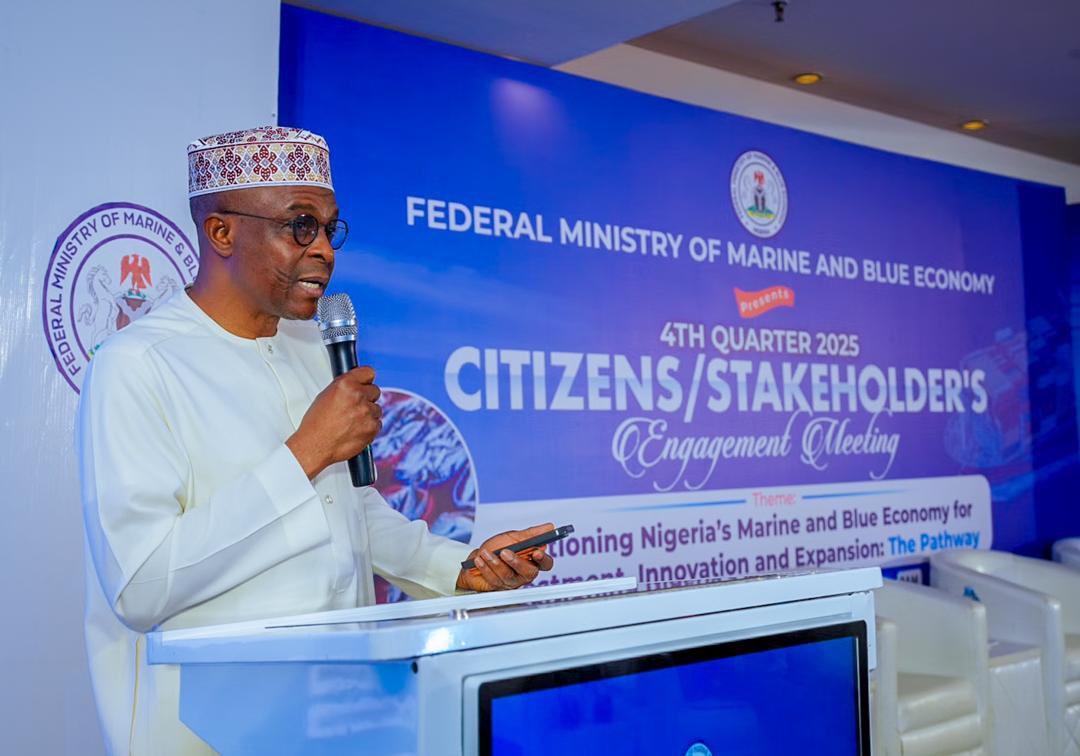



The Nigerian Ports Authority (NPA) is gearing up for a major transformation, with plans to revolutionize the country’s maritime sector through investment, innovation, and expansion.
This was disclosed at a Citizens’ Engagement Meeting in Abuja on Thursday, where NPA Managing Director Dr. Abubakar Dantsoho and Minister of Marine & Blue Economy Dr. Gboyega Oyetola discussed the future of Nigeria’s blue economy.
The meeting highlighted the importance of Public-Private Partnerships (PPPs) in driving sustainable development in the maritime sector.
Stakeholders emphasized the need for a comprehensive approach to governance, and the Minister committed to addressing identified gaps and opportunities.

Dr. Dantsoho shared insights into Nigeria’s port modernization project and automation strategy, aimed at improving maritime transport and infrastructure.
The NPA has already made significant strides in port development, with a $1 billion port rehabilitation and modernization project underway.
The project includes the reconstruction of key ports, upgrade of equipment, and implementation of a Port Community System (PCS) to automate cargo handling and simplify processes.
The PCS is expected to be launched by early 2026.
The idea of Port Community Systems dates back to the late 1970s in Europe, when major seaports such as Hamburg, Rotterdam, and Marseilles sought to digitise port processes to improve cargo throughput and reduce administrative bottlenecks.
The economic benefits of a fully functional PCS are extensive and align directly with the goals of the Renewed Hope Agenda and the Blue Economy framework under the current administration.

The following outlines the potential economic and strategic gains of the system in Nigeria.
Trade Facilitation and Cost Reduction: Streamlined documentation and real-time data exchange reduce vessel turnaround time, demurrage, and port storage costs – saving millions of dollars annually and boosting Nigeria’s competitiveness as a logistics hub in West and Central Africa.
Revenue Growth and Data Integrity: With automated tracking of port transactions, the PCS minimises revenue leakages, enhances transparency in duty collection, and provides reliable trade data for national planning and policy formulation.
Under this national framework, the PCS will serve as a centralised, collaborative digital platform connecting all actors involved in port and trade operations – from ship arrival and cargo handling to customs clearance and final delivery.
It will enable real-time data exchange, automate documentation processes, and serve as a bridge to the National Single Window (NSW) platform, which will eventually integrate other modes of transport, including aviation and rail logistics.
Author












Leave a comment