







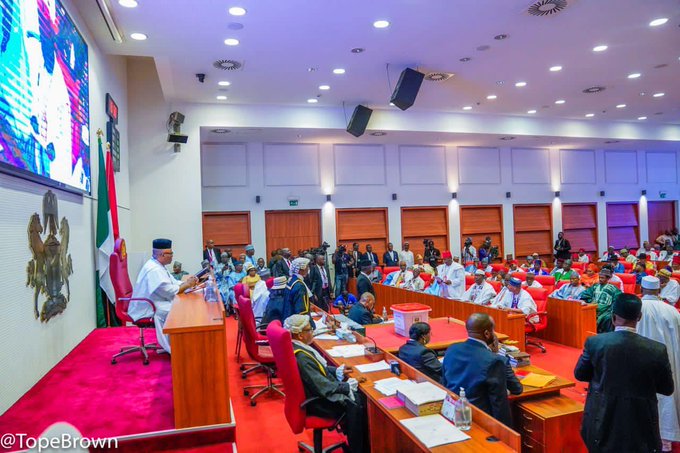



Following a motion on the “Urgent Need to Address Escalating Insecurity in Kwara, Kebbi and Niger States,” the Nigerian Senate called for immediate, comprehensive federal intervention.
To deter escalating crime, the Senate demanded the implementation of the death penalty for kidnappers and a review of Nigeria’s firearms laws to empower citizens against criminal networks, noting that over 175 countries have similar laws.
The motion, moved by Sen. Lola Ashiru (Kwara South), highlighted a pattern of attacks, including the tragic November 18 raid on a Christ Apostolic Church in Eruku, Kwara, which resulted in two deaths and 38 abductions.
While security operations have successfully secured the release of the Eruku abductees, along with 51 students in Niger State, the mass abductions have had severe consequences: senators noted that school closures have been enforced across five local government areas in Kwara, in Niger and Kebbi States, and in all 47 Federal Unity Schools across the country.
“We must act decisively to protect children, worshippers, and rural communities from further trauma,” said Deputy Senate Leader Lola Ashiru, sponsor of the motion.
The Senate called for an urgent probe into the reported withdrawal of military personnel from Government Girls Secondary School, Maga, Kebbi, which preceded a kidnapping.
Senators warned that sophisticated criminal networks are exploiting forest corridors across Kwara–Kogi, Kebbi–Zamfara, and Niger’s Shiroro–Rafi–Munya regions with the help of internal collaborators.
Sen. Sani Musa expressed skepticism over the recent release of 58 abductees without resistance, suggesting ransom might have been involved.
Musa criticized the National Security Adviser’s office and the Ministry of Communications, stating they should be able to locate and arrest terrorists who use communication gadgets, as defeating them requires modern technology.
He also demanded the identification of those negotiating ransoms, noting they must know the criminals’ whereabouts.
Meanwhile, Sen. Eyinnaya Abaribe has accused the government of not being truthful about the security situation.
He revealed that communities in numerous local governments in Katsina, Zamfara, and other northern states are being forced to pay “taxes” to terrorists and bandits for their own safety.
“If I were the Commander-in-Chief, I would call for the head of the commander who ordered the withdrawal of troops from the Kebbi school shortly before the terrorists arrived,” Abaribe said.
Sen. Abdul Ningi noted that kidnapping has become somewhat a more “lucrative business” than oil and politics, even as he charged the government to be more proactive in responding to the mounting challenges.
On his part, Kwara senator Sadiq Umar, said the work against terrorism cannot be won if collaborators are not arrested and prosecuted.
Declaring that the country is at war, Umar said there are gaps in the operational method of the troops while calling for more investment in security.
The Senate called for an amendment to the Firearms Act to allow “responsible bear arms for self-defence,” noting that the practice is obtainable in about 175 countries of the world.
It was also observed that the nation’s armed forces are being overstretched, citing a country like Egypt with bigger numerical strength than Nigeria, despite its lower population.
Providing a detailed breakdown, Borno South Senator Ali Ndume highlighted Nigeria’s severe security manpower deficit by comparing it to Egypt.
Ndume noted that Egypt, with a population of about 100 million, maintains a one-million-man army, 500,000 police personnel, and 800,000 persons in reserve.
In sharp contrast, he stated that the Nigerian Army, despite conducting operations in 32 states, has less than 200,000 officers and men, while the Nigeria Police Force has only about 400,000.
However, Benue Senator Titus Zam shifted the focus to political will, lamenting that bandits have displaced farmers and taken over many communities in his state. Zam declared: “The military knows where the terrorists are. They know their locations. [But] there have never been determined efforts to rout them out.”
Kebbi Senator Yahaya Abdullahi agreed, urging immediate action: “We know who they are, where they are, the routes they follow, so we must pursue and eliminate them… We are shutting down schools; what do we tell the world? That bandits have forced the Nigerian government to shut down schools. We should go after them and eliminate them.”
In closing remarks, Deputy Senate President Barau Jibrin stressed the need for collective action, saying, “No state can tackle this alone. We must harness technology, deploy drones, and enhance surveillance alongside our security agencies.”
Senate Majority Leader Opeyemi Bamidele added: “All hands must be on deck. This is not the time to grandstand,” while Minority Leader Abba Moro warned of the spreading insecurity.
Former Senate President Ahmad Lawan described the crisis as akin to a war and called for full support for President Bola Tinubu.
Author








Leave a comment