











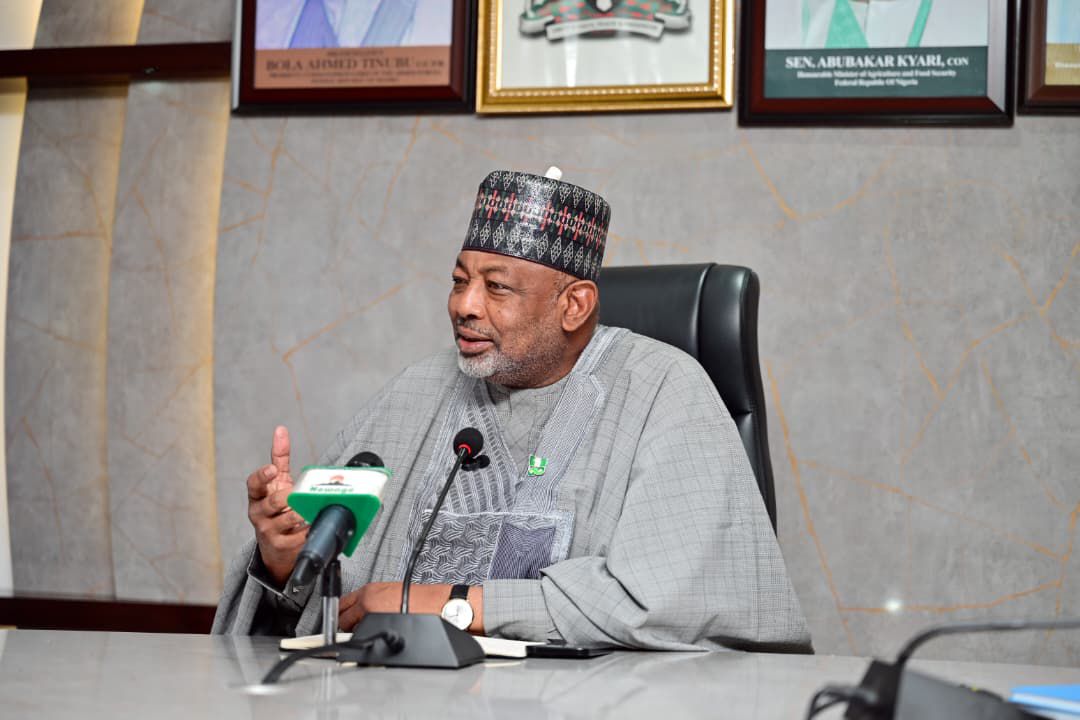




The 2025 Agricultural Performance Survey report has revealed a notable decline in food prices and an improvement in crop production across Nigeria.
According to the Minister of Agriculture and Food Security, Sen. Abubakar Kyari in a statement on Wednesday, the report confirms steady growth in the production of major staples such as rice, maize, sorghum, millet, cowpea, yam, and cassava, all showing increases over 2024 levels.
“The report confirms steady growth in the production of major staples such as rice, maize, sorghum, millet, cowpea, yam, and cassava, all of which show increases over 2024 levels,” Kyari said.
He attributed the progress and significant drop in food prices across all zones to improved supply conditions and the cumulative effect of government interventions in input support, extension service delivery, and mechanization.
Despite the positive trends, Kyari cautioned that rising input costs and weak postharvest infrastructure remained key obstacles.
“Rising input costs, particularly for fertiliser and fuel, continue to limit productivity among smallholders,” he noted.
Mechanisation coverage, though improving, remains uneven, and postharvest losses, especially in the South-West and North-Central zones, pose serious threats to food availability and farmers’ income.
The survey also highlighted challenges in the livestock and fisheries sectors, with Kyari pointing to the need for stronger animal health systems, aquaculture development, and adaptive measures in response to climate variability.
“The survey’s documentation of livestock disease outbreaks and fisheries decline in certain regions underscores the need for stronger animal health systems, aquaculture development, and adaptive measures in response to climate variability,” he said.
To address these challenges, the Ministry plans to institutionalise a Dry Season Agricultural Performance Survey, intensify support for local fertiliser production, enhance climate-smart agricultural initiatives, and strengthen extension systems.
Kyari stressed the necessity of empowering young people and women in the agricultural sector, specifically through technology and infrastructure.
He stated: “Equally, we recognise the urgency of modernising mechanisation services, promoting the inclusion of youth and women through affordable, labour-saving technologies, and investing in postharvest handling, storage and processing facilities to minimise losses and boost value addition.”
To ensure sustained progress, the Minister pledged deeper collaboration with private sector entities, research institutions, and subnational governments.
Furthermore, he reiterated that the Agricultural Performance Survey is a vital national knowledge asset whose continuity and integrity require the collective effort of all stakeholders.
“Let us continue to strengthen this vital knowledge system that guides Nigeria’s journey towards sustainable food and nutrition security.”
Author













Leave a comment