













The Central Bank of Nigeria (CBN) has retained its benchmark interest rate, the Monetary Policy Rate (MPR), at 27.5 percent, citing underlying pressure on prices of goods and services and continued global uncertainties.
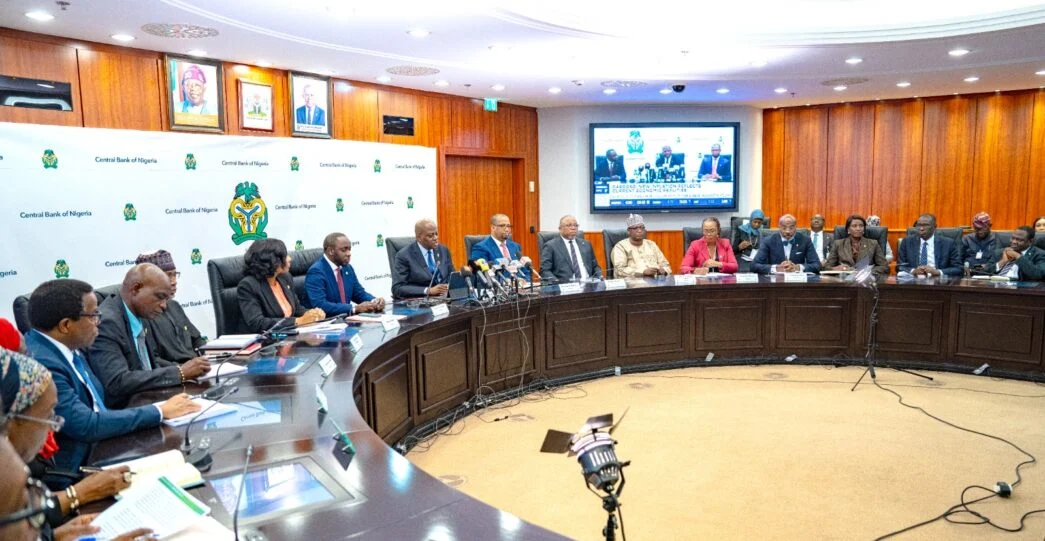
CBN Governor Olayemi Cardoso announced the decision after the 301st Monetary Policy Committee (MPC) meeting in Abuja on Tuesday.
The apex bank also disclosed that eight banks have so far met the new minimum capital requirements.
The CBN Governor explained that the decision to maintain the current MPR was premised on the need to continue ensuring ongoing disinflation while vigorously ensuring declining prices.
“The committee decided to maintain the current monetary policy stance and hold all policy parameters constant,” he said.
The MPC will continue to undertake rigorous assessments of economic conditions, price development, and outlook to inform future policy decisions.
As a result of the decision, the asymmetric corridor around the MPR was retained at +500/-100 basis points, while the Cash Reserve Ratio (CRR) was retained at 50 percent for Deposit Money Banks and 16 percent for Merchant Banks.
The Liquidity Ratio was also retained at 30 percent for all banks. Cardoso noted that the decision was aimed at sustaining the momentum of disinflation and sufficiently containing price pressures.
The CBN chief revealed that the nation’s Foreign Reserves stood at $40.1 billion as of July 18, which could provide import cover for nine and a half months.
He also disclosed that eight banks have achieved the new recapitalization requirements, while others are making progress toward meeting the deadline.
The Committee urged the management of the bank to sustain its oversight of the banking system to ensure continued resilience, safety, and soundness of the financial system.
The MPC noted the sustained stability in the foreign exchange market, accentuated by improved capital flows, earnings from increased crude oil.
Real GDP in the first quarter of 2025 grew by 3.13 percent, compared with 2.27 percent and 3.38 percent in the corresponding and preceding quarters of 2024, respectively.
The CBN Governor further added that available projections suggest that global output recovery continues at a gradual pace.
However, recent developments, especially the persistent tariff war and the geopolitical tensions, may continue to disrupt supply chains and exert upward pressure on the price of imports.
Author










Leave a comment