











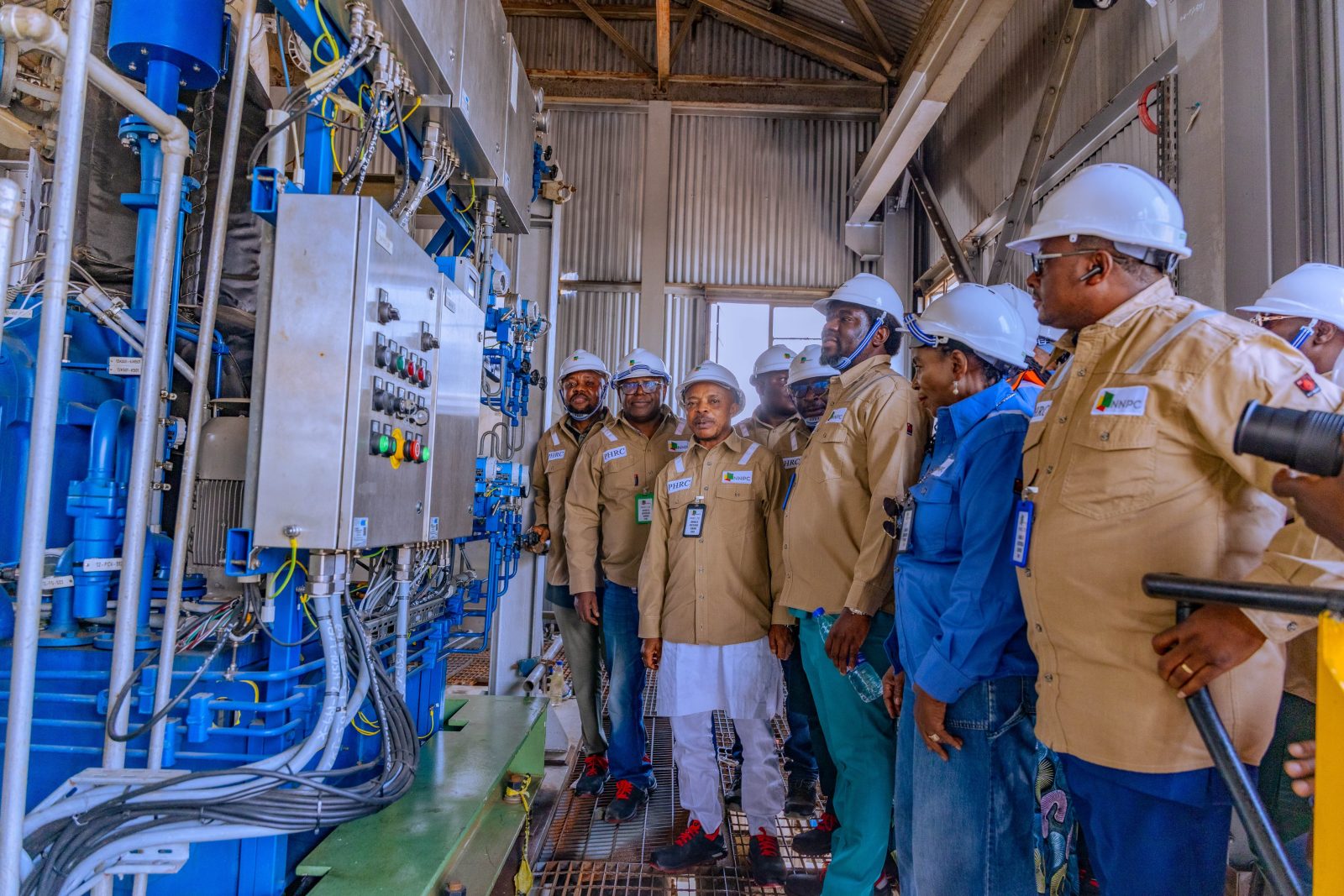



A recent fact-finding visit by labour leaders has dispelled the uncertainties surrounding the operational status of the newly revived old Port Harcourt Refinery, with a capacity of 60,000 barrels per day.
The unions have confirmed that the refinery is running efficiently and have called on the Federal Government to ensure the facility remains operational and does not fall into disuse again.
If there was any significant take-away from the facility tour of the Port Harcourt refinery complex by the leadership of the country’s major labour unions, it is the crushing, like a pack of cards, the rumours that the refinery was not operating after the Nigerian National Petroleum Company Limited reopened it.
The Nigeria Labour Congress, Trade Union Congress, Petroleum and Natural Gas Senior Staff Association of Nigeria, and Nigeria Union of Petroleum and Natural Gas Workers had during the week visited the refinery amid the controversy surrounding its full operability.
The Port Harcourt Refinery in Eleme comprises two facilities: the old refinery, with a 60,000-barrel-per-day capacity, and the new refinery, capable of refining 150,000 barrels per day. The old refinery, operational since 1965, is Nigeria’s first refinery and had remained idle since 1990 when the newer unit became the primary production hub.
The refinery has a unique configuration where one barrel of crude oil yields a maximum of 23–24 per cent gasoline.
After over 30 years of dormancy, the old Port Harcourt refinery resumed operations, on Tuesday, 26 November, 2024. This became possible following the Federal Government’s approval, in 2021, of $1.5 billion for the comprehensive rehabilitation of the refinery and the sound leadership of the NNPCL’s Group Chief Executive Officer (GCEO), Mele Kyari.
By December 2023, the NNPC had completed the mechanical phase of the refinery’s turnaround maintenance and by November this year, returned it to active operations.
The old refinery currently produces straight-run gasoline (Naphtha) blended into 1.4 million liters of PMS daily; 900,000 liters of kerosene; 1.5 million liters of Automotive Gas Oil (Diesel); 2.1 million liters of Low Pour Fuel Oil (LPFO), and additional volumes of Liquefied Petroleum Gas (LPG), also known as cooking gas.
NNPC Ltd GCEO, Mr Kyari, described the achievement as “monumental” and a turning point for Nigeria’s energy sector.
Despite widespread acclaim, scepticism lingers on social media, with some critics alleging that the refinery operates as a blending facility rather than a crude oil processing plant.
But Mr Kyari, the NNPC boss, countered the naysayers insisting that the refinery is up and running, with loading operations in full swing.
Olufemi Soneye, NNPCL’s Chief Corporate Communications Officer, had quoted Mr Kyari as inviting all those in doubt to “join the NNPC Ltd. on a tour of the refineries in Port Harcourt, Warri, and Kaduna to verify their status.”
He also dismissed the mischievous noise about blending, saying, “If you don’t blend, you will bring out off-spec products which will destroy your vehicles. Every refinery blends because what is on the specification in the United States of America will be off-spec in Nigeria and elsewhere. Blending is necessary to bring products to the specification of different countries or regions.”
Labour leaders under the auspices of the NLC, TUC, PENGASSAN and NUPENG confirmed that the old refinery is operational after a tour of the facility to assess its operations.
President of the NLC, Joe Ajaero, said, “When there was an increase in the pump price of petroleum products, part of the agreement we had with the Federal Government was that this refinery must work. And now that it is working, it is our duty to come here to confirm that it is working. We also confirm that the new one, which is under rehabilitation, is almost completed. “
In a similar vein, the President of the Trade Union Congress, Festus Osifo, explained that the labour unions were on a fact-finding mission to ascertain that the refinery was working.
“Going through the plants, we were shown the various processing units – burners, heat exchangers, compressors, turbines – and how these units tie into the production of petroleum products. To a very large extent, we are satisfied with what we have seen – the level of work and details that went into the rehabilitation,” Mr Osifo, who doubles as the President of PENGASSAN, said.
President of NUPENG, Williams Akporeha, said, “They took us round to reconfirm what we already know as an insider. Before I came here, I knew the refinery was working.”
The labour leaders also warned against the privatisation of the refinery, calling for the adoption of the NLNG model whereby the Federal Government and International Oil Companies will jointly manage the facility.
“Having gone and seen the massive investment that was made here, I believe that selling this refinery to some individuals will not serve the interest of Nigerians. The NLNG model should be adopted in running this refinery and not on outright sale,” Mr Akporeha, the NUPENG president, added.
The labour leaders urged the government to put measures in place for regular turnaround maintenance of the refinery.
President of the Nigeria Society of Chemical Engineers, Tony Ogbuigwe, in an interview with Arise TV, had affirmed that the refinery was indeed operational based on intelligence from engineers on site.
Meanwhile, the NNPC Ltd has confirmed that the ongoing repair of the new 150,000-barrel-per-day Port Harcourt Refining Company has reached over 90 per cent completion rate.
NNPC Ltd’s Group Executive Vice President, Downstream, Isiyaku Abdullahi, while conducting the labour leaders around the facility, said the latest report received from the contractor showed that over 90 per cent of rehabilitation work had been completed.
He said, “This asset is under rehabilitation or an upgrade. There is an established process so that when the rehabilitation is completed, it will start running and it’s a state of art compared to any refinery in the world.
“From the contractors’ view, and from the report they sent to us, the refinery is over 90 per cent completed and will be finished as soon as possible. We are following through and ensuring that we get value for money. And then we can combine 60,000 barrels making it a total of 210,000 barrels. This would support our refining processes and products with the multiple effects that we would get from refining products. And then we can have sufficient products and then export them to other countries.”
The refinery’s Managing Director, Ibrahim Onoja, said, “This is the new Port Harcourt refinery, a 150,000-barrel-per-day plant commissioned in 1989. The rehabilitation work is ongoing in this new Port Harcourt refinery at the same time we were working on the old Port Harcourt refinery. The old one is completed and the plant is running. You can see the new Port Harcourt refinery is at an advanced stage but importantly size matters.”
The blending controversy being peddled against the old Port Harcourt refinery had been roundly condemned by experts, who considered the sinister development as an attempt to de-market the refinery and downplay NNPCL’s achievement in this regard.
Light Shedrach, an energy analyst in a recent interview with TVC, reasoned that the Port Harcourt refinery demonstrated what was possible when strategic planning met commitment, and clarified that blending is a standard practice globally done to meet product specifications.
Bode Sowomi, a gas consultant and Chairman of the Energy Transition Study Group of the Nigerian Gas Association, during an interview on Channels TV, explained that refining was a delicate process rooted in the principles of fractional distillation.
“This is basic chemistry,” he said. ”Crude oil is refined through a series of steps where different components are distilled at varying temperatures, each serving a unique purpose. Diesel, kerosene, and naphtha are among the key products derived through this process, with each component having a distinct boiling point that allows for their separation.”
“Blending is not a criminal activity but a standard global practice in petroleum refining. It is simply the process of mixing different crude oil components to produce a product that meets specific specifications,” he added.
He explained that blending is an essential step to achieving refined products with consistent quality and performance. “Blending is not a problem, it’s a solution,” he remarked.
While the controversy surrounding the Port Harcourt is fast fizzling out, the NNPCL appears unperturbed and insists on the resolution to rehabilitate the Warri and Kaduna refineries and bolster the nation’s energy security while dismantling monopolistic tendencies by some industry operators.
Author








Leave a comment