









“It is the responsibility of the government to monitor broadcast content even on the internet”
A move by the Federal Government to control internet content through a legislation by the National Assembly has drawn a great deal of flak from Nigerians and stakeholders.
The move is sequel to a recent suspension of Twitter operations in the country after it deleted President Muhammadu Buhari’s tweet on Nigerian Civil War, Persecondnews recalls.
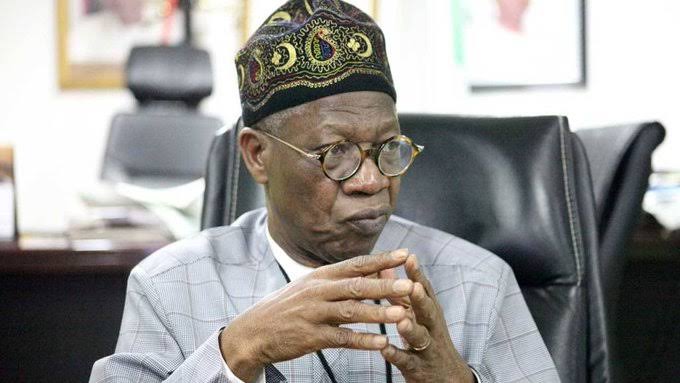
Information and Culture Minister Lai Mohammed, has appealed to the National Assembly to legislate on granting the federal government powers to regulate internet content.
The minister said this at a public hearing on a bill to amend the National Broadcasting Act organised by the House Committee on Information, National Orientation, Ethics and Values.
According to him, it is the responsibility of the government to monitor broadcast content even on the internet.
Mohammed urged the lawmakers to amend the existing NBC law to include that it had power to regulate internet broadcast and all online media broadcast in the country.
He listed the categories of licences to be granted by the NBC which include cable television services, direct satellite broadcast, direct to home, IPTV Radio, EPG and digital terrestrial television, radio and television stations owned, established or operated by the federal, state and local governments; broadcast signal distribution; online broadcast, community broadcasting and public service broadcasting.
He said internet broadcasting and online media should be included in the list.
“I want to add here specifically that internet broadcasting and all online media should be included in this. This is because we have the responsibility to monitor content, including Twitter,” Mohammed said.
Irked by the latest move to obstruct or close the media and civic space, stakeholders in the nation’s media industry said it would amount to strangling media business particularly broadcast and online media.
Reacting, the Broadcasting Organisation of Nigeria (BON), International Press Centre (IPC) and other stakeholders were unanimous that some provisions of the bill would grant sweeping powers to the NBC which might hurt the industry.
Stakeholders have also rejected moves to empower the National Broadcasting Commission (NBC) to regulate tariffs charged by Pay TV operators.
They want the National Assembly to whittle down the powers of the NBC to unilaterally sanction broadcast stations, just as they demanded that the proviso of 30 days’ notice before the NBC can be sued to court (on actions it had taken) should be expunged from the proposed amendment.
BON in its presentation at the public hearing urged the lawmakers to expunge a provision which states that before NBC can be sued to any court, a 30-day notice must be issued to the commission.
BON’s legal representative, Ayo Ogundele, noted that the 30-day notice expected to be issued in the proposed amendment was enough to kill the business of broadcasting.
Ogundele suggested that the process of revoking a broadcasting license by the NBC should rather be subjected to legal intervention.
According to him, it will protect licensees from arbitrary revocation and further ensure stability in the industry.
BON further canvassed that the penalty for a delay in the renewal of the licence should only attract a fine in monetary terms and not revocation of the licence.
“We submit that the 30 days’ caveat should be removed and the law should allow direct legal access to sue NBC in courts.
“Also, we will like to suggest that the process of revocation should be subjected to legal intervention through a judicial process,” he said.
Also, the Executive Director of the International Press Centre (IPC), Lagos, Mr Lanre Arogundade, in his presentation, corroborated the position canvassed by BON, sayi the NBC, as currently constituted, “operates as an institution that is an island onto itself.”
“As it suits the whim and caprice of its director-general, it decides that an offence has been committed, decides on the punishment and goes ahead to apply the sanctions, which sometimes includes the shutdown of broadcast stations.
“In other words, NBC is often the accuser, the prosecutor and the judge in its case,” he said.
Arogundade also noted that allowing the NBC to regulate the tariff of Pay TV services represents a usurpation of the powers of the Federal Competition and Consumer Protection Commission Act (FCCPC Act).
The IPC scribe explained that giving NBC the sole right over tariff issues could be interpreted as an ouster clause that arrogates to it arbitrary powers that cannot be challenged even in the court of law.
According to him, FCCPC already had adequate provisions to deal with the often contentious issue of competition and pricing in Nigeria.
“The FCCPC is indeed more technically equipped to handle the kind of matters being dabbled into here, being a specialised agency established for specific purposes.
“Fixing tariffs arbitrarily could lead to excessive pricing that has the potential of discouraging investment in the sector and the attendant job losses,” he said.
He, however, suggested that the NBC Act should provide for the right of appeal to the Board of the NBC where sanctions are applicable for alleged breaches.
“The NBC should play an administrative role when it comes to the matter of alleged breach of the code and imposition of sanctions.
“The NBC Act should only mandate the director general to refer such to the board,” Arogundade, a former Chairman of Nigeria Union of Journalists (NUJ), Lagos State Council, stressed.
In its own reaction, the Newspaper Proprietors’ Association of Nigeria (NPAN) has cried foul, saying its exclusion from the public hearing on the Nigerian Press Council (NPC) Amendment Bill by the House of Representatives Committee on Information, National Orientation, Ethics and Values is suspect.
In a statement signed by its President, Kabiru Yusuf, expressed shock for excluding the organization from the public hearing scheduled for Thursday (June 17).
He urged the leadership of the National Assembly, particularly the House of Representatives to redress the anormaly.
“With the public hearing now delayed by a day, the NPAN will endeavour to attend even without a formal invitation.”
The association also enjoined all media workers, and their organisations, to pay attention to the public hearing which may have important consequences on the freedom of the press in particular and good governance in general.
“As a stakeholder in the Nigerian media space, we don’t understand why print media owners have not been invited to participate in the hearing.
“This is contrary to earlier practice when NPAN was invited to a public hearing on the same bill in the last Senate.
“This time around, we find it strange that we would get to know of this development by sheer happenstance,” he said.
Author





Leave a comment