








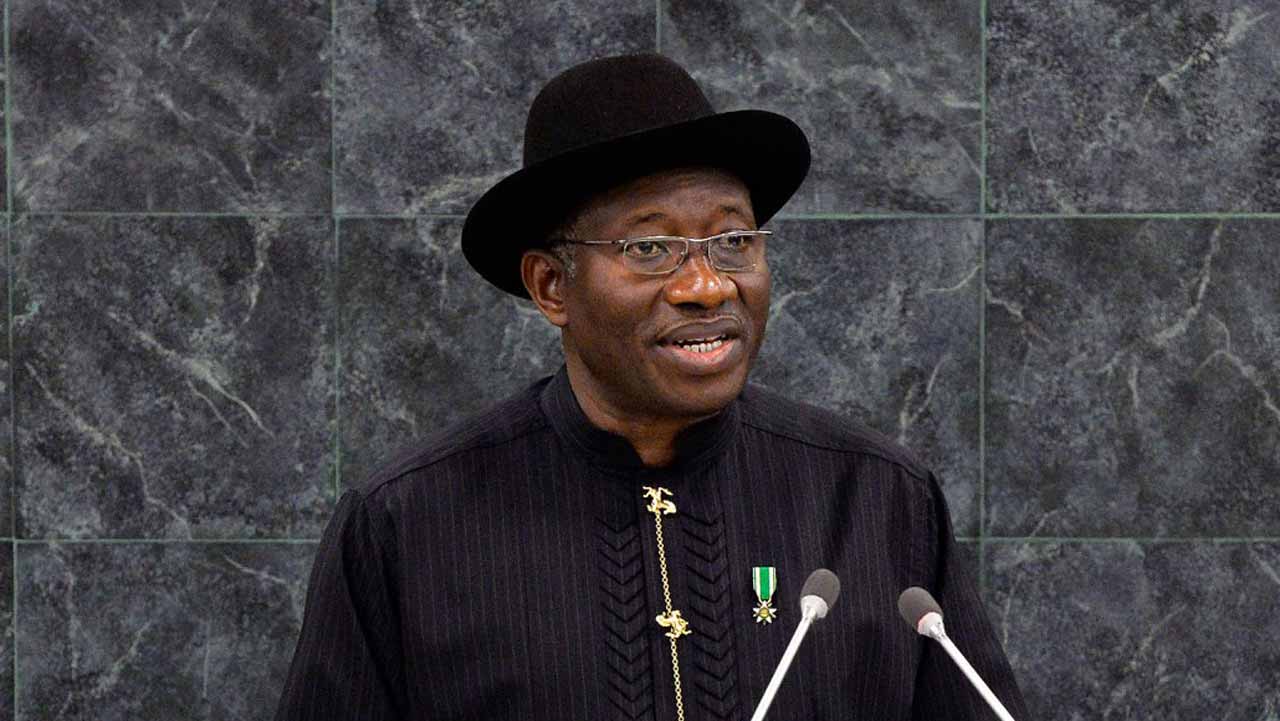



Former President Goodluck Jonathan, reflecting on the 11-year-old national trauma of the Chibok girls’ abduction, has revealed a surprising detail: the role played by Muhammadu Buhari in the rescue efforts.
At the book launch for “Scars,” written by former Chief of Defence Staff, Gen. Lucky Irabor in Abuja on Friday, Jonathan acknowledged that his administration struggled to contain the insurgency that overshadowed his tenure.
He recounted that the terrorists, when approached about surrendering, specifically named Buhari as the individual they wished to negotiate with.
Jonathan confessed that this request prompted him to speculate that the Boko Haram crisis would resolve itself once Buhari became president.
He said: “One of the committees we set up then, the Boko Haram nominated Buhari to lead their team to negotiate with the government.
“So I was feeling that, oh, if they nominated Buhari to represent them and have a discussion with the government committee, then when Buhari took over, it could have been an easy way to negotiate with them and they would have handed over their guns.”
Jonathan noted that the inability of Buhari to eradicate Boko Haram terrorists showed that the crisis was more complex than often portrayed.
He said: “If you conduct research and interview many people, you will only get part of the story but never the full story of Boko Haram. I was there.
“Boko Haram started in 2009 when I was vice president. I took over in 2010 and spent five years battling the insurgency until I left office. I thought that after I left, within a reasonable time, General Buhari would wipe them out. But even today, Boko Haram is still there.
“The issue of Boko Haram is far more complex than it is often presented. So, it’s a bit complex, and not a matter of a single story. But I believe, as a nation, we have to look at the Boko Haram issue differently from the conventional approach. I believe one day we’ll overcome it.”
The former president thanked Gen. Irabor for the book, saying he always appreciates people who document events clearly.
“That way, when we write our own accounts, we can borrow from such documentation. I also believe that all the military officers involved in the Boko Haram saga should provide information about what the group truly stood for,” he said.
Jonathan also said the issue of Boko Haram was beyond hunger, adding that his administration employed so many strategies which did not work.
He said: “If it was only about hunger—because we tried different options—I don’t want to sound like I’m defending my government. That will be left for history when we document our books.
“But I believe we did our best. We set up different committees and tried various approaches during the five years I was in office. I believe the late Buhari too must have tried his best.
“I believe the government—luckily, with the Defence Minister here and the service chiefs represented—must adopt a slightly different approach. God willing, we will be able to resolve this crisis.”
‘I’ll die with scars of Chibok schoolgirls’ abduction’
The former president described the abduction of the Chibok schoolgirls in 2014 as a permanent scar on his administration.
He added that he hoped some leaders of the insurgent group would eventually document their actions, similar to how key actors of the Nigerian Civil War wrote their own accounts, to provide clarity on the insurgency’s motives.
He said: “One of the major scars on my government—and it will remain on my face, as Bishop Kukah said, no plastic or cosmetic surgeon can remove it—is the issue of the Chibok girls.
“It is a scar I will die with. But perhaps later, more details may become known, and that too has to do with Boko Haram.
“What do they really want? Our chairman once raised the issue when he interviewed some of them, and they gave him certain perspectives.
“But I pray that one day, some of the Boko Haram leaders may be literate enough to document what they have done, so that people will truly understand what they want. It is similar to the story of the Nigerian Civil War.”
Jonathan urged the current administration to consider the carrot and stick approach to address the insurgency, which has lasted more than a decade.
Reacting sharply to Jonathan’s disclosure, former presidential spokesman Mallam Garba Shehu dismissed the account as misleading, suggesting it was politically motivated.
Shehu argued that if Jonathan’s comments were designed as a pitch for a possible 2027 presidential bid, he was taking “a false start.”
According to Shehu, the claim that Boko Haram’s founding leader, Muhammed Yusuf, or his successor, Abubakar Shekau, nominated Buhari for mediation is simply untrue.
Shekau, he noted, consistently opposed and even threatened Buhari due to their sharply different viewpoints.
Shehu backed up this stance by recalling the 2014 incident in which Buhari narrowly survived a Boko Haram bomb attack in Kaduna that left several of his aides wounded.
“Buhari’s campaigns focused on fighting Boko Haram and restoring security to Nigeria whenever he became president, putting him in direct opposition to the terrorist group’s leaders,” Shehu said.
Shehu further explained that Buhari himself had denied knowledge of any such nomination when the issue surfaced in 2011.
The former spokesman clarified that the confusion arose after a Boko Haram faction, possibly sponsored by Buhari’s political opponents, staged a press conference in Maiduguri through one Abu Mohammed Ibn Abdulaziz, who claimed the sect preferred Buhari and other northern elders, including the late Shettima Ali Monguno and Senator Bukar Abba Ibrahim, to mediate.
Abdulaziz’s claims, Shehu stressed, were swiftly disowned by Shekau’s loyalists, who said he had no mandate to speak for the group.
Speaking at the launch, President Bola Tinubu—represented by Defence Minister Mohammed Badaru—hailed General Lucky Irabor’s book, Scars: Nigeria’s Journey and the Boko Haram Conundrum.
Tinubu stated the work offers crucial guidance and a roadmap for Nigeria to secure a safer future.
He added that Irabor had proven that “leadership in war is not solely about firepower but also about intellectuals.”
“As Theater Commander, Irabor confronted an existential threat to our national identity with the desired determination and pragmatism.
“Scars tells a story. It reminds us of pain, but it also proves that survival is possible. Therefore, the scars we carry as a nation are evidence of our resilience.
They remind us of the sacrifice of our heroes past, soldiers, displaced families, and communities,” Tinubu said.
The President emphasised that the book encourages learning from past experiences to build a safer, more stable future.
He reaffirmed his administration’s commitment to this vision, highlighting the Renewed Hope Agenda’s goal of transforming Nigeria into a nation of peace, opportunity, and unity.
Tinubu emphasised that security is central to his vision, highlighting efforts to modernise the armed forces with cutting-edge technology and platforms.
“We are also streamlining intelligence gathering capability and deepening regional partnership to boost collective security.
“We are investing in a whole-of-society approach to security so that peace is not only won on the battlefield but sustained in daily life with participation of the citizens. Let all Nigerians be aware that we will not rest until we defeat all indices of insecurity,” the president said.
Chief Olusegun Obasanjo, former President, declared that Nigeria can only defeat Boko Haram when its political and security leaders adopt a strategy that goes beyond the existing narrative of the sect.
Chairing the public presentation of General Lucky Irabor’s book, Scars, Obasanjo stressed that documenting the experiences of those affected by the insurgency is essential.
He believes this step will deepen the country’s understanding of the conflict and help formulate effective solutions.
He said: “When in 2011, after Boko Haram had attacked the UN office here in Abuja, I went to Maiduguri to find out if there was Boko Haram, and what was it? Who were they? What are their objectives? What do they want? How can we satisfy them?
“And I found out, yes, there was Boko Haram. I found they were not really aiming for anything political or anything seriously religious, but people that were looking for a better life, and any other thing attached to that is a better life for them.
“Have we understood that? If we have, have we taken the steps that we should take? If we have, why is it that after 15 years, Boko Haram is now gradually becoming part of our life? Should we accept that?
“If we do not accept it, what should we do? How much do we know?” Even from the other side, and from this side, have we been active enough? Have we been proactive enough?
“I think we have to ask ourselves the necessary questions to be able to deal with this … something that is now becoming a monster within our country.”
The former president noted that while Nigeria has faced various security challenges since independence, Boko Haram stands out for persisting over 15 years without resolution, largely due to a lack of proper understanding of the group.
The Bishop of Sokoto Diocese, Most Rev. Dr. Matthew Hassan Kukah, says Leah Sharibu and every Nigerian child unaccounted for in the war against Boko Haram is a scar on Nigeria.
Kukah said this when he spoke as the book reviewer at the official launch of “Scars: Nigeria’s Journey and the Boko Haram Conundrum”, a book authored by former Chief of Defence Staff, General Lucky Irabor.
Rev. Kukah said: “Now, the issue of Leah Sharibu and the Chibok girls, these are what the author refers to as the scars. And in my view, as long as Leah Sharibu is unaccounted for, as long as any of the adopted children in Nigeria is unaccounted for, every child that is unaccounted for is a scar on the face of Nigeria.”
According to Kukah, military efforts alone would not end the Boko Haram insurgency, as the insurgents are driven by a willingness to die while soldiers fight to stay alive.
Kukah also criticised the narrative to label the insurgents as “Boko Haram,” arguing that this approach misses the roots of the issue.
“And I think this is where the Nigerian government has gotten it wrong. First of all, let’s not forget, we are the ones who gave them the name Boko Haram,” he said.
“They didn’t say that they are Boko Haram. We are the ones who gave them the name, and because we gave them the name Boko Haram, we have become comfortable. It has affected our strategy.
“Boko Haram says their name is Jama’at Ahl al-Sunna li al-Da’wa wa al-Jihad. That is their name. And the English translation is that people committed to the prophet’s teachings for the propagation of jihad…
The challenge is what context of preaching?”
Yrging political leaders to write biographies, Rev. Kukah said the nation was already in trouble and needed the way out.
He said: “First, the Nigerian military must be inspired by this book to also create a sense of urgency about returning to the barracks so that their honor, their integrity, their professionalism can be guaranteed.
“Soldiers have written to say that they are often better off under civilian government than under military government.
“However, the presence of the military in 36 states out of 36 states in Nigeria makes the notion of democracy an oxymoron.
“We cannot be in a democracy and be surrounded by soldiers. Because increasingly, psychologically, people are beginning to think, see the military as an army of occupation. It shouldn’t be so.”
He also charged the federal government to expand its concept of national security to cover all aspects of security, including food and health.”
Faulting Kukah’s claims, the Sultan of Sokoto, Alhaji Sa’ad Abubaker III, said: “I also want to correct a wrong notion that many non-Muslims hold about jihad. Jihad does not mean a Muslim must kill a non-Muslim.
“Jihad means “to strive. In every aspect of life, one strives to be the best they can be—to be a good Muslim, a good Christian, a good farmer, or a good engineer. Jihad is not about killing non-Muslims; that is a misconception that has persisted for decades.
“In addition, I want to clarify another issue. When Bishop Kukah spoke about Islamism, he may have used some words in a way that created misunderstanding, making Islam to appear negative.
“But Islamism is not about seeking power for its own sake. Rather, Islam emphasises good governance in society.
Whoever is in power—take for example President Goodluck Jonathan—we gave him 100% support throughout his presidency.
“Nobody said anything negative about him, and he himself knows that. So, Islamism is not what some people think. It is not about seizing power; it is about promoting good governance.”
Author






Leave a comment