











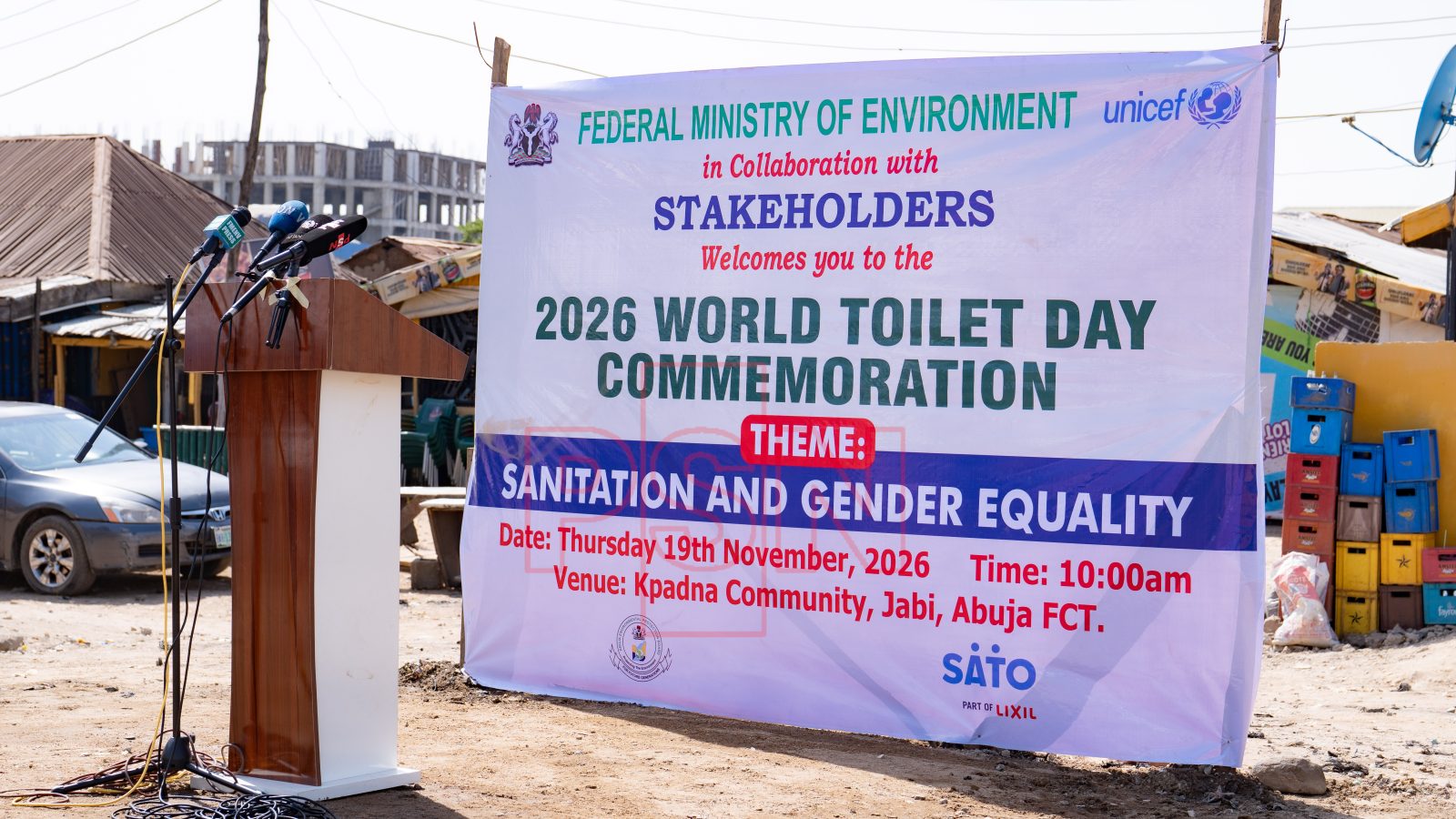




The Federal Government has promised to address sanitation challenges at LEA School in Kpadna Community, Abuja, following reports that pupils have been forced to practise open defecation because the school’s toilet facilities were locked over inadequate water supply.
The Minister of Environment, Mallam Balarabe Abbas Lawal, described the situation as unacceptable, announcing proposed interventions to restore the toilets, provide reliable water supply and establish a sustainable sanitation management system.
Lawal, represented by the Permanent Secretary, Dr Salihu Usman, spoke on Thursday at the 2026 World Toilet Day commemoration held in Kpadna Community, Jabi District, Federal Capital Territory.
“It is particularly disturbing that in an environment where toilet infrastructure is already available, the absence of a reliable water supply has rendered the facilities unusable.
“A toilet that cannot be used is effectively no toilet at all,” he said.
The Minister said the Federal Ministry of Environment, through the Inter-Ministerial Committee for the commemoration, would work with relevant authorities on an immediate assessment and restoration of the school toilets, provision of reliable water, rehabilitation of the facilities, environmental health education and continuous monitoring.
He said the Ministry would also collaborate with the Federal Capital Territory Administration, Area Council authorities, education authorities, water supply agencies and development partners to address the identified challenges.
Lawal urged the committee to document the situation at LEA School as a case study for interventions in other schools and public institutions where toilet facilities remain unusable because of inadequate water supply, poor maintenance or other operational challenges.
He said the situation had particular implications for girls, who require safe and private facilities to manage their menstrual hygiene, adding that children should not have to choose between attending school and meeting their basic sanitation needs.
Citing the 2024 Nigeria Demographic and Health Survey, the Minister said approximately 20 per cent of Nigeria’s household population still practised open defecation.
He warned that inadequate sanitation contributed to diseases such as cholera, typhoid and other faecal oral infections, while contaminating surface water and groundwater.
The Etsu of Kpadna Community, Sunday Zabazuwo Bitus, however, used the occasion to appeal for public toilets, mobile toilets, a proper drainage system, a community borehole and improved waste management.
He also requested solar-powered streetlights, a primary healthcare facility, community fencing, women’s empowerment programmes and scholarships, saying residents had yet to benefit from scholarship or empowerment initiatives despite living within the FCT.
Welcoming the Federal Ministry’s decision to hold the commemoration in the community, Bitus said the visit had given residents hope that their challenges would receive attention.
“Out of all the communities, you look at us, you remember us, and you choose us. That decision has given us hope. It has told us that we are not forgotten. It has told us that the Federal Government sees us, hears us and cares about us,”

He said the community was not merely complaining but appealing for interventions that would improve residents’ living conditions.
Bitus also pledged that residents would take responsibility for maintaining any facilities provided by government.
“We will take ownership. We will maintain those facilities. We will protect them. We will form a committee, environmental committee to keep our toilet clean and drainage clean,”
He promised to work with the Ministry to make Kpadna an open defecation free community that could serve as a model for other communities.
A representative of the WASH Consultant, Blessing Jeffery Ose, warned that open defecation in uncompleted buildings, cemeteries and other open spaces could expose communities to serious health risks.

She explained that faecal matter does not simply disappear when it rains, warning that contaminated water and soil could expose children to hookworm infections, while flies and domestic animals could spread contamination into homes.
“The little act of open defecation we do in the cemetery close to our house, back of our houses and our environment is a very simple act, but the end is very devastating.”
Ose warned that such practices could contribute to outbreaks of cholera, dysentery and hepatitis A, urging communities to take collective responsibility for ending open defecation.
“Open defecation free Nigeria is not the responsibility of the government alone. It is not the responsibility of the development partners alone. It is a collective responsibility,” she said.
She called for gender responsive and disability inclusive toilet facilities in schools, communities and public institutions, stressing the need for separate facilities and designated sections where women and girls could manage their menstrual hygiene.
“Sanitation facility must be in a way that is gender responsive and disability inclusive. There must be disability inclusion. When the sanitation facility has no access for menstrual health management, then the motive is defeated.”
Also speaking, the Antimicrobial Resistance Surveillance Officer at the Nigeria Centre for Disease Control, Anietie Akpan, called for responsible use of antibiotics, warning that antimicrobial resistance was an increasing public health concern.
He explained that antimicrobial resistance occurs when bacteria, viruses, fungi and parasites no longer respond to medicines used to treat infections.
Akpan said more than 4.7 million deaths were attributed annually to antimicrobial resistance, urging Nigerians to take the threat seriously and use antibiotics rationally.
“The essence of this awareness week is to create a global campaign to raise awareness and increase understanding on the use of antimicrobial agents, and this is to help us promote global action to tackle the emergence and spread of drug resistance,” he said.
He urged the public to ensure the right use of antibiotics, emphasising the importance of the right person, the right place and the right time.
The 2026 World Toilet Day was commemorated under the theme, “Sanitation and Gender Equality,” with the campaign tagline, “Safe Toilets. Equal Futures.”
Author









Leave a comment