














By Omoyeni Ojeifo
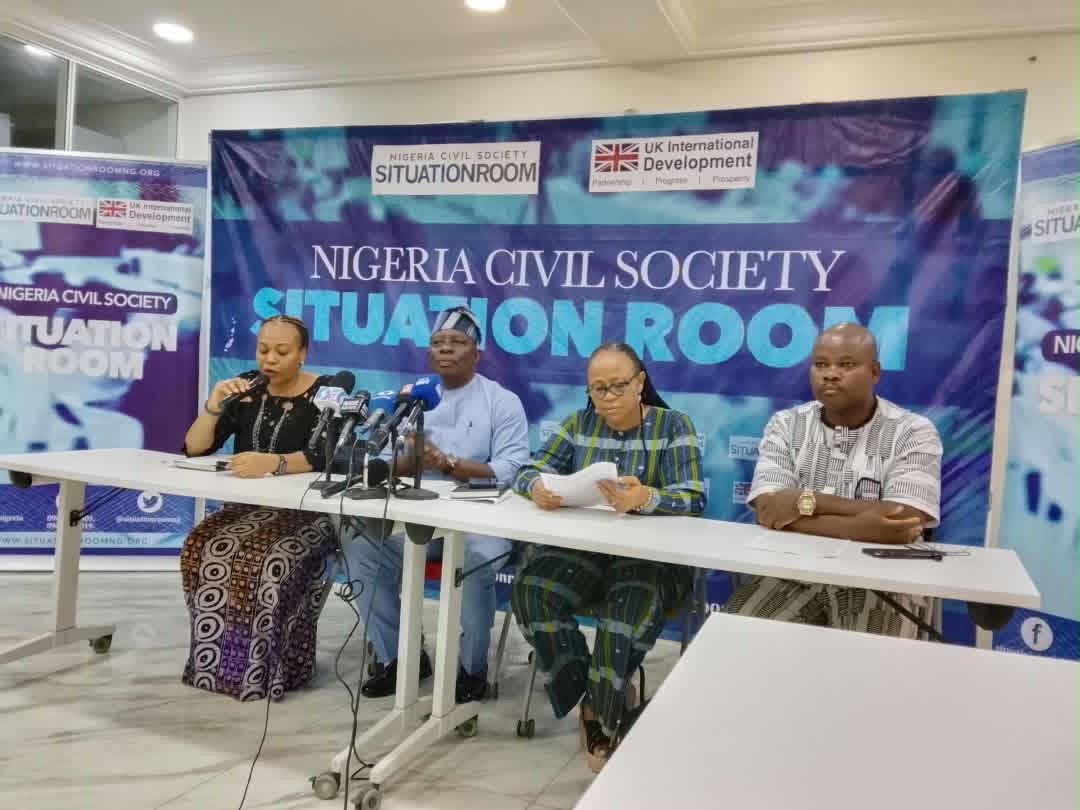
The Nigeria Civil Society Situation Room has faulted presidential campaign billboard fees running into hundreds of millions of naira in some states, warning that the charges threaten a level playing field ahead of the 2027 general elections.
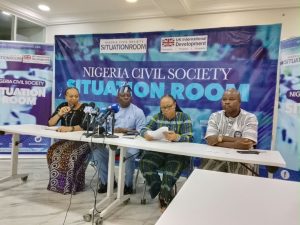
The position was presented at a media briefing in Abuja on Thursday by the coalition’s Co-Conveners, Celestine Odo and Mma Odi, Programme Manager, Agianpe Onyema, and Austin Aigbe.
The coalition examined eight major concerns ahead of the elections, covering political party development and shrinking space for competition, political rhetoric and election-related insecurity, the Electoral Act 2026, INEC’s independence, abuse of incumbency, judicial decisions, disinformation and citizens’ participation.
PerSecondNews correspondent at the briefing reports that among the issues raised, the Situation Room faulted the high charges for presidential campaign billboards in seven states, warning that the fees could undermine equal opportunities for political parties and candidates.
It identified Abia, Enugu, Kogi, Cross River, Rivers, Anambra and Benue as states imposing the charges, with Abia recording the highest fee at ₦200 million.
Enugu, Kogi and Cross River each charge ₦150 million, while Rivers charges ₦75 million, Anambra ₦50 million and Benue ₦40 million.
The coalition contrasted the charges with conventional billboard rental rates of between ₦200,000 and ₦15 million monthly, depending on location and size.
“We also acknowledge ongoing preparedness dynamics. However, we emphasize that competitive elections require more than the existence of multiple political parties or the administrative regimes to conduct voting.”
According to the coalition, the credibility of the elections depended on creating an environment where candidates could compete freely and voters could make their choices without intimidation or undue restrictions.
“The credibility of the 2027 general elections must be secured before election day, through an environment where political competition is protected, institutions act impartially and every valid vote is accurately counted and reflected in the declared results.”
On election-related security, the coalition cited a CLEEN Foundation Election Security Threat Assessment which recorded 70 physical election-related incidents across 19 states and the Federal Capital Territory between January 1 and October 27, 2026.
The assessment also documented 27 fatalities in 20 separate incidents, identifying campaign rallies and party conferences among the major targets. September recorded 14 physical incidents.
The coalition called for stronger protection of political actors, citizens, election officials, journalists and observers, alongside investigations into incidents of electoral violence.
It also warned against the use of public office and government resources to give political parties or candidates unfair electoral advantages.
“Public office must not be used to confer unlawful electoral advantages, intimidate political opponents, or restrict access to public facilities and resources.”
On the Electoral Act 2026, the Situation Room examined provisions for electronic transmission of polling-unit results to INEC’s result viewing portal and the use of Form EC8A where communication difficulties prevent electronic transmission.
It called on INEC to clarify how communication failures would be established and documented, and how electronic records would be reconciled with physical result forms.
“Transparent, verifiable, and accountable result management is indispensable to credible elections. Every stage of accreditation, counting, transmission, collation, and declaration must be transparent and verifiable.”
The coalition also called for clarification of the relationship between BVAS accreditation data, polling-unit results, electronic publication and the collation process.
On INEC’s independence, it raised concerns about the nomination of Prof. Mustapha Ali as a Resident Electoral Commissioner, citing his reported family relationship with the Sokoto State Governor, who is seeking election on the APC platform.
“While the family relationship does not in itself establish political partisanship or disqualify the nominee, the Senate must carefully examine any credible concerns related to impartiality, independence, and public abuse of incumbency,” it said.
The Situation Room also called on political parties to uphold internal democracy and conduct peaceful, issue-based campaigns, while asking the judiciary to ensure timely and independent resolution of electoral disputes.
It urged anti-corruption agencies to investigate vote-buying and illicit campaign financing, while calling for collaboration among the media, technology platforms and civil society organisations to counter disinformation.
The coalition warned that artificial intelligence could be exploited to manipulate electoral information, misrepresent candidates and mislead voters through fabricated audio, images and videos.
“Citizens must not be reduced to spectators in a democracy that derives its legitimacy from their participation.”
The Situation Room maintained that credible elections would depend on protecting political competition, addressing insecurity, preventing the misuse of public resources and ensuring that citizens can freely participate and have their votes accurately counted.
Author









Leave a comment