







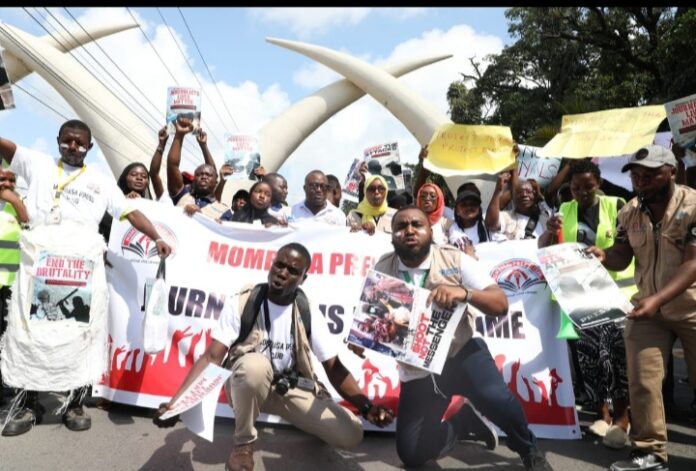




Civic society actors operating under the G16 Regional Security Advocacy Group on Counter Terrorism in Africa, have urged the Malian government to ensure due process and independent review following its decision to freeze the assets of 12 individuals.
The targeted group includes journalists, lawyers, political leaders, civic actors, and a former judicial officer, all suspected of financing terrorism.
To guarantee access to fair legal procedures and an effective appeals process, the G16 demanded that the government provide clear information regarding the legal and evidentiary basis for Order No. 2026-1409/MEF-SG.
Furthermore, the group cautioned the government against implementing disproportionate measures that could inadvertently harm non-profit organizations and civil society actors within the country.
G16 made its position known in a statement signed by Spaces for Change (S4C) West Africa, Article 19, Senegal and West Africa, Coalition Communautaire pour la Paix et la Promotion du Vivre Ensemble (COPAVE), West Africa Network for Peace Building – Togo (WANEP-Togo), BEOGE NEERE, APAC and Human Rights Reporters Ghana emailed to Persecondnews on Sunday.
It stated: “The attention of the G16 Regional Security Advocacy Group on Counter Terrorism in Africa (hereinafter referred to as G16) has been drawn to the recent freezing of assets and economic resources of twelve individuals, including journalists, lawyers, political leaders, civic actors, and a former judicial officer, on suspicion of financing terrorism by the Government of Mali.
“This action was based on Order No. 2026- 1409/MEF-SG of June 18, 2026, which directs banks, financial institutions, and other regulated entities in Mali to freeze the affected persons’ assets.
“The G16 takes note of the seriousness of terrorism financing concerns and of the responsibility of the Malian authorities to protect national security and public safety.
“At the same time, the G16 expresses concern that the application of targeted financial sanctions in this context raises important questions relating to transparency, due process, proportionality, and the protection of civic space.
“This measure follows earlier designations. On 22 May 2026, a separate order (Arrêté n°2026-1194/MEF-SG) placed former MP and SADI (Solidarité Africaine pour la Démocratie et l’Indépendance_SADI) party president Oumar Mariko, economist Étienne Fakaba Sissoko, and the Front de libération de l’Azawad on the same national targeted sanctions list.
“The G16 notes that these developments should be approached with particular care, given the sensitive political, security, and civic context in Mali.
“The security situation in Mali remains serious and complex, with persistent violence involving armed groups and other security threats affecting communities and institutions. This violence has caused displacement, weakened public confidence, and continues to affect stability across the wider region.
“The Government of Mali has a responsibility to protect its citizens and to take lawful, necessary, and effective measures to prevent terrorism and terrorism financing. Such measures are most effective when they are evidence-based, proportionate, transparent, and accompanied by safeguards that protect fundamental rights and public trust.”
G16 also noted: “Mali’s Order No. 2026-1409/MEF-SG appears to draw on relevant national frameworks as well as international standards relating to anti-money laundering, counter-terrorism financing, and the proliferation of weapons of mass destruction.
” The Financial Action Task Force (FATF) has emphasized that such standards should be implemented through focused, proportionate, and risk-based measures, and should not unduly disrupt legitimate civil society activities. The G16 therefore encourages careful implementation of these standards in a manner that preserves both security objectives and the conditions necessary for civic actors, media professionals, legal practitioners, and political actors to operate within the law.
“The Order imposes an immediate, renewable six-month freeze on the affected individuals’ assets. Based on the information available, it is not clear whether the measure was preceded by judicial authorisation, an individualised evidentiary review, or an accessible mechanism for appeal.
” In light of the impact that such measures can have on the affected persons and on public confidence, the G16 encourages the Malian authorities to ensure that the process is guided by legality, necessity, proportionality, and individualised assessment.
“The FATF’s 2023 revision of Recommendation 8 also underscores the importance of avoiding disproportionate measures that may affect non-profit organisations and civil society actors. The revised approach encourages countries to identify specific risks and apply focused, proportionate, and risk-based measures, while avoiding the undue disruption of legitimate activities.
“The United Nations Special Rapporteur on the promotion and protection of human rights and fundamental freedoms while countering terrorism has also highlighted the need to ensure that counter-terrorism measures do not unduly restrict civic space or the rights of civil society actors and human rights defenders.”
According to G16, this guidance is particularly relevant in contexts where security concerns, political transition, and public debate intersect.
“The G16 is concerned that, if not accompanied by clear safeguards and accessible review mechanisms, measures of this nature may have significant implications for the enjoyment of freedoms of expression, opinion, association, and the press, as protected under the Malian Constitution, relevant national legislation, the International Covenant on Civil and Political Rights, and the African Charter on Human and Peoples’ Rights.
“The G16 condemns all forms of terrorism and the financing of terrorism. The G16 also recognises the responsibility of the Malian authorities to respond to security threats in accordance with national law and applicable international standards.
“In this regard, the G16 respectfully urges the Government of Mali to provide clear information on the legal and evidentiary basis of Order No. 2026-1409/MEF-SG, guarantee access to due process and effective review, and consider reviewing or revising the measures where appropriate.
“The G16 remains committed to advocating for the accurate implementation of global counter- terrorism standards, including the FATF’s 40 Recommendations, and to promoting an open civic space where civic actors can operate freely within the law, without undue disruption across the sub-region,” the statement said.
Author








Leave a comment