













By Omoyeni Ojeifo
The National Drug Law Enforcement Agency (NDLEA) and the United Nations Office on Drugs and Crime (UNODC) have launched weeklong activities marking the 2026 World Drug Day in Abuja, with a renewed focus on evolving drug threats and global responses.
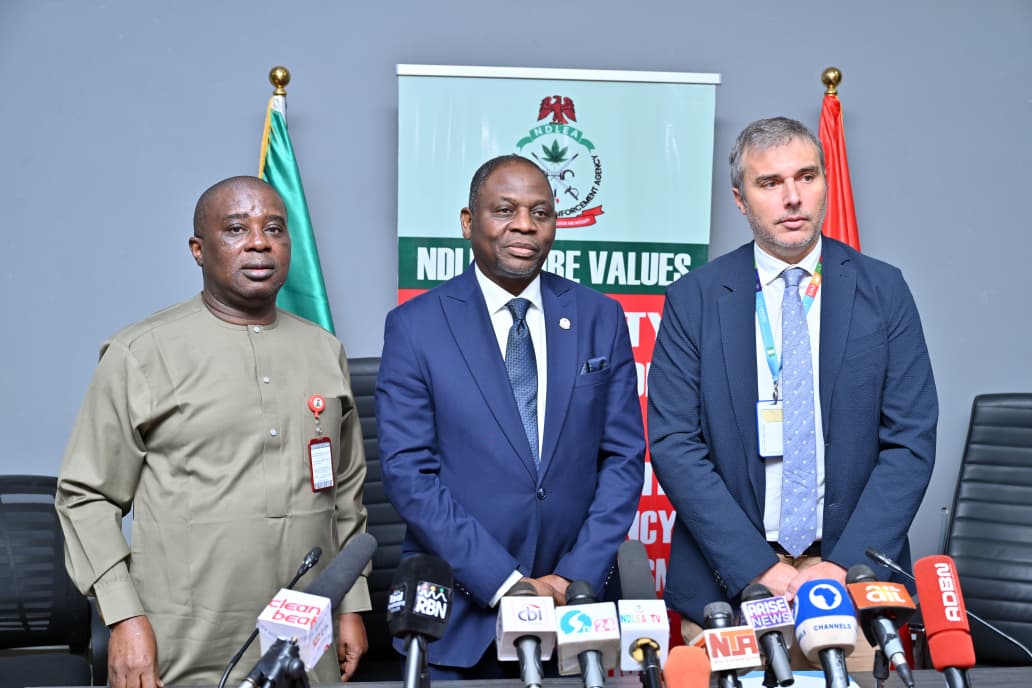
The Director of Media and Advocacy, Femi Babafemi, made the announcement at a joint media briefing held at NDLEA headquarters in Abuja on Friday, Persecondnews reports.
Retired Brig.-Gen. Mohamed Buba Marwa, NDLEA Chairman/Chief Executive Officer, said World Drug Day, observed annually on June 26, serves as a global platform for assessing, refining, and strengthening responses to the drug problem.
Marwa said the 2026 theme, “The World Drug Problem: Persisting Issues, New Challenges, Innovative Responses,” reflects the changing global drug landscape, including synthetic substances, sophisticated trafficking networks, and emerging digital illicit markets.
He noted that the evolving situation demands proactive, technology driven responses, stressing that old strategies cannot solve new problems.
“The agency has modernised its operations and strengthened its balance between enforcement and prevention through its War Against Drug Abuse (WADA) initiative”.
He explained that WADA now integrates data, community intelligence, and public enlightenment tools to prevent drug abuse and protect young people from illicit substances.
Marwa said the weeklong programme runs from Friday, June 19, to Friday, June 26, 2026.
The programme opened on Friday, June 19, with the press briefing, while a Juma’at service was also held at the National Mosque in Abuja at 1:30pm.
He added that on Saturday, June 20, a “Walk Against Drugs” will be held in collaboration with Baze University, Nile University, and the MTN Foundation, with participants converging at the African University of Science and Technology, Galadimawa, at 8:00am.
He further noted that Sunday, June 21, will feature a Thanksgiving Church Service dedicated to spiritual reflection and renewed commitment to the anti-drug campaign.
Monday, June 22, will host the final stage of a national essay competition themed “Say No to Drugs: Building a Healthy and Responsible Generation” at the NDLEA headquarters in Abuja.
Tuesday, June 23, will be observed as NGO Day at the NDLEA Conference Room, focusing on collaboration with civil society partners, while Wednesday, June 24, will feature the Youth Out-of-School Programme targeting high-risk environments in FCT markets and motor parks with anti-drug sensitization.
According to the anti-drug agency, Thursday, June 25, will be dedicated to strategic planning sessions, final reviews, and briefings ahead of the grand finale.
The week will culminate on Friday, June 26, at the State House Conference Centre, Abuja, where government officials, diplomats, and international partners will unveil new policy directions on drug control.
Marwa said the NDLEA’s WADA programme has evolved into a whole-of-society approach, strengthening collaboration between law enforcement, communities, and civil society.
He said the agency’s “Offensive Action” against drug cartels has continued, leading to arrests, prosecutions, and the dismantling of trafficking networks.
Marwa added that the NDLEA is not only arresting traffickers but also targeting their financial structures through asset forfeiture under the Proceeds of Crime Act (POCA), effectively cutting off their lifelines.
He expressed appreciation to President Bola Ahmed Tinubu for his support, as well as to international partners including the UNODC, the US Drug Enforcement Administration (DEA), the Bureau of International Narcotics and Law Enforcement Affairs (INL), UK agencies, France, and Germany.
He also acknowledged cooperation with Nigerian security and regulatory agencies including the Armed Forces, Nigeria Customs Service, Nigeria Police Force, Nigeria Immigration Service, NAFDAC, NFIU, FRSC, and NSCDC, as well as the media.
UNODC Country Representative Cheikh Ousmane Toure, represented by Deputy Country Representative Danielo Campisi, said the global drug problem is evolving and requires adaptive responses.
He noted that no single institution can address the challenge alone, stressing the importance of partnership, shared responsibility, and sustained action.
He reaffirmed UNODC’s commitment to supporting Nigeria through evidence-based, innovative, and human-centred approaches to strengthen the global response to drug trafficking and abuse.
Author








Leave a comment