















By Omoyeni Ojeifo
About 32,000 Nigerian students are set to benefit from a new Digital Training Academy designed to equip them with digital and professional skills for employment and entrepreneurship opportunities.
PerSecondNews correspondent reports that the Digital Training Academy was launched on Monday in Abuja by the Minister of Education, Dr. Maruf Tunji Alausa, with the theme, “Opening Doors to a World of Learning,” as part of efforts to provide Nigerians with digital and professional skills for the changing world of work.
Alausa linked the initiative to President Bola Tinubu’s Renewed Hope Agenda, particularly its focus on expanding access to quality education, developing human capital and preparing Nigerians for opportunities in the changing world of work.
“We are not merely unveiling an online learning portal. We are opening new pathways to opportunities for thousands of Nigerians. We are connecting talents and providing the knowledge and ethical skills needed to thrive in a rapidly changing world,” he said.
He cited the scale of more than 2.2 million digital jobs available globally as a key reason for the training, highlighting opportunities in software development, cybersecurity, artificial intelligence and machine learning, natural language processing, cloud computing and quantum computing.
The six-month training will equip Nigerians with skills required to compete for such opportunities and earn from the global digital economy without having to leave the country.
“We need to give them a way to sit in their homes in this country and secure jobs and get decently paid, rather than training Nigerians only to go abroad and work. We are training you to work from Nigeria,” he said.




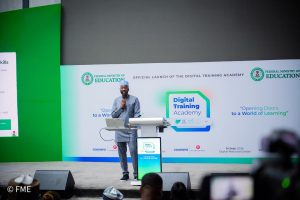



The academy will deliver training through global learning platforms, including Coursera and Pluralsight, giving beneficiaries access to courses and professional skills in areas such as artificial intelligence, cybersecurity, cloud computing, FinTech, product management and other emerging technologies.
The programme will provide free learning licences to beneficiaries, while designated study centres will support participants who do not have personal computers or reliable access to learning devices.
Alausa outlined the entrepreneurship component of the programme, including the introduction of an Entrepreneurial Innovation and Business Incubation Certificate.
“It is not just education; it is learn to work. If you learn without work, it is futile. We have started the Entrepreneurial Innovation and Business Incubation Certificate to make you entrepreneurs, job creators and not job seekers,” he said.
The Minister of State for Education, Prof. Suwaiba Sa’id Ahmad, noted that the Digital Training Academy would strengthen access to digital education and prepare Nigerian students and young people for opportunities in the modern economy.
“This initiative is a significant step towards equipping Nigerian students and young people in our country with the digital skills, knowledge and competencies required to drive the modern economy,” she stated.
In her goodwill message, the Minister of Industry, Trade and Investment, Dr. Jumoke Oduwole, said the academy would help young Nigerians transition from education into employment while strengthening the country’s digital talent base.
“By funding digital training and internationally recognised education for eligible beneficiaries, their hiring will ease their transition into employment,” she said.
Oduwole linked the initiative to Nigeria’s ambition to expand digitally enabled employment and connect Nigerian professionals with international employers and buyers.
“The accelerator advances Nigeria’s ambition to enable one million export-based digitally enabled jobs by 2030. As the academy develops capability, we must broaden access to demand and help ensure that the potential and talent of Nigerians translate into sustained commercial relationships and deliver jobs and prosperity for Nigerians,” she said.
In his remarks, the Senior Special Assistant to the President on Student Engagement, Sunday Asefon, described the initiative as an important platform for equipping Nigerian students and young people with skills needed to participate in the modern economy.
“Technology is taking over the world, so Nigerian students, Nigerians and Nigeria must not be left behind. Technology has become a barrier across all levels, and this training academy will provide an important platform for Nigerian students and other beneficiaries,” he stressed.
Also speaking, Dr. Abisoye Coker Odusote, Director General of the National Identity Management Commission, NIMC, linked the academy to the broader effort to build a digitally empowered society by connecting digital skills with access to trusted identity and services.
“A trusted identity is fundamental to accessing services in the digital economy. When people have trusted identities and the skills to navigate digital platforms, they are better positioned to access opportunities, learn, innovate and contribute to the economy,”she emphasised.
Providing details on the programme, the National Coordinator, Special Programmes Operations and Implementation Unit, SPOIU, Bayo Onigbanjo, outlined the partnership with Yaba College of Technology and the National Open University to provide facilitators, mentors and physical study centres for participants.
“Both universities are providing us with facilitators, mentors, and study centres. This allows the students to have a physical space they can actually go into, and they also have mentors that will continue to urge them to complete their courses,” he noted.
The Digital Training Academy is open to Nigerian citizens aged 18 and above, including students, job seekers and working professionals.
Interested applicants are required to create an account with their National Identification Number and phone number, complete their profiles, select a learning track and take a pre-assessment before commencing the free training.
PerSecondNews also reports that the event was attended by education stakeholders, including representatives of the National Universities Commission, National Open University, Joint Admissions and Matriculation Board, Tertiary Education Trust Fund and other stakeholders.
Author











Leave a comment