












By Omoyeni Ojeifo
As Nigeria faces intensifying pressure for faster responses to nationwide insecurity, the debate over state policing has gained fresh momentum.
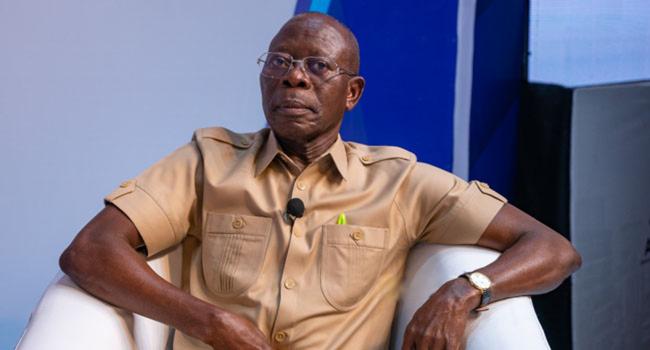
Speaking at an Arise Television town hall meeting on Thursday in Abuja, Edo North Senator Adams Oshiomhole threw his weight behind state police reform as a critical solution to the security gap.
He argued that the current centralized structure creates a contradiction where governors are expected to protect lives and property as Chief Security Officers, yet lack any direct control over the police forces operating in their states.
Oshiomhole argued that the gap between responsibility and authority has made it difficult for citizens to know who should be held accountable when insecurity persists, insisting that state police would give governors the tools to act.
“If you look at the provisions of the Constitution, the state governor is the Chief Security Officer. What is the tool of a full security”?
The senator said Nigeria’s security structure requires a reform that aligns responsibility with authority, arguing that governments cannot effectively protect citizens without the necessary institutions and tools to act.
“You cannot have a subnational government charged, among other things, with the responsibility of contributing to the maintenance of law and order, protecting life and property, and deny any level of government the means with which to do so,” he said.
Addressing concerns over whether states can finance police structures, Oshiomhole said governments fund areas they consider priorities, dismissing arguments that state police would be impossible to sustain financially.
“Nobody will be able to fund anything you do not believe in. Where we put money is a reflection of our values and of our priorities,” he said.
Drawing from his experience as Edo State governor, Oshiomhole said state governments already provide substantial support for security operations but lack the legal authority to manage the personnel receiving such assistance.
“I can tell you as a governor, a former governor and current governors may dispute it if they so wish, but in truth, the amount of money I had to spend to procure vehicles, communication gadgets as governor of Edo State was much more than the Federal Government vehicles that we had in Edo State,” he said.
He, however, said governors often have limited powers when such resources are misused or when security personnel fail to perform their duties.
“My responsibility ends at procuring these vehicles. When they are misused, they are mismanaged, and I even suspect that they are stolen by those who are supposed to tell them, I do not have the legal enablement to go beyond asking questions to enforce discipline,” Oshiomhole said.
The senator dismissed concerns that state police could automatically lead to abuse of power by governors, arguing that misuse of security structures is not limited to state authorities.
“People talk about abuse and possible abuse. My response is even today, Nigerians, including the media, are not defying some cases of abuse of federal police either by federal authorities ,” he said.
Oshiomhole said state police should complement the Nigeria Police Force rather than replace it, adding that countries operating federal systems have both state and federal policing structures.
“We say we make references to the American system. They have state police, they have federal police. Both levels of policing must work together to improve security outcomes”.
“They have to learn how to complement, not how to compete,” Oshiomhole added.
Oshiomhole said giving governors greater security powers would also improve accountability, as citizens would clearly know who to hold responsible for security failures.
“Let citizens know who they should hold responsible. If they are shouting at their governor, I am under attack, let the governor deploy his men. If he doesn’t deploy, let the people vote against him in the next election,” he said.
Persecondnews recalls the push for state police gained momentum after the House of Representatives passed the constitutional amendment bill seeking to establish state police services across Nigeria on June 11, 2026.
The Senate later passed its own version of the bill on June 24, 2026, moving the proposed reform closer to becoming law.
The bill has now moved to the 36 State Houses of Assembly for consideration, where it must secure the required approval before the constitutional amendment can take effect.
Author










Leave a comment