











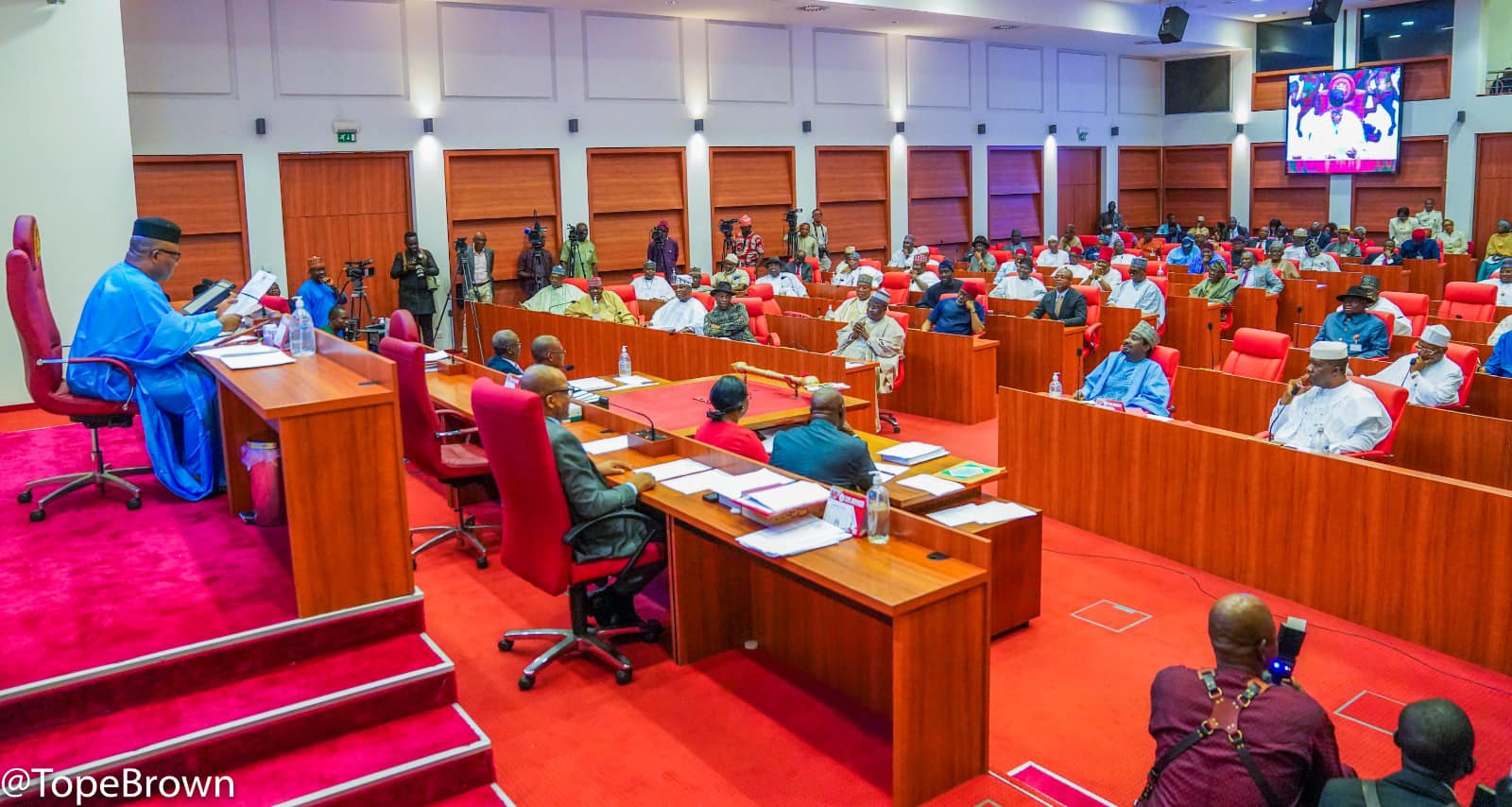



In an emergency session on Tuesday, the Senate moved to protect the 2027 election cycle from significant religious and logistical disruptions.
By adjusting the legal notice period required for elections, the upper chamber has paved the way for INEC to shift the dates originally set for February and March 2027.
The Senate Leader, Sen. Opeyemi Bamidele, cited “fundamental discrepancies” in the previous draft as the reason for the recommittal.
While the House of Representatives continues to push for mandatory electronic result transmission, the Senate maintained its preference for manual backups, citing Nigeria’s infrastructure gaps.
This “mixed mode” of transmission remains one of the most contentious points in the ongoing harmonization of the 2026 Bill.
Coming under Orders 1(b) and 52(6) of the Senate Rules, Bamidele explained that the primary focus of the emergency session was to review Clause 28 of the bill, which currently mandates a 360-day notice for elections.
Order 52(6) reads: “It shall be out of order to attempt to reconsider any specific question upon which the Senate has come to a conclusion during the current Session except upon a substantive motion for rescission.”
Order 1(b) reads: “In all cases not provided for in this Standing Order, or by Sessional or other Orders or practice of the Senate, the Senate shall by Resolution regulate its procedure.”
The amendment was effected on Tuesday during the clause-by-clause consideration of the reworked Electoral Act Amendment Bill.
The Senate amended Clause 28 of the Electoral Act Amendment Bill, slashing the notice of election requirement by 60 days, from 360 days to 300 days, leaving INEC the flexibility to fix election dates between December 2026 and January 2027.
The amended Clause 28 states that: “The Commission shall, not later than 300 days before the day appointed for holding of an election under this Bill, publish a notice in each State of the Federation and the Federal Capital Territory stating the date of the election and appointing the place at which nomination papers are to be delivered.
“The notice shall be published in each constituency in respect of which an election is to be held. In the case of a by-election, the Commission shall, not later than 14 days before the date appointed for the election, publish a notice stating the date of the election.
“There shall not be substitution of candidates in a by-election except where a candidate of a political party in a by-election dies; the party shall submit to the Commission the name of its substitute candidate within seven days of the death of the candidate in the form prescribed by the Commission.”
The amendment was finalized on Tuesday during a clause-by-clause review of the reworked Electoral Act (Amendment) Bill, 2026.
This followed a motion by Senate Leader Opeyemi Bamidele to rescind and recommit the bill for further adjustment.
Bamidele argued that the existing 360-day notice requirement in Clause 28 was too rigid, as it would likely force the 2027 presidential and National Assembly elections to overlap with the Ramadan fast—a scenario the Senate is actively seeking to avoid.
The motion also highlighted discrepancies discovered in the Long Title and several clauses of the bill, including Clauses 6, 9, 10, 22, 23, 28, 29, 32, 42, 47, 51, 60, 62, 64, 65, 73, 77, 86, 87, 89, 93, and 143. The identified issues reportedly affected cross-referencing, serial numbering, and internal consistency within the legislation.
Bamidele’s motion read: “Rescission and Recommittal of the Electoral Act, 2022 (Repeal and Enactment) Bill, 2026 to the Committee of the Whole. Sponsor: Sen. Bamidele, Michael Opeyemi (Ekiti Central – Senate Leader).
“The Senate recalls that the Electoral Act, 2022 (Repeal and Enactment) Bill, 2026 was duly considered and passed by the Senate and the House of Representatives; notes that upon further critical review of the Bill as passed, it has been observed that the 360-day notice requirement prescribed in Clause 28 may result in the scheduling of the 2027 presidential and National Assembly elections within the period of Ramadan;
“Also notes that the coincidence of the elections with the Ramadan period could adversely affect voter turnout, logistical coordination, stakeholder engagement, and the overall inclusiveness and credibility of the electoral process;
“Observes that upon painstaking scrutiny of the Bill, discrepancies were identified in the Long Title and Clauses 6, 9, 10, 22, 23, 28, 29, 32, 42, 47, 51, 60, 62, 64, 65, 73, 77, 86, 87, 89, 93, and 143, which affected other clauses of the Bill, including issues relating to cross-referencing, serial numbering, and internal consistency;
“Aware that a Technical Committee comprising the leadership of both Chambers, members of the Conference Committee, the Clerks of the Senate and the House of Representatives, and legal drafting experts from the Directorate of Legal Services of the National Assembly met to harmonise and address the identified anomalies;
“Recognises the imperative of ensuring that electoral timelines and statutory provisions promote maximum participation, fairness, inclusivity, administrative efficiency, and public confidence in the electoral system;
“Desirous of correcting the identified inconsistencies and unintended consequences through appropriate legislative action in order to safeguard the integrity of the electoral framework; and relying on the provisions of Orders 1(b) and 53(6) of the Senate Standing Orders (as amended)
“Accordingly resolves to:
i. Rescind its decision on the Electoral Act, 2022 (Repeal and Enactment) Bill, 2026 as previously passed; and
ii. Recommit the Bill to the Committee of the Whole for comprehensive reconsideration and necessary amendments.”
Proceedings in the Senate ground to a halt on Tuesday as lawmakers swarmed the desk of Senate President Godswill Akpabio.
The confrontation occurred during the clause-by-clause review of the Electoral Act (Amendment) Bill, 2026, sparked by a motion to rescind the bill’s earlier version.
The session hit a major deadlock at Clause 60 when Senator Enyinnaya Abaribe (Abia South) raised a point of order.
As murmurs rippled through the chamber, lawmakers huddled in small groups or crowded the Senate President’s platform for frantic consultations.
Unable to restore order, Akpabio led the chamber into a closed-door session lasting nearly an hour.
When the doors reopened, the tension remained high as Abaribe invoked Order 72(1), formally calling for a division to challenge the provision allowing manual result transmission when electronic systems fail.
Citing Order 52(6), the Deputy Senate President, Barau Jibrin, argued that it would be out of order to revisit any provision on which the Senate President had already ruled.
This submission sparked another uproar in the chamber, during which Senator Sunday Karimi (APC, Kogi West) had a brief face-off with Abaribe.
The Senate Leader, Opeyemi Bamidele, reminded lawmakers that he had sponsored the motion for rescission, underscoring that decisions previously taken by the Senate were no longer valid.
He maintained that, consistent with his motion, Abaribe’s demand was in line.
Akpabio initially dismissed Senator Abaribe’s call for a division as a performative gesture intended for the public.
However, following a point of order and an intervention by the Senate Leader, Abaribe was granted the privilege to proceed with a formal recorded vote.
In a rare display of legislative theater, Akpabio moderated the process as senators signaled their positions by standing and raising their hands.
The result was a decisive blow to the push for mandatory digital results. A coalition of 55 senators—including the Deputy Minority Leader—voted to keep the “manual fallback” clause.
This left Abaribe and 14 other opposition members in the minority. Akpabio hailed the outcome as a “rescue of Nigeria’s democracy,” even as he commended the opposition for their resolve.
For the second time in a week, the Senate has now solidified its stance – if the electronic network fails, the manual Form EC8A remains the ultimate authority.
Author










Leave a comment