




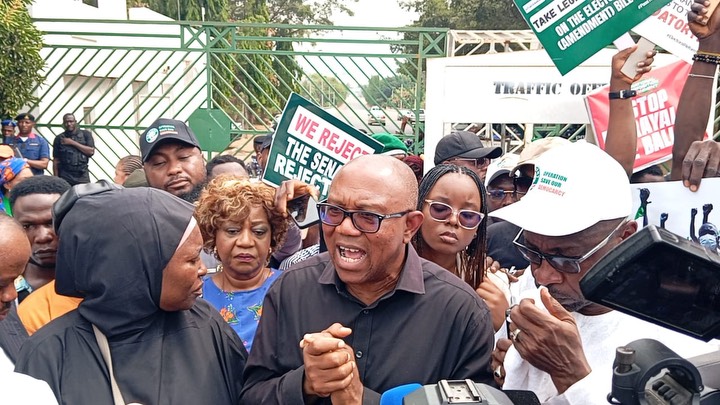


Ahead of the 2027 general elections, Labour Party leader Peter Obi joined forces with civic advocacy groups on Monday to demand mandatory real-time electronic transmission of results.
During a peaceful demonstration at the National Assembly, Obi warned that Nigeria’s democratic stability hinges on the transparency of its voting process, asserting that without trustworthy elections, the nation’s democratic framework “risks collapse.”
The protest, organized by the “Enough is Enough” network, comes as a direct response to the Senate’s recent decision to exclude mandatory digital uploads from the 2026 Electoral Act amendment.
“No more manual loopholes,” was the sentiment as crowds converged on the nation’s capital.
Protesters told Persecondnews that embedding real-time electronic sharing into the Electoral Act is the only path to a fraud-free future.
Obi echoed this demand, pivoting the conversation toward a holistic reform.
For Obi, integrity isn’t just about the vote count; it’s about a seamless journey that spans from the initial vetting of candidates to the moment the final results are announced to the public.
“Everything must be done in a manner that we will show we are exemplary as giants of Africa,” he said.
“This giant must now rise and be giant. We cannot continue to be giants in doing the wrong thing. We want to be giants in doing the right thing now.”
Additionally, he emphasized the necessity of institutional integrity, arguing that by rooting out malpractice, Nigeria can reposition itself as a continental leader in governance and transparency.
“We must dismantle our criminality and show that we are not a nation that should lie to Africa,” Obi added, highlighting the urgency of reforms to restore integrity.
Speaking with Persecondnews at the protest, entertainer Peter Ogbudu (“Ghana Must Go”) expressed hope that united public pressure would finally force the desired legislative changes.
He emphasized that only through such collective efforts can Nigeria achieve a more transparent system
“We will get it right, we must demand for our right,” Ogbudu declared.
He criticized the current leadership in the upper house, saying Senate President Godswill Akpabio, holds no superiority over the nation.
“Senate President Godswill Akpabio is not bigger than Nigeria,” he asserted, labeling the ongoing 10th legislative session as overly compliant, noting Akpabio’s past acclaim as a top state leader has faded.
“Akpabio’s 10th Assembly is rubber stamp, he was one-time best governor in Nigeria, but now we can’t say the same.”
Large crowds of citizens turned out for the demonstration, according to Ogbudu, all seeking to reclaim basic freedoms.
“Nigerians are out in their number today, we are here to ask for our fundamental human rights,” he said.
He praised the demonstration as a positive move forward.
“This peaceful protest is a step in the right direction.”
Isaac Fayose, ex-Ekiti governor Ayo Fayose’s brother, also addressed the crowd, rejecting assertions that unreliable connectivity hinders digital election result sharing.
He viewed such reasoning as pretexts for dishonest practices.
“Dismissed claims that poor network coverage would make electronic transmission of results impossible, describing such arguments as excuses meant to justify electoral fraud,” Fayose remarked.
He challenged the logic behind massive investments in polling infrastructure only to sideline key safeguards.
“How do we explain something that we spend close to a billion, a trillion, and you just want to throw it away like that?” Fayose questioned.
“It’s like carrying our money, throwing it like that. No, it’s not,” he said, underscoring the waste of public funds on systems meant to ensure fairness.
The demonstrations come in the wake of the Senate’s February 4th endorsement of an electoral reform bill that conspicuously omitted the electronic transmission mandate.
Despite widespread public support, the provision—which would require real-time result uploads from polling units to a public portal—was stripped from the final draft.
Opposition lawmakers later confirmed the omission, marking a significant setback for transparency advocates.
Defending the move at a weekend book launch, Senate President Godswill Akpabio explained that the clause was removed following “thorough debate.”
He cited concerns that mandatory uploads could trigger a wave of litigation should technical glitches occur during the transmission process.
Campaigner Aisha Yusufu dismissed lawmakers’ media engagements as insufficient, demanding tangible changes instead.
She affirmed the assembly’s power to legislate clear digital protocols.
Challenging Akpabio’s network concerns, Yusufu urged infrastructure upgrades where needed.
“The Senate President is saying that there are places where there are no networks. If they don’t have, which is a shame by the way, Nigeria would provide that network,” she said.
“If either can register everywhere, they can also provide those networks,” pointing to existing telecom reach used in registrations.
Persecondnews recalls that following the bill’s passage, the Senate adjourned for a two-week recess to focus on departmental budget defense sessions.
A deep dive into the approved legislation reveals a cautious approach to technology; specifically, Section 60 maintains traditional result transmission to collation centers rather than mandating real-time digital uploads.
On the issue of voter identity (Section 47), lawmakers reinforced the Permanent Voter Card (PVC) as the sole valid credential, rejecting proposals to allow National IDs or passports due to technical chip incompatibilities.
However, the law officially integrates the Bimodal Voter Accreditation System (BVAS) for both verification and ballot processing.
On electoral fraud, Section 22 prescribes a10-year prison sentence for credential violations was rejected in favor of the existing two-year term, though fines were increased to N5 million.
On vote buying, fines for vote trading saw a significant jump from N500,000 to N5 million while the deadline for parties to submit candidate lists (Section 29) was narrowed from four months to three months before the election.
Author






Leave a comment