












Rep. Abdussamad Dasuki has alerted the House of Representatives to alleged discrepancies in the recently gazetted tax bills.
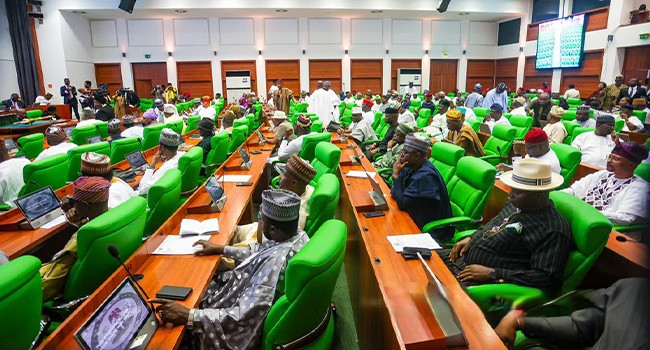
Raising a point of privilege during Wednesday’s plenary, Dasuki claimed that the version currently in circulation contains clauses that differ from the harmonized text officially passed by both the Senate and the House.
He said: “I am here today because my privilege has been breached as a member of this all-important House. Mr Speaker, honorable colleagues, we passed the tax laws (bills) on this floor. I took my time in the last three days to look at the gazetted copy.
“I also looked at the votes and proceedings of the House of Representatives, and also went an extra mile to look at the votes and proceedings of the Senate, which were harmonized.
“Mr. Speaker, Honorable colleagues, what was passed on this floor is not what is gazetted. I am coming under privilege, because I was here. I gave my vote, and it was counted, and I am seeing something completely different.
“On that note and on this privilege, I call on Mr Speaker to graciously look at what was harmonized and what is in the gazetted copy- what was passed in the House and the Senate.
“You will find out that what is before Nigerians, which is being sold to Nigerians at the Ministry of Information, is not what was passed.”
He called on the House to revisit the version passed, saying, “I plead that all the documents should be brought before the Committee of the Whole so that we can make the relevant amendments.”
Dasuki, describing the development as a breach of the Constitution, said:“This is a breach of the Constitution and our laws, and this should not be taken by this Honorable House.”
Reacting, Speaker Tajudeen Abbas promised that the lawmakers would look into the issue and address it in the interest of the nation.
Persecondnews recalls that President Bola Tinubu had in October 2024 transmitted the four tax reform bills to the National Assembly for consideration and passage.
The bills, drafted by the Presidential Committee on Tax Reforms and Fiscal Policy, aim to revolutionize Nigeria’s tax landscape by overhauling the existing tax laws, promoting exports, and streamlining tax administration.
However, the bills faced stiff opposition, mainly from the Northern parts of the country, particularly from Northern governors who had described the bills as “anti-North.”
The debates of the bills took a divisive turn, pitting the North against the South, with the contentious issue of VAT sharing formula at the forefront of the controversy.
The National Economic Council (NEC) chaired by Vice-President Kashim Shettima had urged President Tinubu to withdraw the contentious bills for further consultations across the country.
Tinubu, however, stood his grounds, asserting that all concerns regarding the bills should be addressed during deliberation in the National Assembly, instead of withdrawing the bills.
The bill was later passed by the National Assembly after several months of legislative work and consultations, and President Tinubu assented to it on June 26, 2025.
The four bills are the Nigeria Tax Bill, the Nigeria Tax Administration Bill, the Nigeria Revenue Service (Establishment) Bill, and the Joint Revenue Board (Establishment) Bill, focusing on key areas of Nigeria’s fiscal and revenue framework.
Author








Leave a comment