




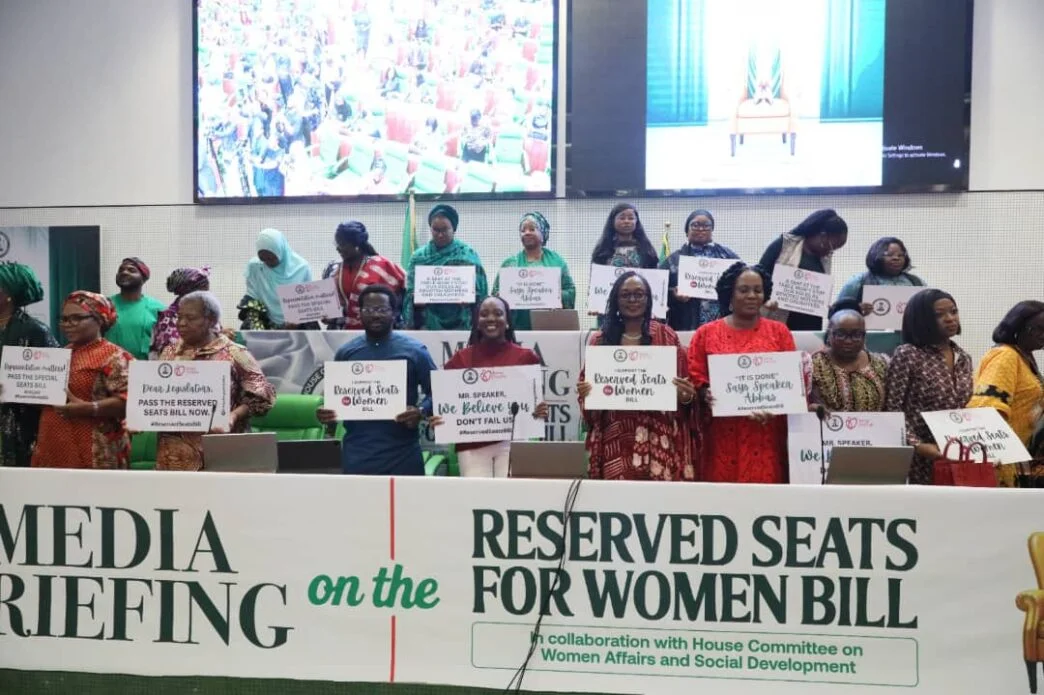



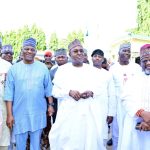
South-West traditional rulers, led by the Ooni of Ife, Oba Adeyeye Enitan Ogunwusi, launched an unprecedented campaign in Abuja on Friday to secure political momentum for the Special Seats Bill.
The bill seeks to correct gender imbalance by proposing constitutionally backed additional seats for women in the Senate, House of Representatives, and state assemblies.
This high-level push, marking the strongest effort so far, was convened by the NILDS and women’s coalitions.
Persecondnews reports that if enacted, the Special Seats Bill would constitute the most significant structural shift in gender representation in Nigeria since independence.
The Ooni passionately appealed to lawmakers, describing the bill as “a long-overdue corrective instrument” and urging them to expand political space for Nigerian women.
The Ooni said: “Women produce, nurture and multiply everything we give them, yet we treat them as afterthoughts. It is not fair.
“We must give them more inclusion, more participation in anything we do. This initiative is yielding results already, and we traditional rulers stand firmly behind it.”
The bill’s provisions, highlighted by the Ooni, propose six additional Senate seats per geopolitical zone, 37 seats for the House of Representatives, and 108 seats across state assemblies—a proposal he called “the minimum acceptable step in the right direction.”
The monarch sharply criticized current practices using a vivid analogy: Nigeria treats women “like caterpillars that clear the road,” only to block their passage when the path is ready.
He pledged that South-West traditional rulers would mobilize their constituencies to secure widespread public support.
“We understand how to speak to our subjects. We will engage them. We are not using force but appealing with wisdom.”
The Ooni also used the occasion to commend the First Lady, Senator Oluremi Tinubu, hailing her as the “mother of the nation” for her long-standing commitment to girl-child education and women’s empowerment.
He stated that “a lot of the seeds she planted are the fruits we are celebrating today,” noting how young women are excelling across all sectors.
The monarch asserted:“They will lead this nation one day, if we create space for them now. The legislative arm is the next frontier, and we are here to make history.”
Meanwhile, Prof. Abubakar Sulaiman, the Director-General of NILDS, confirmed that the gathering was strategically organized to generate political traction ahead of constitutional amendment debates.
He lamented that Nigeria’s women’s representation remains stuck at less than 5 per cent, one of the lowest globally, despite repeated advocacy cycles failing to address structural barriers.
“The Special Seats Bill is a temporary but necessary affirmative action measure, grounded in constitutional equality and aligned with global commitments such as CEDAW and the Maputo Protocol,” he said.
Citing examples from Rwanda, Senegal, Tanzania and Uganda, Sulaiman argued that affirmative action has strengthened governance across Africa.
“When women are at the table, policy outcomes become more responsive to education, healthcare social welfare and human security. This is not theory, African evidence shows it,” he added.
Civil society leaders, who attended the event, also drummed support for the urgency of reform.
Former ActionAid Country Director and member of the 100 Women Lobby Group, Ene Obi, noted that 14 Nigerian state assemblies currently have no female lawmaker. She said this gap severely harms policy development.
She said: “In these states, committees on women affairs are chaired entirely by men. How do we expect policies affecting maternal health, gender-based violence, education or social protection to be addressed adequately when those who understand the pain are absent from the table?”
Obi stressed that Nigeria ranks among the bottom five countries globally in maternal mortality.
“Every pregnant woman in Nigeria is on a death row. If women are not in the room when decisions are made, their issues will never make the agenda,” she added.
Obi recalled that during the ninth Assembly, five gender-related bills, including a version of the Special Seats Bill, were rejected, prompting weeks of protest by women who blocked the National Assembly gates.
“We burnt in the Abuja sun for four legislative weeks, and yet they did not hear us. But the 10th Assembly has given us hope. They promised not to throw away gender bills again,” she said.
Obi urged lawmakers to go beyond the current quota and consider increasing the number of additional Senate seats for women from six to eight to ensure proportional representation.
Persecondnews reports that the meeting, which drew over 100 traditional rulers from the six South-West states, concluded with a pledge to establish a regional advocacy structure.
This coalition, uniting traditional rulers, legislators, and women’s groups with technical support from NILDS, aims to secure the bill’s passage.
Author






Leave a comment