









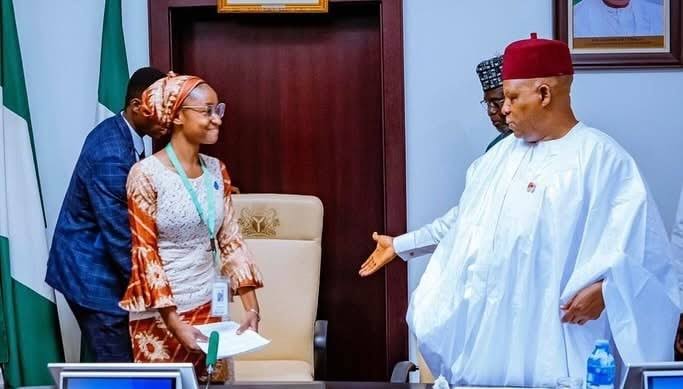



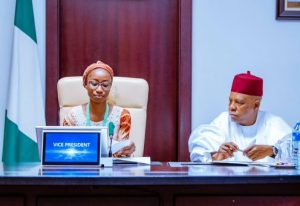
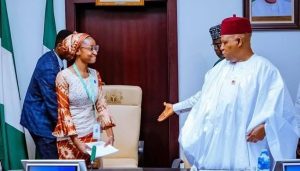
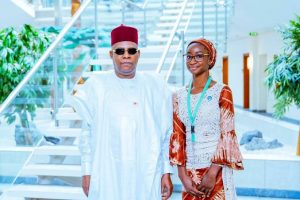
Teenager Joy Ogah symbolically stepped into the role of Vice President Kashim Shettima for a day, using the platform to passionately advocate for girls’ education and rights across Nigeria.
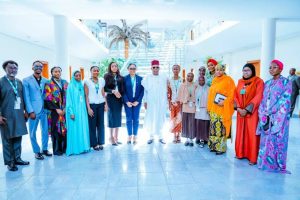
The symbolic takeover occurred during a meeting on Monday between the Vice President and a delegation from PLAN International, led by Director Helen Mfonobong Idiong.
Persecondnews recalls that the symbolic one-day governor programme was first initiated in Lagos State by the then Governor Bola Tinubu in 2001.
The programme aimed to reward academic excellence and foster social inclusion.
The first beneficiary was Ebuka Anisiobi, a secondary school student who won a spelling bee competition organized by Tinubu’s wife, Oluremi Tinubu.
This initiative has since become a tradition in the state, upheld by successive governments.
Speaking from the Vice President’s chair, Ogah highlighted the crisis facing girls, noting that over 10.5 million Nigerian children are out of school, with girls making up more than 60 percent of that figure.
“We must invest in education that is safe and inclusive for every child in Nigeria,” she said, urging policymakers and stakeholders to prioritise interventions that protect and empower young girls.
Beyond education, Ogah pressed the government to address girls’ essential needs by providing free sanitary products in schools and guaranteeing access to clean water, sanitation, and proper nutrition for every child.
She stressed that these measures support her core message: every girl is entitled to a classroom, a choice, and dignity, not silence.
“When girls are protected, peace becomes possible. I may be the Vice President for a day, but the struggles I represent cannot end in a day. They must continue in our policies, our classrooms, our conversations, and our budgets,” she said.
Shettima also used the occasion to reaffirm President Bola Tinubu’s commitment to advancing girl-child education and inclusive learning nationwide.
“We will continue the engagement with PLAN International and see where the force and strength of government can be brought to bear on your solid advice on girl-child education.
“In President Bola Tinubu, you have an ally you can believe in and invest your trust in,” Shettima said.
National momentum is currently building toward greater gender inclusivity in education.
On October 20, 2025, advocacy groups called on all levels of government to significantly invest more in girl-child education, mentorship, and sensitisation programs, stressing the need to eliminate gender bias in schools.
This pressure coincides with several federal initiatives: in September, the government launched the Renewed Hope Social Impact Interventions (RH-SII774), which targets over 10 million women with grants, digital inclusion, and clean energy projects across all 774 local government areas.
Furthermore, the Ministry of Education and the National Assembly have publicly reinforced their support for gender parity and access to learning, reflecting an institutional commitment to equity also visible in the recent workshop on inclusive education, the Student Loans Act, and increased education funding—a commitment amplified by Joy Ogah’s symbolic “Vice President for a Day” advocacy.
Author








Leave a comment