







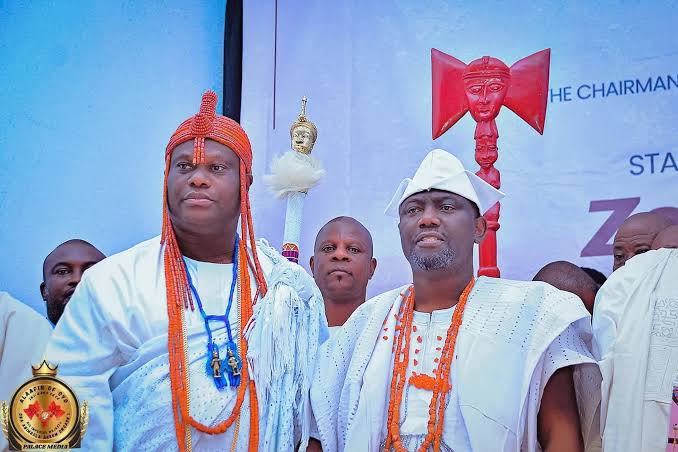



An Ekiti monarch has weighed in on the ongoing debate over which Yoruba king is most supreme, a controversy that has been raging between the Ooni of Ife and the Alaafin of Oyo.
According to Oba Stephen Alabi, the Olosi of Osi-Ekiti and a veteran journalist and lawyer, there is no controversy or question that the Ooni has supreme authority in the Yoruba-dominated Southwest.
“There should be no controversy about
who should be regarded as the highest traditional authority in Yorubaland between the Ooni of Ife and Alaafin of Oyo.
“His Imperial Majesty, the Ooni of Ife has always been the supreme authority, while every Yoruba kingdom traces its history, source to Ile-Ife,” Persecondnews quotes Alabi as saying while speaking with newsmen in Ibadan on Saturday, August 23.
The first-class monarch stated that the Oyo Empire, with its capital in Katunga, collapsed long ago, while Ile-Ife is the undisputed origin of all Yoruba kingdoms, including Oyo.
He pointed out that the collapsed Oyo Empire did not encompass major Yoruba towns and cities like Ekiti, Ijesa, Egba, Ijebu, and Ondo.
He emphasized that the Ooni of Ife has always been the supreme authority, as every Yoruba kingdom traces its history back to Ile-Ife.
“No one traces its history to the Oyo Empire. The Alaafin does not command the awe and respect that the Ooni commands from Yoruba royal fathers.
“Ile-Ife is not a kingdom, but the Source. So, there is no issue with the effusions of the new Alaafin. I will advise him to concentrate on enduring issues, rather than dwell on illusion,” Alabi, a
Public Relations consultant, said.
On the issue of granting constitutional roles to traditional rulers, Oba Alabi, a Constitutional Law lecturer, argues that a parliamentary system would be a better fit for Nigeria than the current “winner-takes-all” presidential system.
He recalled that the late Ooni Adesoji Aderemi once served in a constitutional role as the Governor of the old Western Region.
Alabi also suggested that either the presidential or parliamentary system could be reformed by making the local government system a town-based structure.
In this model, development funds would be disbursed directly to the towns, bypassing a more centralized system, he explained.
“Instead of the Council taking charge of everything and very little gets done, traditional rulers can be given the constitutional role of managing developmental efforts in their kingdoms directly, while the Council takes responsibility for policy approval and supervision.
“The traditional rulers become the ones who make up the Council, not elected officials, thus eliminating the incessant struggle for control of this level of government in every dispensation.
“Where the local government area coincides with the territory of a single royal father, the senior chiefs will join him to form the Council.
“But where there is more than one royal father in a local government area, the first-class Obas will rotate the chairmanship between themselves on a four yearly basis with other royal fathers as members,” he said.
Alabi also noted that the bureaucracy still operates just as it did during the colonial era, advising the Council and handling daily administrative tasks.
Persecondnews had reported the recent controversy stirred up by the Alaafin of Oyo, Oba Akeem Owoade questioning the authority of the Ooni of Ife, Oba Enitan Ogunwusi.
The conflict began after the Ooni conferred the title of “Okanlomo Oodua on a businessman, Dotun Sanusi.
In response, the Alaafin issued a 48-hour ultimatum to the Ooni, demanding that he revoke the chieftaincy title, insisting that only the Alaafin has the exclusive right to confer titles that cover the entirety of Yorubaland.
He accused the Ooni of “overstepping his traditional jurisdiction and ignoring a Supreme Court judgment that he claims affirmed his sole prerogative in such matters.”
The Alaafin has since asserted his historical position, stating that the British colonial government recognized the Alaafin as the “Superior Head of the Yoruba Nation” through a treaty.
While some reports indicate that the Alaafin has denied being in a “supremacy battle,” his actions and statements have reignited the long-standing debate over the traditional authority and primacy of the two prominent monarchs.
Reacting, the Ooni of Ife’s palace has publicly dismissed the claims and ultimatum issued by the Alaafin of Oyo.
According to a spokesperson for the Ooni, Yera Moses Olafare, the Ooni has directed that no official press statement be released on the matter.
The palace has chosen not to “dignify the undignifiable with an official response,” describing the Alaafin’s threat as “empty.”
Olafare further stated on social media that his principal, the Ooni, is focused on initiatives that benefit the Yoruba people and not on a “supremacy battle.”
He emphasized that the Ooni is busy with ventures like creating jobs for youths, while some are “fighting supremacy that does not exist” from a “dead empire.”
In essence, the Ooni’s reaction has been one of dismissal, choosing to ignore the Alaafin’s demands and allowing the matter to be handled in the “court of public opinion.”
Author









Leave a comment