









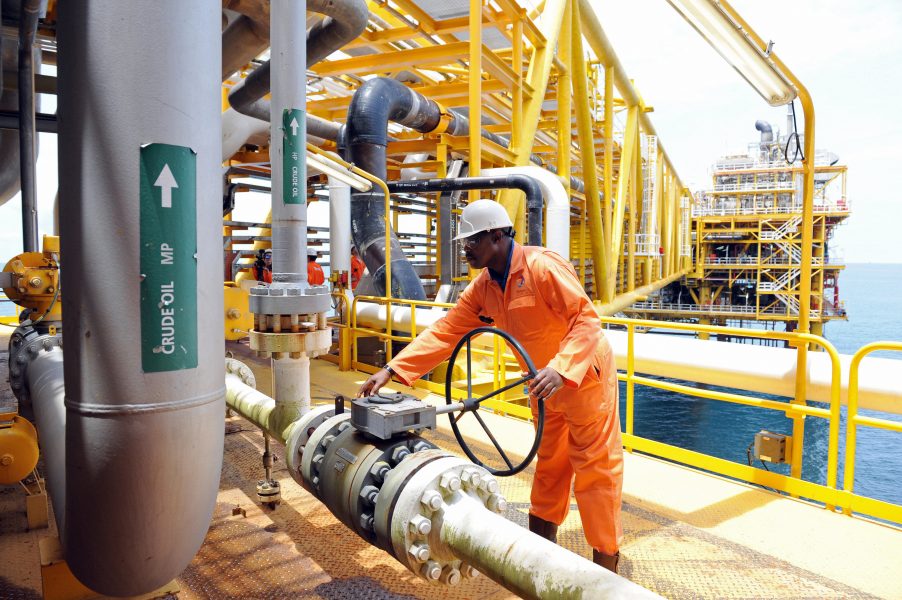




The Nigerian Upstream Petroleum Regulatory Commission (NUPRC) has unveiled plans to increase the country’s crude oil production by 810,000 barrels per day (bpd) from deepwater oil fields through a new cluster and nodal development initiative.
According to Mr. Gbenga Komolafe, Commission, Chief Executive of NUPRC, the initiative aims to revive Nigeria’s offshore oil production, which has suffered a decline in recent years.
He said If fully implemented, the initiative is expected to raise Nigeria’s total monthly crude production by 2.51 million barrels per day (mbpd) with condensates.
This would significantly strengthen the country’s revenue generation capacity and improve compliance with OPEC+ production quotas.
“Once these approved FDPs are executed, we could see peak oil production rise by as much as 810,000 barrels of oil per day,” Komolafe said.
Komolafe disclosed that there are over 5.13 billion barrels of oil and 13.53 trillion cubic feet (tcf) of gas still sitting untapped in the deep-water acreages. Of this, 3.59 billion barrels fall under 2P reserves, meaning they are proven and probable but not yet developed.
“A preliminary regulatory deep dive through the Field Development Plans (FDPs) approvals indicates that current developments in view could unlock around 1.55 billion barrels of oil and condensate and another 1.49 tcf of associated gas,” he said.
Komolafe said to drive the development of these reserves, NUPRC has inaugurated a new Shallow and Deep Water Cluster Development Committee to work closely with International Oil Companies (IOCs) and indigenous producers.
“Through this collaborative approach, we want to maximise returns from existing assets, ramp up volumes, and reduce unit technical costs.”
The CCE expressed dissatisfaction that despite the huge potential, deepwater fields were underutilized due to challenges such as funding gaps, infrastructure limitations, regulatory bottlenecks, and delayed project sanctions.
He, however, noted that with collaboration, more could be achieved.
“We have identified over 20 key deepwater assets such as Owowo, Nsiko, Bolia, Aparo, Bonga South West, Doro, Sheki, Akpo West, and others. While some may lack scale individually, they can become viable if developed together,” said Enorense Amadasu, Executive Commissioner for Development and Production at NUPRC.
Amadasu cited ongoing government interventions, including zero hydrocarbon tax on deepwater fields under the Petroleum Industry Act, as well as Presidential Directives 40, 41, and 42.
These directives aim to address the issue of tax incentives for non-associated gas and accelerate local content compliance and cost reductions in contracting cycles.
Author











Leave a comment