











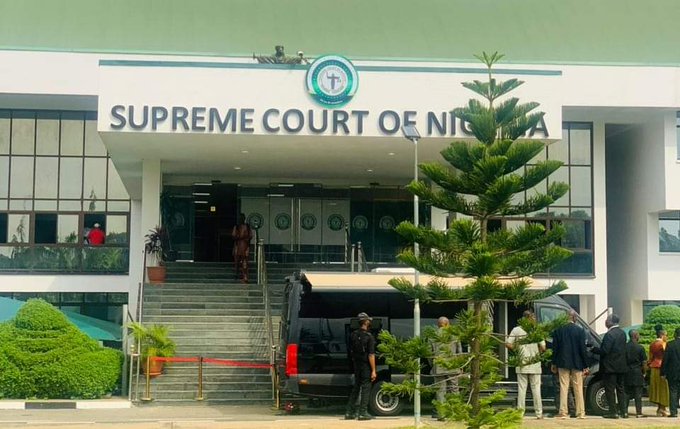



The Supreme Court has reserved judgment on the disputed Edo State Governorship Election.
The apex court reserved judgment on Wednesday, following arguments for and against the election that produced Sen. Monday Obekpolo as the duly elected governor.
Justice Garba Lawal, who presided over the hearing of the appeal filed by Mr. Asue Ighodalo and the People’s Democratic Party (PDP), said the date for delivery of the judgment would be communicated to the parties involved.
Ighodalo, whose appeal was argued by Mr. Ken Mosia (SAN), urged the Supreme Court to remove Obekpolo and pronounce him as the winner of the election.
His ground was that he scored the majority of lawful votes in the election.
However, the Independent National Electoral Commission(INEC), represented by Chief. Kanu Agabi (SAN), asked the apex court to dismiss the appeal in its entirety.
Agabi argued that Ighodalo and the PDP had, in their petition, stigmatised the election as invalid and unlawful on the ground of non-compliance with the Electoral Act 2022.
The electoral body said that having declared the election as unlawful and illegal, Ighodalo and the PDP cannot turn around and ask the court to declare them as winners of an illegality.
INEC accused Ighodalo and the PDP of being inconsistent in their grievances against the election and pleaded that their case be dismissed for want of merit.
Persecondnews reported that INEC had declared Okpebholo of the APC the winner of the election, securing 291,667 votes, defeating the PDP and Ighodalo, who garnered 247,655 votes.
Dissatisfied with the outcome of the election, Ighodalo and the PDP filed a petition with the tribunal, listing INEC, Okpebholo, and the APC as the first to third respondents.
They argued that Okpebholo did not secure the majority of lawful votes, alleging widespread irregularities, over-voting, and non-compliance with the Electoral Act.
They sought to nullify the election, citing issues including non-serialisation of ballot papers, incorrect collation of figures, and computational errors in 765 polling units.
They also accused INEC of failing to serialise and pre-record sensitive electoral materials, thereby enabling alleged rigging in favour of the APC.
The tribunal, in its judgment, ruled that Ighodalo and the PDP failed to substantiate their allegations, leading to the dismissal of their petitions.
The petitioners proceeded to the Appeal Court to contest the judgment.
After the Appeal Court validated the election on May 29, Ighodalo and the PDP again took their case to the Supreme Court.
Author










Leave a comment