


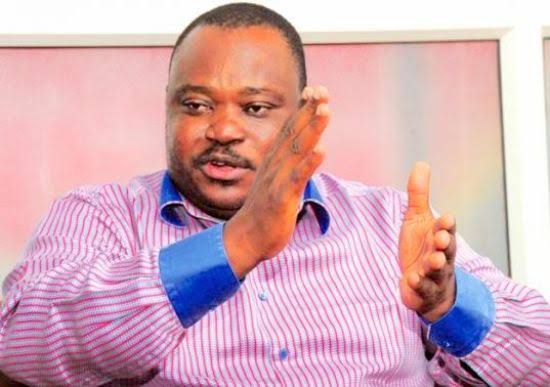
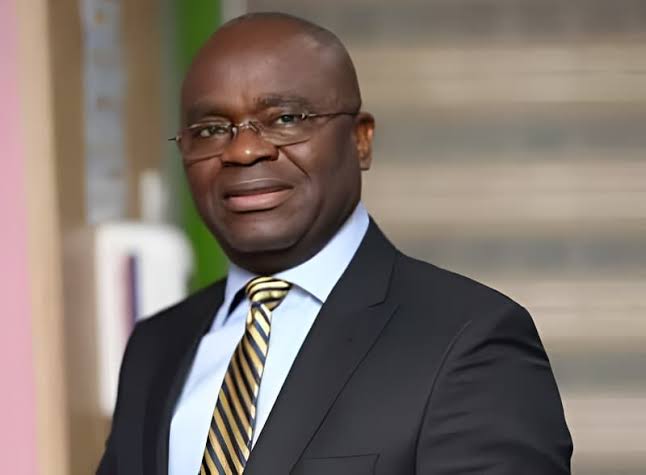


Dr. Kayode Opeifa, the Managing Director of the Nigerian Railway Corporation (NRC), has said the Nigeria’s rail sector has achieved more significant progress in the last decade than it did in the preceding 60 years.
Opeifa acknowledged the prevalent public perception of the railway sector as dormant, often characterized by frustration and stagnation.
He, however, emphasized that this view overlooks the sector’s substantial untapped potential, ready for revitalization and development.
The NRC boss made these remarks on Monday during an appearance on TVC News Business Nigeria monitored by Persecondnews, where he reviewed the corporation’s activities under President Bola Tinubu’s administration and detailed projections for future sectoral growth.
Opeifa highlighted that while the previous administration had already revived the rail sector, the current administration has built upon that foundation and significantly expanded it.
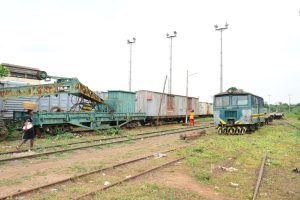
He said: “So, if we had continued to achieve the same level of progress over the years, I think we should be talking of about 30,000 kilometres of rail. We currently have just under 4,000 kilometres of rail, between 1898 when the plan started and 1960 at independence; we have done about 3,000 kilometres since then. From 1960 to 2000, progress was minimal.
“A 25-year strategic plan was proposed, but nothing materialised until 2015, when we completed the Abuja-Kaduna rail line, the Warri-Itakpe rail line, and started the Lagos-Ibadan standard gauge rail. These projects align with Chief Obafemi Awolowo’s vision outlined in his book in 1970.
“For me, this narrative highlights untapped potential for national integration, economic development, and social emancipation from poverty.
“Over the past three years, our focus has been on completing ongoing projects, ensuring they benefit Nigerians, and utilising railways as a cornerstone of economic growth to boost GDP and drive Nigeria towards prosperity.”
Opeifa explained that while rolling stock is available, the system previously lacked redundancies, adding that the essential redundancies are now being progressively implemented.
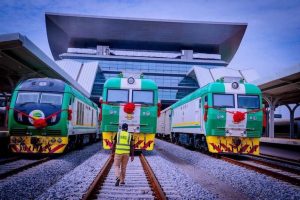
He said: “More importantly, the focus is on optimising all infrastructure and capacity within the rail sector, particularly for freight, as this was the foundation upon which the NRC was established.
“So, what this administration has done in the rail sector is increase capacity without adding additional infrastructure, optimising what is on the ground and expanding to ensure that Nigeria’s maritime sector, freight sector, transport sector, and logistics sector can take advantage of the narrow gauge and standard gauge rail lines available.
“This is the current focus. We have now connected with major terminals at Apapa Port, enabling freight movement on both standard gauge and narrow gauge lines. For instance, we can move freight from Apapa to our yard at Ebute Meta, to Idu, to Moniya and Omi-Adio in Ibadan, and all the way to Ilorin.
“Plans were underway to extend services to Minna and then Kaduna by Sallah – we were actually in Kaduna about eight months ago – but recent washouts, which have been made public, have hindered progress. These washouts, caused by water eroding the tracks, have been a recurring issue.
“On the other hand, there is the issue of rail links with states. We have implemented a track access programme, allowing idle tracks to be optimized. Lagos State is currently taking advantage of this on the Red Line, while Plateau State is utilising it from Jos to Bukuru and Idu. This project would have been commissioned if not for recent events.
“Additionally, Borno State is making efforts in this regard, and we are working on the Minna to Kaduna line, which will also come online. This will revitalise narrow gauge lines, making them relevant in the present day.”
He also said: “The track access programme has enabled private sector companies to utilise both standard and narrow gauge lines to transport their cargo. Currently, you can see cargo being moved from Lagos to other destinations along the rail lines.
“There is significant interest from major logistics companies, which is also on record. For instance, pipes for the AKK project, shipped through Warri Port, will be transported via the central line.”
The NRC boss said that globally, the transport sector, excluding the domestic sector, contributes the highest amount of carbon emissions into the atmosphere.
He said: “When the President took office in May 2023, exactly two years ago, he made it clear that Nigeria would align with the 2060 carbon emission programme, and subsidies would be discontinued.
“With the removal of subsidies, we would transition to cleaner energy, specifically Compressed Natural Gas (CNG).
“Prior to my resumption, the sector, ministry, and Nigerian Railway Corporation had already explored using CNG or Liquefied Natural Gas (LNG). They concluded that LNG would be suitable, and a proof of concept demonstrated that engines retrofitted to use 70% LNG and 30% diesel could operate effectively.
“A 30-day test run was successfully conducted. While CNG is also viable, it requires more carriages due to its compressed nature.
“Upon resumption, I found that diesel costs were a significant expense for our operations. Given the volatility of diesel prices, we decided to adopt the President’s initiative. Collaborating with the Pi-CNG project team, we determined that transitioning to CNG could yield substantial savings in diesel costs, energy costs, and operational expenses.
“The Memorandum of Understanding (MoU) signed with them is a collaborative effort in line with the presidential directive on interagency collaboration.”
Author



Leave a comment