













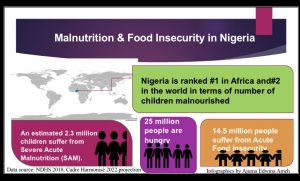
Due to the rising food prices as a result of insecurity and other factors, 14.5 million Nigerians currently suffer from acute food insecurity, with the number projected to increase to 19.5 million by August 2022. With this projection, Nigeria stands the risk of not achieving the Sustainable Development Goal (SDG) on zero hunger by 2030, and also back-sliding on the gains made on nutrition as food insecurity leads to malnutrition in children.
AJUMA EDWINA AMEH writes on the effect of the rising food insecurity on children in Nigeria.
Nigeria seems to be plunging deeper into food crisis which has further increased the issue of food insecurity in the country. Food insecurity in Nigeria is continuously being aggravated by several factors, with the most common being insecurity. Insurgency as well as farmers-herders clash, had forced many farmers to abandon their farmlands.
According to ScienceDirect, Food insecurity is lack of access to the kinds and amounts of food necessary for each member of a household to lead an active and a healthy lifestyle.
Food insecurity is reported to predict all forms of malnutrition including stunting, wasting and micronutrient deficiencies. Also, hunger measured by prevalence of undernutrition, is a key indicator of food insecurity.
The latest data from Cadre Harmonisé (CH), a unified tool for consensual analysis of acute food and nutrition insecurity in the Sahel and West African Region, noted that 14.5 million people including 385,000 IDPs in 21 States and FCT of Nigeria are facing food insecurity till May 2022.
The analysis for the month of March to May covered Abia, Adamawa, Benue, Borno, Cross-River, Edo, Enugu, Gombe, Jigawa, Kaduna, Kano, Katsina, Kebbi, Lagos, Niger, Plateau, Sokota, Tarba, Yobe, and Zamfara, and the Federal Capital Territory (FCT).
Cadre Harmonisé further noted that between June to August, 2022, the number may increase to 19.5 million (12.3%) of the overall population analyzed, unless conscious efforts are made to provide strategic resilience-focused interventions and humanitarian assistance in areas where necessary.
According the analysis, access to food among several households was limited by the soaring food prices which was heightened by the fuel and gas scarcity and its resultant hike in cost of food haulage and distribution systems from several production baskets to the markets.
It further added that the state of insecurity across several areas/zones negatively impacted on households capacity to access stable income sources which significantly reduced their purchasing power to sustain a minimal acceptable food consumption status.
“Of particular concern are IDP populations and populations in inaccessible areas who are facing high food deficits gaps and non-access to income sources,” the report notes.
Connection between food insecurity, malnutrition
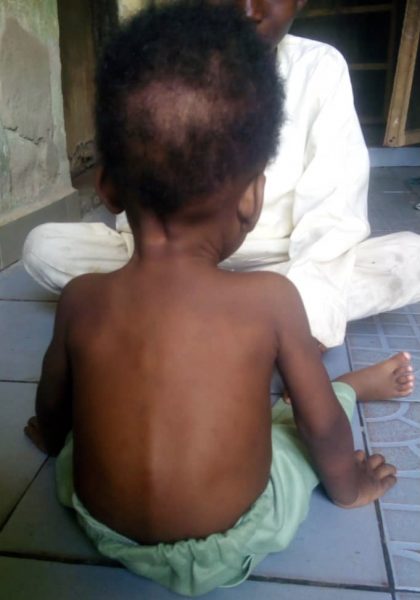
Little Sulemanu fondly called Baba by his parents and siblings, is the last of four children. Baba who is 18-month-old can be mistaken for a six-month-old or even less as he is too small and underweight for children his age. Also, he could neither crawl nor walk and is still finding it difficult to sit on his own. Baba is obviously suffering from malnutrition.
Baba’s mother, Hajara, 26, is a full-time housewife who does not know what malnutrition is, as she believes it’s Baba’s nature to be small. She also has no idea of what a proper diet is, as they are barely struggling to feed from the meagre money her husband makes as a commercial motorcyclist popularly known as Okada, in Nassarawa State.
“I give him pap every morning. I cannot afford to be buying sachet milk everyday, so I add milk to his pap once in a while. In the afternoon we, including Baba, eat Tuwo (cornmeal) with fresh or dry Okro soup. I usually reserve some of the Tuwo from the afternoon food for our evening meal. This is what we can afford as we are barely struggling to survive from the little money my husband makes from his Okada business. We eat rice once in a while, mostly on occasions.
“I didn’t know my child was malnourished, I thought it’s his nature to be small because we are all small in my family, but I was however worried that at one year six months old, he hasn’t started crawling not to talk of walking.
It was some health workers who were going from house to house immunizing children that told me to take him to the health center for treatment. We took him to the Primary Healthcare Centre here, but they referred us to Federal Medical Centre (FMC), Keffi.
We are yet to go to FMC Keffi because we don’t have enough money for transportation and we don’t know how much they will charge us there,” she explained in an exclusive chat with Persecondnews.
Hajara’s plight is one in many who poverty and ignorance have robbed them of giving their children a proper meal with the necessary nutrients.
Goal two of the United Nations Sustainable Development Goals (SDGs) is to end hunger by 2030. It also requires the world to ensure that all people have access, particularly, the poor and people in vulnerable situations including infants, to safe, nutritious and sufficient food all year round.
An estimated 2.3 million children in Nigeria suffer from Severe Acute Malnutrition (SAM). Nigeria also has the second-highest burden of stunted children in the world, with a national prevalence rate of 37 percent of children under five years of age.
Quoting the CH data, a UNICEF Nutrition officer, Nkeiru Enwelum, stated that the current food insecurity situation in Nigeria is worsening the burden of malnutrition, adding that Nigeria is at risk of back-sliding on of the gains made on nutrition and achieving the SDG on zero hunger by 2030.
She further highlighted poverty as one of the major factors causing malnutrition and affecting the well-being of a child, adding that Nigeria remains off track to achieving the SDGs target to ensure adequate nutrition for children and women.
Enwelum who stated this at a media dialogue on “SDGs as child rights with a focus on malnutrition”, organised by the Child Rights Information Bureau (CRIB) of the Federal Ministry of Information and Culture in collaboration with UNICEF in Enugu, disclosed that 45 percent of child deaths are as a result of poor nutrition, stressing the need for good nutrition for the survival of a child.
In her presentation titled: ‘‘Child Malnutrition Situation In Nigeria: An Overview,’’ she explained that children under the age of two are most vulnerable to all forms of malnutrition; stunting, wasting (low weight for height), micronutrient deficiencies, overweight and obesity.
“This is as a result of poor diets, due to their greater need for essential nutrients per kilogram of body weight than at any other time in life.
“Childhood stunting which is undernutrition; a child too short for his or her age, may have a long-term effect on physical development, cognitive development, educational performance and economic productivity in adulthood,” she explained.
Also speaking at the dialogue, a public health expert from Enugu State University of Science and Technology, Chidi Ezinwa, expressed concerns that Nigeria may continue to lag on nutrition targets and the overall SDG goals.
“We are making a backward movement. In 2019 we ranked 159th, in 2020, we ranked 160th, but before that time, there was no crisis in different parts of the country.
“Now that we have this crisis situation, it is reasonable to think that malnutrition will be on the increase because you can’t separate conflict from malnutrition and hunger.
“Given the situation we are not likely to make any progress,” he posited.
The public health expert also regretted that rising poverty and hunger are denying children of some of their basic rights, such as the right to quality healthcare, and education, nutrition among others, as he disclosed that more than 70 percent of Nigerian children live in poverty, out of which 23.3 percent live in extreme poverty.
LGAs, States faced with food insecurity
According to the analysis by Cadre Harmonisé, the result for the current period (March-May, 2022) shows that 459 areas, comprising of zones and LGAs, were analysed across the 21 states; of which 188 were classified in the minimal phase, 221 under pressure, 49 in crisis phase while one LGA ( Gubio) in Borno State is under the emergency phase of food and nutrition insecurity.
In the projected period (June – August, 2022) about 19, 453, 305 people were classified under the combined critical (crisis and emergency) phases of food and nutrition insecurity in the 21 states and the FCT. This figure includes the IDPs populations of 27, 165 in Sokoto, 321, 726 in Benue and 67, 060 in Zamfara State.
Also, 79 LGAs /Zones will be in crisis while three LGAs (Abadam, Gubio and Mobbar) in Borno State will be in the emergency phase of food and nutrition insecurity.
During this period, access to food may deteriorate slightly across the states but will be most severe among IDPs population whose sources of income and livelihood are currently under crisis to emergency phases.
“However, early harvest from the 2022/23 cropping season may help ameliorate the situation. Expectantly, households in partially and inaccessible areas may resort to more difficult livelihood coping measures to meet their food and essential non-food needs during the projected period putting them in dire food and nutrition security situations,” CH added.
Conclusion
With these recent statistics on food insecurity in Nigeria, will Nigeria meet the UN SDG target of ending hunger and ensuring that its citizens have access, particularly, the poor and people in vulnerable situations, to safe, nutritious, and sufficient food all year round, by 2030?



























Leave a comment