











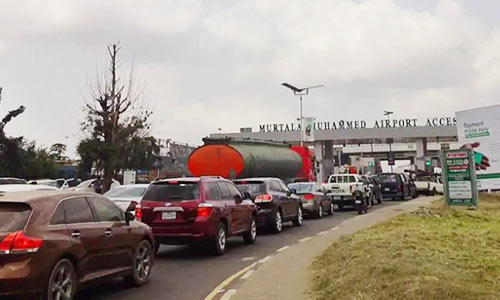




Departure schedules at the Lagos and Abuja airports have been thrown into disarray as travelers continue to miss flights due to crippling traffic at access gates.
The gridlock, triggered by the mandatory enforcement of a new cashless payment policy, has left major access roads at a standstill.
One motorist in Lagos, identified as Azeez, recounted the frustration of the commute, noting that his passenger was forced to disembark and proceed on foot to avoid missing their flight.
“I have been in this traffic since 12 noon and my passenger had a 2 p.m. flight. He had to come down from my vehicle with his luggage and find another means to the local airport.”
“This is because I have been waiting to get registered so I can get the card, but haven’t been able to due to the long queue,” he said.
An arriving passenger also described the situation as chaotic, alleging that cash was still being collected for card issuance despite the cashless directive.
At the Lagos airport, traffic built up along the tarmac linking the international and domestic terminals, stretching as far back as the airport road toll gate.
According to Persecondnews, commuters reported spending more than an hour on a distance of less than two kilometres as motorists struggled to comply with the new rules.
Officials confirmed that drivers were required to either pay electronically using point-of-sale (POS) terminals or register on the spot for a newly introduced airport access card with many, however, arriving unprepared.
Persecondnews recalls that in September last year, the Federal Airports Authority of Nigeria (FAAN) had launched a “go cashless policy” across all airports beginning with the Murtala Muhammed International Airport in Lagos, and the Nnamdi Azikiwe International Airport in Abuja, to block revenue leakages and improve seamless operations.
The agency also stated that it will be phasing out physical cash payments at all FAAN revenue points, including access gates, car parks, and VIP lounges, by the first quarter of 2026.
The Managing Director of FAAN, Mrs. Olubunmi Kuku, during the flag-off of the Operation tagged ‘Operation Go Cashless’, said the authority had begun phasing out physical cash at all FAAN revenue points, including access gates, car parks, and VIP lounges, to upgrade passenger experience and express their commitment to transparency and excellence.
However, this appears not to be so as similar scenes were reported at the Abuja airport, where several drivers were reportedly turned back for failing to present the mandatory access card.
An official of FAAN, who preferred anonymity admitted that the situation was worsened by motorists who waited until the last minute to register for the card.
Although the access card itself is free, it attracts a ₦500 maintenance fee once loaded with credit.
In a later statement issued, FAAN apologized for the disruption, acknowledging what it described as “initial adjustment challenges” and urged travellers to exercise patience and cooperate with airport officials.
In an interview with journalists, the Director of Commercial and Business Development at FAAN, Adebola Agunbiade, explained that the gridlock was linked to the full implementation of a cashless payment system at airport access points, with cash payments outrightly rejected.
She said the cashless policy was not unique to airports but part of a broader federal government directive requiring all agencies to go cashless.
“This was a good thing for us,” she said, explaining that FAAN had also been seeking ways to plug revenue leakages and improve efficiency.
According to her, airport access gates were identified as one of the busiest revenue points, where slow payment processes had long contributed to congestion.
She noted that before the new system, payments via regular POS terminals could take between five and eight minutes per vehicle—an unacceptable delay at airport toll points.
To address this, FAAN introduced a contactless, closed-loop payment solution known as the airport card.
“With this card, you just tap and go. It literally takes about two seconds.”
Agunbiade explained that the airport card was developed last year and officially launched in September.
Registration, she said, takes about a minute via FAAN’s cashless portal, after which users can fund their wallets and pay seamlessly at access gates.
In addition to the card, FAAN retained other non-cash options, including RFID-enabled e-tags for frequent airport users and chip-and-pin POS terminals that allow drivers to pay with their bank cards, albeit more slowly.
“We created different options so users can make payments without using cash,” she said.
According to FAAN, more than 30,000 users were onboarded between September and the beginning of enforcement in March. As of this week, that figure has risen to over 70,000.
Agunbiade described the chaos witnessed in Lagos and Abuja as a “teething phase,” insisting that the authority had carried out extensive sensitisation before enforcement began.
She cited press conferences, radio and television appearances, billboards, signage at airport gates, and dedicated onboarding stations as part of FAAN’s awareness campaign.
“I feel the information was out there,” she said, adding that strong early uptake of the card suggested the message reached many Nigerians, even if some commuters missed it.
However, the sheer scale of disruption suggested that awareness efforts may not have gone far enough, particularly in an era of information overload.
Agunbiade acknowledged this and apologised directly to travellers for the distress caused while also outlining several steps FAAN is undertaking to prevent a recurrence.
She said additional onboarding stations would be rolled out beyond airport premises, including partnerships with commercial banks and private organisations, allowing motorists to obtain access cards well before travelling to the airport.
She also urged Nigerians to check with their banks to see whether their debit cards are enabled with Near Field Communication (NFC) technology, which can be used directly at airport payment terminals without requiring a separate airport card.
“If your bank card is NFC-enabled, you can use it for the same one- or two-second payment process,” she said.
According to her, pressure at access gates in both Lagos and Abuja has already reduced significantly since Monday, and FAAN expects the situation to normalise fully by the end of the week.
“We believe this will soon be a thing of the past,” she added.
For now, travellers are being advised to plan ahead, ensure they have valid electronic payment options, and arrive earlier than usual as the new system beds in across Nigeria’s major airports, including Murtala Muhammed International Airport in Lagos and the Nnamdi Azikiwe International Airport in Abuja.
Author










Leave a comment