












By Femi Soneye
In March 2021 a few months before the Petroleum Industry Act (PIA) came into force, President Muhammadu Buhari announced the “Decade of Gas”. The previous year, the government had declared “The Year of Gas”. Explaining the decision of the government to declare the decade of gas, Buhari said: “When we declared 2020 as “The Year of Gas” in Nigeria, it was a bold statement to demonstrate our administration’s resolve that gas development and utilization should be a national priority. Now we’re going a step further to dedicate this decade to industrializing Nigeria using gas”.
The Decade of Gas policy came on the heels of the National Gas Expansion Program (NGEP) rolled out by the Buhari administration in 2020. The NGEP, a 250 billion naira initiative funded by the Central Bank of Nigeria (CBN), had an original timeline of converting one million cars to run on gas by the end of 2021. Although that original timeline was not met, the program remains on course as serious effort is currently being made to encourage the widespread use of Compressed Natural Gas(CNG). One of the key drivers of the program is the NNPCL, which is committed to establishing designated NNPC retail filling stations offering free petrol-to-gas conversion services for “some cars” to enable vehicles to run on LPG or CNG.
As with the NGEP, the Mele Kyari-led NNPCL is a key actor in the Federal Government’s Decade of Gas initiative. According to the initiative, the Buhari
administration through the Ministry of Petroleum Resources and the NNPCL aims to, working in tandem with stakeholders in the oil and gas sector, engender an exponential increase in the usage of gas in the country.
Unlocking The Potential
With Nigeria having over 208 cubic feet of trillion feet of natural gas reserves and ranking ninth in the list of countries with huge reserves of gas, the Buhari administration envisions the resource as a key element in the growth and development of the Nigerian economy.
The overarching strategy of the government with regard to the Decade of Gas policy is to unlock this vast reserve of gas out of which only about 8 billion standard cubic feet (bscf) are produced for the local and international markets.
As enunciated by the Buhari administration, the $20 billion policy, which is expected to grow demand for gas by 16.6 percent between 2020 and 2030, is underpinned for strategic considerations:
• Increasing domestic gas utilization
• Expanding gas infrastructure
• Increasing gas exports, and
• Attracting Foreign Direct Investment to the gas sector.
As a way of ensuring that these objectives are realized, a number of measures have since been unfolded by the government including the implementation of a new gas pricing regime to encourage investment in the sector, the development of new gas infrastructure, and the promotion of gas-based industries such as fertilizer production, power generation, and petrochemicals.
Of these measures, the development of gas infrastructure has been given top priority by the government. The projects through which the spike in demand is expected to happen include the Nigeria-Morocco pipeline NLNG Train 7 and 8 projects, the AKK pipeline project, the different power plants currently being constructed in different parts of the country, and the Brass Fertilizer among others.
Of these projects, the one most critical to the realization of the Decade of Gas policy is the AKK (Ajaokuta-Kaduna-Kano) pipeline project currently being undertaken by NNPCL. The NNPCL, which has been spearheading the economic diversification efforts of the Nigerian government, through domestic gas expansion projects by the delivery of the Trans-Nigeria Pipeline Project (TNGP) which includes the Escravos to Lagos Pipeline System (ELPS; ELPS II), the Obiafu-Obrikom-Oben (OB3) gas pipeline, has been in the driver’s seat in the construction of the Ajaokuta-Kaduna-Kano (AKK) gas pipeline.
The Ajaokuta-Kaduna-Kano (AKK) Gas Pipeline and Stations Project is a huge project with the capacity to further the integration of the Northern region of the country with the Niger Delta, Eastern and Western regions of the Country.
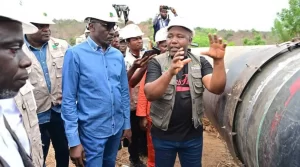
The gas pipeline is a 614KM project running from Ajaokuta in Kogi State traversing FCT, Niger, and Kaduna States and terminating in Kano as well as 15KM Spur Line to Abuja Terminal Gas Station. It also includes the construction of four terminal gas stations, twenty-two block valve stations, and intermediate pigging stations with other ancillary facilities.
Since the flag-off of the project in June 2020, NNPCL under the purposeful leadership of Mallam Mele Kyari has made giant strides towards completing the project.
The following details about the project underscore the frenetic pace at which the NNPCL is executing the project. According to available information:
• Overall Engineering Design for the linear section of the two segments of the project stands at 93.48%.
• The Overall Procurement for the linear section for the two segments is at 88%
• 94% of the total line pipes have been manufactured and 90% are already in-country.
• Construction activities in both segments are ongoing. They have completed 400km of the linear section/mainline welding, representing 68% of ROW from Ajaokuta in Kogi State to Kano.
• Also, several back-end activities have commenced including field joint coating, trenching and lowering, temporary cathodic protection, and talks of pre-commissioning of some sections have equally commenced.
The cost of the project was originally $2.8 billion but was renegotiated downward to $2.5 billion saving the Federal Government a whopping $300 million dollars.
Discussions for the project funding began in 2018 with the Bank of China as the Mandated Lead Arranger, leading a consortium of interested Chinese banks. All the
banks secured credit approvals from their various boards to proceed with the deal, which led to the sign-off of the term sheet for the facility with the Bank of China.
With the financing deal, NNPC commenced pre-funding the project with President Buhari flagging off construction on June 30, 2020. The NNPC has so far committed over $1 billion of the $2.5 billion earmarked for the project with work progressing along stipulated timelines. Presently, the project is at 70 percent completion stage.
Providing Value
The AKK Gas Pipeline Project will have the capacity to transport two billion standard cubic feet of natural gas daily to three proposed independent power plants in Abuja, Kaduna, Kano, and other gas-based industries, including other identified and proposed commercial off-takers along the entire pipeline route. Kyari says it is one of the most massive projects the NNPCL has undertaken and is of “immense proportion and value to our country and to the socioeconomic growth of our country”.
In addition to boosting the domestic gas supply, the project will greatly improve the nation’s power generation capacity and the economy as a whole through Industrialization as well as other economic uses.
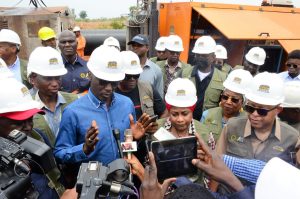
Commenting on the pace of work on the project, the NNPCL GCEO Kyari, in a recent interview said everything was proceeding as scheduled. He said while paying attention to the commencement of construction of the three power plants, the NNPCL is not unmindful of the challenge of supply of gas faced by existing
power plants. “We are resolving the pricing issues. We are already delivering gas to most of them. And for few of them that don’t have gas supply, we are working on the process,” Kyari said.
There is no doubt that since his appointment in 2019 as GMD of the defunct NNPC and his subsequent appointment as GCEO of NNPCL, Kyari has worked assiduously to ensure that Nigeria unlocks and maximally utilizes its vast gas reserves.
The NNPCL under his leadership has continued from where the defunct NNPC left off as the key driver of the nation’s march to gas sustainability. With millions of Nigerian households still not accessing gas for domestic use (most use firewood and charcoal for cooking with its deleterious impact on the environment) he and his team at the NNPCL are committed to ensuring that gas becomes available for domestic usage even as the power plants receive the needed supply for their use.
Extending The Frontier
As the AKK project remains on course, Kyari is averting his attention to other projects aimed at not only deepening penetration in gas exploration for domestic use but equally in helping to boost Nigeria’s earnings from gas internationally. One of these projects is the Nigeria-Morocco Gas Pipeline (NMGP). The project, initiated by the Buhari administration and the government of Morocco, is a 5,600 kilometers gas pipeline project cutting through 13 African countries namely: Nigeria, Benin, Togo, Ghana, Cote d’Ivoire, Liberia, Sierra Leone, Guinea, Guinea Bissau, Gambia, Senegal and Mauritania to Morocco.
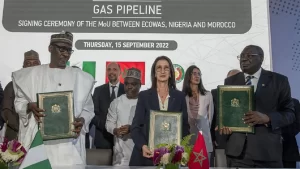
The NNPC has signed Memoranda of Association (MoU) with many of these countries, including the national oil companies of Ghana, Gambia, Guinea, Guinea Bissau, and Sierra Leone in furtherance of the project.
On completion, the project will supply about 3 billion standard cubic feet of gas per day (3bscf/d) from Nigeria to the Kingdom of Morocco and subsequently to Europe. Also as part of its efforts in repositioning the Nigerian gas sector, NNPCL this year signed a memorandum of understanding (MoU) with Golar Liquefied Natural Gas Energy (GLNG), a Norwegian company, to build a floating LNG plant in Nigeria. NNPC GCEO, Kyari, and Karl Fredrik, Chief Executive Officer (CEO) of Golar LNG, signed the agreement in Abuja.
The NNPC in a statement afterward, said the agreement was in furtherance of its efforts to deepen Nigeria’s domestic gas utilization and enhance gas export.
Golar LNG is one of the world’s largest independent owners and operators of marine-based LNG midstream infrastructure that is active in the liquefaction, transportation, and re-gasification of natural gas.
In addition to these interventions, the NNPCL last year sealed a $1.4 billion external project finance agreement for some hydrocarbon projects in the Niger Delta. The agreement, signed in London under the NNPC Limited/Chevron Nigeria Limited joint venture, is codenamed Project Panther. The deal was jointly arranged by Standard Chartered Bank UK and the United Bank for Africa (UBA).
Clearly, these efforts by the Kyari led-NNPCL will in no distant time help in addressing the challenges in the gas sector while helping the government to realize the objectives of the Decade of Gas policy.
Mr. Soneye, is a journalist and publisher of Per Second News












Leave a comment